


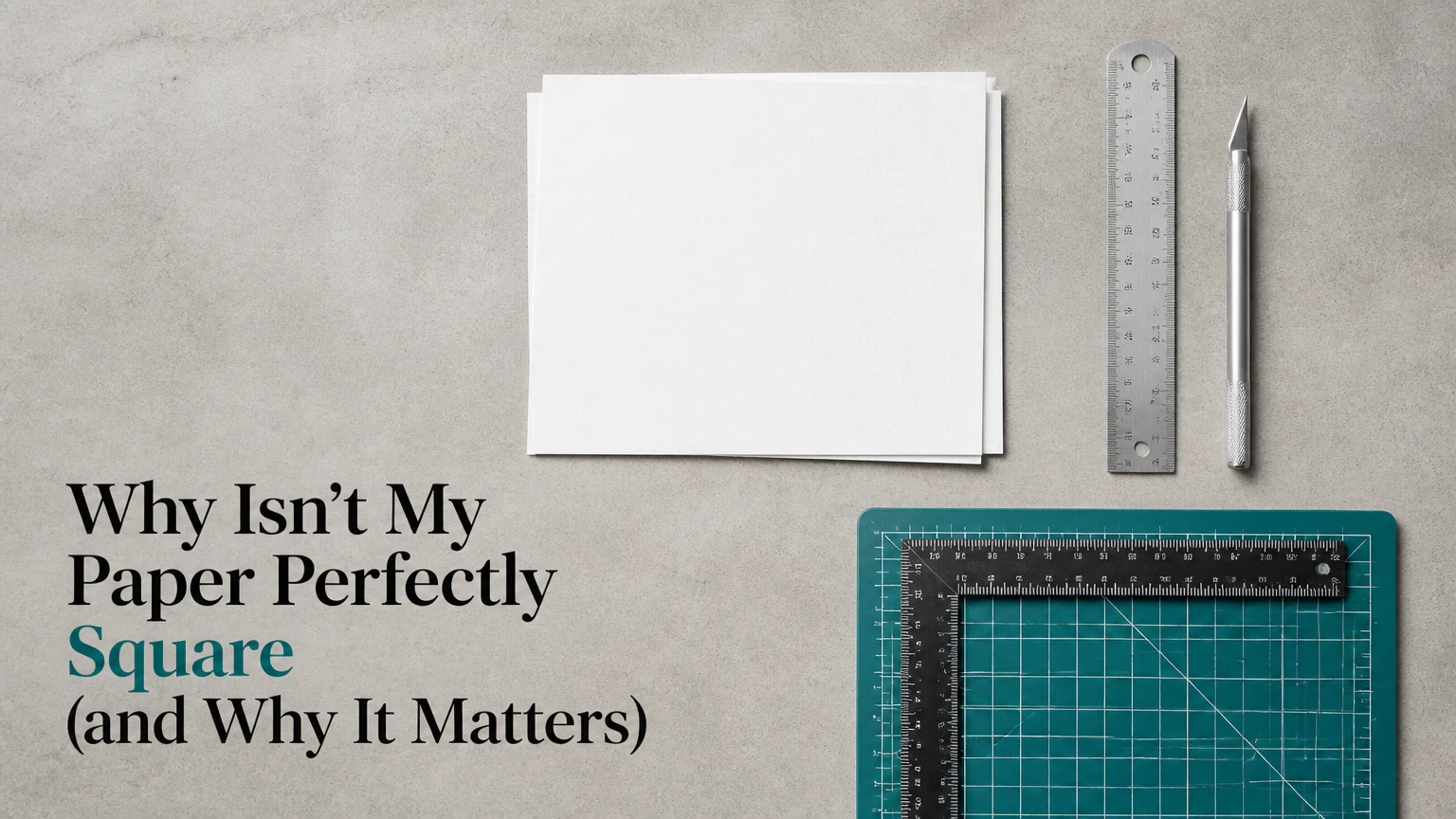
Paper is rarely perfectly square because office sheets are manufactured as efficient rectangles, while origami paper is intentionally cut with four equal sides. The difference matters because square paper gives diagonal folds, center lines, and symmetrical flaps a common geometric reference; even a 1-2 mm error can become visible when several folds meet at one point.
Key Facts at a Glance
ISO A-series paper uses a long-side to short-side ratio of approximately 1:√2, not a square ratio.
A4 paper measures 210 × 297 mm, so it cannot produce a full 210 × 210 mm square without removing material.
Origami square accuracy matters most in models with repeated diagonals, bilateral symmetry, grids, or tessellations.
A 1 mm edge error on a 150 mm sheet is usually minor for a beginner model but significant in a dense crease pattern.
Paper grain changes stiffness and folding behavior, even when the paper has been cut perfectly square.
A steel ruler, sharp knife, and diagonal measurement can produce reliable square paper from ordinary office stock.
Why Is Paper Usually Rectangular?
Rectangular paper is the industrial default because rectangular webs can be produced, rolled, slit, stacked, packed, and printed with little handling complexity. The rectangle is not a manufacturing defect. It is the output of a standards system designed around documents, envelopes, printers, folders, and repeated size conversion.
ISO 216 defines the A series around a 1:√2 aspect ratio. A0 is specified as 841 × 1189 mm, with an area very close to 1 square metre. Each succeeding size is created by halving the previous sheet across its longer dimension, with dimensions rounded to whole millimetres.
The system preserves the document’s proportions during scaling. A4 can be enlarged to A3 or reduced to A5 without changing the page shape, although printers still impose margins and may require scaling. The result is efficient for publishing and office workflows, but it does not create a square sheet.
North American sizes follow a different historical system. Letter paper uses clean inch dimensions, 8.5 × 11 inches, rather than the ISO ratio. That choice supports existing printers, filing systems, and business forms, but Letter paper is no closer to square than A4.
What Is the Mathematical Difference?
A square has an aspect ratio of 1:1. ISO paper has an aspect ratio of approximately 1:1.4142. When an A-series sheet is halved, the new rectangle retains the same ratio because the original long side is approximately the square root of two times the short side.
For an A4 sheet, the dimensions are 210 × 297 mm. Folding it in half produces approximately 148.5 × 210 mm, which rounds to A5 at 148 × 210 mm. The result remains rectangular by design.
| Format | Nominal dimensions | Aspect ratio | Area |
|---|---|---|---|
| A4 | 210 × 297 mm | 1:1.4143 | 62,370 mm² |
| A5 | 148 × 210 mm | 1:1.4189 | 31,080 mm² |
| Letter | 215.9 × 279.4 mm | 1:1.2941 | 60,322 mm² |
| 150 mm square | 150 × 150 mm | 1:1 | 22,500 mm² |
The slight difference between the theoretical ratio and printed dimensions comes from rounding. ISO 216 dimensions are expressed in millimetres, so real sheets do not preserve infinite mathematical precision.
Why Does Square Paper Matter in Origami?
Square paper matters in origami because many traditional bases use the sheet’s four equal edges, two diagonals, and intersecting center lines as a shared coordinate system. Equal sides make left and right flaps comparable, while diagonal folds create predictable 45-degree relationships that support preliminary folds and traditional bases.
A bird base, waterbomb base, preliminary base, and many box constructions depend on relationships between corners and midpoints. The model instructions may not state every measurement because the paper’s square geometry supplies those relationships automatically.
A rectangular sheet can still produce origami. The difference is that the designer must account for the extra length, remove a strip, or create a model whose proportions deliberately use a rectangle. A crane diagram made for a square sheet cannot be transferred casually to A4 without changing the geometry.
The effect compounds. If an initial edge is 2 mm short on a 150 mm sheet, a single flap may look acceptable. After several synchronized folds, the error can appear as a 4 mm offset, a twisted body, or a wing that refuses to match its partner.
Which Folds Reveal Errors First?
Diagonal folds and symmetrical sinks reveal squareness errors before simple edge folds do. A model with a central crease grid may tolerate a small discrepancy, whereas a radial tessellation can magnify the same error across every repeated unit.
| Origami feature | Geometry required | Visible symptom of error | Typical sensitivity |
|---|---|---|---|
| Preliminary base | Equal corners and diagonal intersections | Unequal triangular flaps | Medium |
| Waterbomb base | Matching diagonals and centers | Twisted collapse | High |
| Crane base | Balanced side flaps | Uneven wings or neck | Medium-high |
| Tessellation grid | Repeated equal intervals | Progressive drift | Very high |
A useful practitioner rule is to measure the model’s smallest repeated unit, not only the full sheet. If a 150 mm sheet supports a 10 mm tessellation grid, a 1 mm cutting error equals 10 percent of one unit. The same error is only 0.67 percent of the full edge.
How Does Paper Ratio Affect Folding?
Paper ratio determines which geometric relationships survive folding. A 1:1 square supports four equivalent corners and two equal diagonals, while a 1:√2 rectangle supports proportional halving but gives the corners unequal roles in a square-based model.
The distinction is important when using office paper. Folding A4 corner to corner does create a diagonal, but the remaining strip is not evidence that the diagonal has been placed incorrectly. The strip exists because A4 is rectangular. Removing it produces a square.
Letter paper creates a different strip because its dimensions are 8.5 × 11 inches. If you fold one corner across the sheet to form the largest square, the square side equals the short side, 8.5 inches, and the leftover strip measures 2.5 × 8.5 inches.
| Source sheet | Largest practical square | Leftover strip | Material retained |
|---|---|---|---|
| A4, 210 × 297 mm | 210 × 210 mm | 87 × 210 mm | 70.9% |
| Letter, 215.9 × 279.4 mm | 215.9 × 215.9 mm | 63.5 × 215.9 mm | 77.3% |
| Legal, 215.9 × 355.6 mm | 215.9 × 215.9 mm | 139.7 × 215.9 mm | 60.6% |
| A3, 297 × 420 mm | 297 × 297 mm | 123 × 297 mm | 70.7% |
The retained percentages use the square area divided by the original sheet area. The calculation demonstrates why ISO conversion is efficient for documents but not necessarily efficient when extracting one square for origami.
How Square Must Origami Paper Be?
Origami paper does not need mathematical perfection for every model. A practical tolerance is about 0.5-1 mm for casual folding, 0.2-0.5 mm for symmetrical representational models, and below 0.2 mm for dense tessellations or modular assemblies.
Accuracy should be judged relative to sheet size and model complexity. A 1 mm difference on a 300 mm sheet is less consequential than a 1 mm difference on a 75 mm sheet, and a simple bookmark is less sensitive than a model with twelve matching points.
Measure both side pairs. A sheet can have four nominally similar sides but still be skewed if opposite edges are not parallel or corners are not close to 90 degrees.
| Use case | Sheet size | Recommended edge tolerance | Check to perform |
|---|---|---|---|
| Beginner crane | 150-200 mm | 1.0 mm | Compare both diagonals |
| Traditional animal | 120-180 mm | 0.5 mm | Match opposite sides |
| Modular unit set | 75-120 mm | 0.3 mm | Use one master template |
| Tessellation | 150-300 mm | 0.2 mm or less | Measure grid intervals |
The diagonal test is especially useful. A true rectangle has equal diagonals only when it is a square, so measure from corner one to corner three and from corner two to corner four. A difference of 1 mm indicates a visible geometric imbalance in precision work, even if the edge lengths appear equal.
Does Paper Grain Affect Origami?
Paper grain affects origami because fibers formed during papermaking create directional stiffness, stretch, and fold resistance. A perfectly square sheet can still fold unevenly if one diagonal crosses a stiff direction while its matching diagonal crosses a softer direction.
The Fourdrinier papermaking process forms a continuous fiber web that moves through pressing and drying stages. Machine direction commonly produces different behavior from cross direction, although coating, fiber composition, humidity, and paper finishing also influence the result.
For a crane, grain direction may affect how the neck and tail reverse folds hold. For a box, grain parallel to a long wall can make one pair of sides behave differently from the other pair. In wet folding, moisture softens fibers temporarily, but uneven drying can introduce further distortion.
How Can You Test Grain Direction?
Tear a narrow strip from the sheet and compare the two directions. A tear that travels relatively straight usually follows the grain; a tear that wanders and produces a rougher edge often runs across it. The test is approximate, especially with coated or synthetic papers.
A second test is folding resistance. Fold narrow strips in both directions using the same pressure. The direction that produces a cleaner, easier crease generally follows the more compliant axis, but the result can be affected by coating and thickness.
The paper grain should not be treated as an absolute instruction to place every major crease parallel to it. Model geometry comes first. Instead, orient the sheet so the most demanding long folds, spine folds, or repeated creases use the direction that gives the needed strength and control.
Expert insight: For a complex model, grain direction is often more important after the first collapse than during the initial crease map. Early folds can appear accurate while a later reverse fold exposes directional stiffness through asymmetrical resistance.
How Can You Make a Square From A4 or Letter?
You can make a reliable origami square from A4 or Letter paper by aligning one short edge against a long edge, creasing the diagonal, and cutting away the rectangular strip. A knife and ruler usually produce a cleaner result than scissors because the ruler controls the cut against the existing fold.
Step 1: Choose the Cutting Surface
Place the sheet on a self-healing cutting mat or a firm sacrificial board. Use a metal ruler at least 300 mm long for A4 and a sharp craft knife with a fresh blade.
Do not cut directly on a table. A dull blade can compress the edge and create a slight curve that later appears as a folding error.
Step 2: Form the Diagonal
Bring one corner of the short side to the opposite long edge. Align the edges carefully before creasing from the corner outward. For A4, the resulting square should measure approximately 210 × 210 mm; for Letter, it should measure approximately 8.5 × 8.5 inches.
You will know the alignment worked when the two exposed edges coincide without a wedge-shaped gap.
Step 3: Remove the Strip
Cut along the exposed rectangular strip, using the ruler as a guide. Keep the blade vertical and make one controlled pass rather than repeatedly sawing through the fibers.
For a folded sheet, cut through both layers only if the fold is tight and the ruler cannot shift. A single unfolded-sheet cut often gives better control.
Step 4: Verify the Square
Open the sheet and measure both side pairs and both diagonals. For precision origami, aim for a diagonal difference below 0.5 mm. If one corner is visibly open after matching opposite edges, trim the smallest amount possible from the offending edge.
| Tool | Typical cost | Useful accuracy | Best use |
|---|---|---|---|
| Paper scissors | $5-$15 | 1-2 mm | Casual practice sheets |
| Craft knife | $8-$20 | 0.5-1 mm | Repeated home cutting |
| Metal ruler | $6-$20 | 0.5 mm scale | Straight trimming |
| Rotary trimmer | $20-$80 | 0.5-1 mm | Multiple identical squares |
Step 5: Mark the Grain
If the paper type is unfamiliar, make a small tear test on the leftover strip and record the easier tear direction. Store the square flat, especially when the paper has a strong curl from packaging.
A practical cutting checkpoint is simple: fold the finished square along each diagonal, then compare the crease intersections. If the diagonal creases do not cross at the same center point, the sheet is skewed or the folds were misaligned.
Which Regional Paper Format Is Easier to Square?
A4 and Letter are both easy to convert into squares, but Letter preserves more area because its short side is proportionally closer to its long side. Legal paper produces a larger waste strip, although its extra length can be useful for long rectangular origami designs.
| Format | Short side | Long side | Square conversion | Strip length |
|---|---|---|---|---|
| A4 | 210 mm | 297 mm | 210 × 210 mm | 87 mm |
| Letter | 8.5 in | 11 in | 8.5 × 8.5 in | 2.5 in |
| Legal | 8.5 in | 14 in | 8.5 × 8.5 in | 5.5 in |
| Tabloid | 11 in | 17 in | 11 × 11 in | 6 in |
For a beginner, Letter is convenient in the United States because it is widely available and its 8.5-inch short edge produces a useful medium-large square. A4 is equally practical elsewhere, especially when a project requires standard document paper or a 210 mm model.
The larger issue is not the regional format. It is whether the sheet has been cut cleanly and whether the paper weight suits the model.
Which Paper Works Best for Origami?
The best origami paper depends on model complexity, finished size, and whether the design needs crisp creases or soft shaping. For general practice, uncoated paper around 60-90 gsm offers a workable balance between fold memory, strength, and ease of handling.
Thin kami paper is convenient for traditional models, while heavier cardstock is better for standing boxes and display pieces but becomes difficult in dense layers. Foil-backed paper holds sharp edges and resists fiber splitting, although it can show accidental creases and may tear at narrow points.
| Paper type | Typical weight | Strength | Suitable models |
|---|---|---|---|
| Kami | 60-75 gsm | Moderate | Cranes, flowers, traditional bases |
| Copy paper | 75-90 gsm | Moderate-high | Practice models, boxes, simple animals |
| Tant or similar colored paper | 70-100 gsm | High | Sculptural models, repeated folds |
| Foil-backed paper | 50-80 gsm | High surface crispness | Insects, sharp geometric designs |
| Cardstock | 120-250 gsm | Very high | Cards, broad boxes, display forms |
GSM means grams per square metre. It does not fully describe thickness because fiber density and coating vary, but it gives a useful purchasing comparison.
What Is the Best Size for a Paper Crane?
A 150-200 mm square is a practical starting size for a standard paper crane. Smaller sheets expose alignment mistakes and require more precise fingernail control, while larger sheets make early folds easier but can become floppy if the paper is too thin.
For a child or first-time folder, 200 mm kami or copy paper provides enough surface area to see the creases. For a display crane, 150 mm paper usually creates a more manageable finished model with cleaner proportions.
Can You Use Rectangular Paper for Origami?
Rectangular paper works for origami when the model is designed for a rectangle or when the maker accepts a non-square starting geometry. Newspaper hats, bookmarks, envelopes, boxes, aeroplanes, and some modular forms use rectangles deliberately.
A square-based diagram cannot always be adapted by simply folding the excess length backward. The extra strip changes corner positions, center points, and diagonal intersections, so later flaps may not align with the published sequence.
Rectangular paper has useful advantages. A4 produces a tall format for envelopes and long bookmarks, while Legal paper supports extended strips and narrow architectural forms. Treating the rectangle as a design parameter is more reliable than forcing it into a square model.
When Should You Keep the Rectangle?
Keep the rectangle when the finished model benefits from length, when the instructions specify A4 or Letter, or when removing material would make the model too small. A rectangle is also preferable for testing crease patterns that depend on a 1:√2 proportion.
Use a square when the model includes a traditional base, four-way symmetry, radial repetition, or matching corner flaps. Use a rectangle when the diagram’s first instruction identifies the long and short edges as different functional boundaries.
What Problems Does an Imperfect Square Cause?
An imperfect square causes uneven diagonals, mismatched flaps, off-center collapses, and progressive drift in repeated folds. The defect may remain invisible in a simple crease but become obvious when the model is compressed into a symmetrical base.
| Symptom | Likely cause | Diagnostic test | Correction |
|---|---|---|---|
| One wing is longer | Unequal starting edges | Compare side pairs | Recut the sheet |
| Center collapse twists | Diagonals differ | Measure both diagonals | Use a new square |
| Box walls lean | Skewed corners or grain | Fold both diagonals | Trim and refold |
| Grid drifts outward | Repeated interval error | Measure five units | Use a template |
| Creases miss the center | Misalignment or rounded corner | Mark sheet center | Re-square the paper |
Do not immediately blame the paper. Folding pressure, corner alignment, crease order, and paper curl can create the same symptoms. Repeat the first two reference folds on a fresh sheet and compare the intersections before changing the model sequence.
Expert insight: A perfectly cut square cannot compensate for a fold made from corner-to-edge alignment that was off by 1 mm. In practical origami, alignment accuracy and sheet accuracy multiply rather than add.
How Do You Fix Paper That Is Slightly Out of Square?
For an error below about 1 mm, continue with a simple model and use the most accurate corner as your reference. For precision work, recut the sheet because correcting one edge after several creases usually creates more distortion than starting over.
To repair a slightly skewed sheet, mark the intended square on the back with a set square or by transferring a trusted template. Trim the smallest edge excess, then verify both diagonals. Avoid pulling or stretching the paper because cellulose fibers can retain a temporary deformation.
Humidity can also change paper dimensions and curl. Store sheets flat in a dry room, and allow paper moved between a cold vehicle and a warm room to acclimate before measuring. A warped sheet may become usable after flattening under books for several hours, but moisture-sensitive handmade paper may change size again.
What Are the Most Common Origami Paper Mistakes?
The most common mistakes are using the wrong starting shape, ignoring grain, cutting with a flexible ruler, and judging accuracy only by side length. Each mistake creates a different failure pattern, so diagnosis should begin with geometry rather than folding harder.
- Assuming A4 is nearly square: A4 is 87 mm longer than its short side, which is a major difference for square-based models.
- Checking only one diagonal: Equal side lengths do not guarantee a square if the corners are skewed.
- Using a blunt blade: A compressed or ragged edge can shift during corner alignment.
- Folding against strong grain without a reason: The crease may spring open or force the model out of symmetry.
- Using thick paper for a layered model: Eight layers of 200 gsm cardstock behave very differently from eight layers of 75 gsm paper.
- Scaling a diagram without scaling the paper: A model’s proportions may remain correct, but the smallest flap may become too narrow to manipulate.
One honest limitation matters here: paper accuracy cannot solve a diagram that contains an ambiguous reference, an incorrect crease location, or an intentionally asymmetric design. Some models are supposed to have unequal flaps, and forcing symmetry can destroy the intended shape.
The Bottom Line
Why isn’t my paper perfectly square? Because ordinary paper is manufactured for rectangular standards such as ISO A4 and North American Letter, not for origami’s square-based geometry. Origami paper needs equal edges when a model depends on matching diagonals, center points, repeated grids, or bilateral symmetry.
Use a 150-200 mm square and 60-90 gsm paper for most beginner models. Cut A4 to 210 × 210 mm or Letter to 8.5 × 8.5 inches, then compare both diagonals before folding. For dense tessellations and modular work, hold the edge error below 0.2-0.3 mm and control the grain direction as carefully as the cut.
The practical answer is proportional, not absolute: a tiny defect may not matter in a simple crane, but the same defect can control the outcome of a complex crease pattern.
FAQ
Is A4 paper good for origami?
A4 paper is good for origami practice after you cut it into a square, and its 210 mm short side produces a useful medium-sized sheet. Uncut A4 remains suitable for rectangular models such as envelopes, bookmarks, boxes, and paper aeroplanes. Standard 75-90 gsm copy paper handles beginner folds well.
Why does my origami crane look uneven?
An uneven crane usually results from one of four causes: an inaccurate square, a misplaced diagonal, unequal flap folds, or paper grain resistance. Compare the starting sheet’s diagonals, then inspect the first base collapse. If the initial flaps match but the wings do not, the later dividing folds are more likely responsible.
Can I make origami paper square without cutting it?
You can fold a rectangular sheet into a square-like region, but the unused strip remains attached and changes the model’s geometry. This method is acceptable for testing a fold sequence, but cutting or tearing the strip produces a true square for models that require four equal edges.
Does expensive origami paper fold better?
Expensive paper does not automatically fold better. Paper quality depends on GSM, fiber length, coating, grain, sizing, and surface strength. A reasonably priced 60-90 gsm uncoated sheet may outperform thick decorative paper in a detailed model because it forms narrower layers and sharper reverse folds.
Should the grain run along the diagonal?
No universal grain orientation works for every origami model. Grain direction should be chosen according to the model’s longest structural folds, narrow points, and desired stiffness. Test both orientations on a small strip, then select the direction that gives controlled creases without excessive spring-back or tearing.
Is a 1 mm error too much for origami?
A 1 mm error is usually acceptable for a simple model on a 180-200 mm sheet, but it can be excessive for a dense tessellation, modular unit, or small model. Judge the error against the smallest repeated feature. If a 1 mm error equals 5-10 percent of that feature, recut the paper.
