

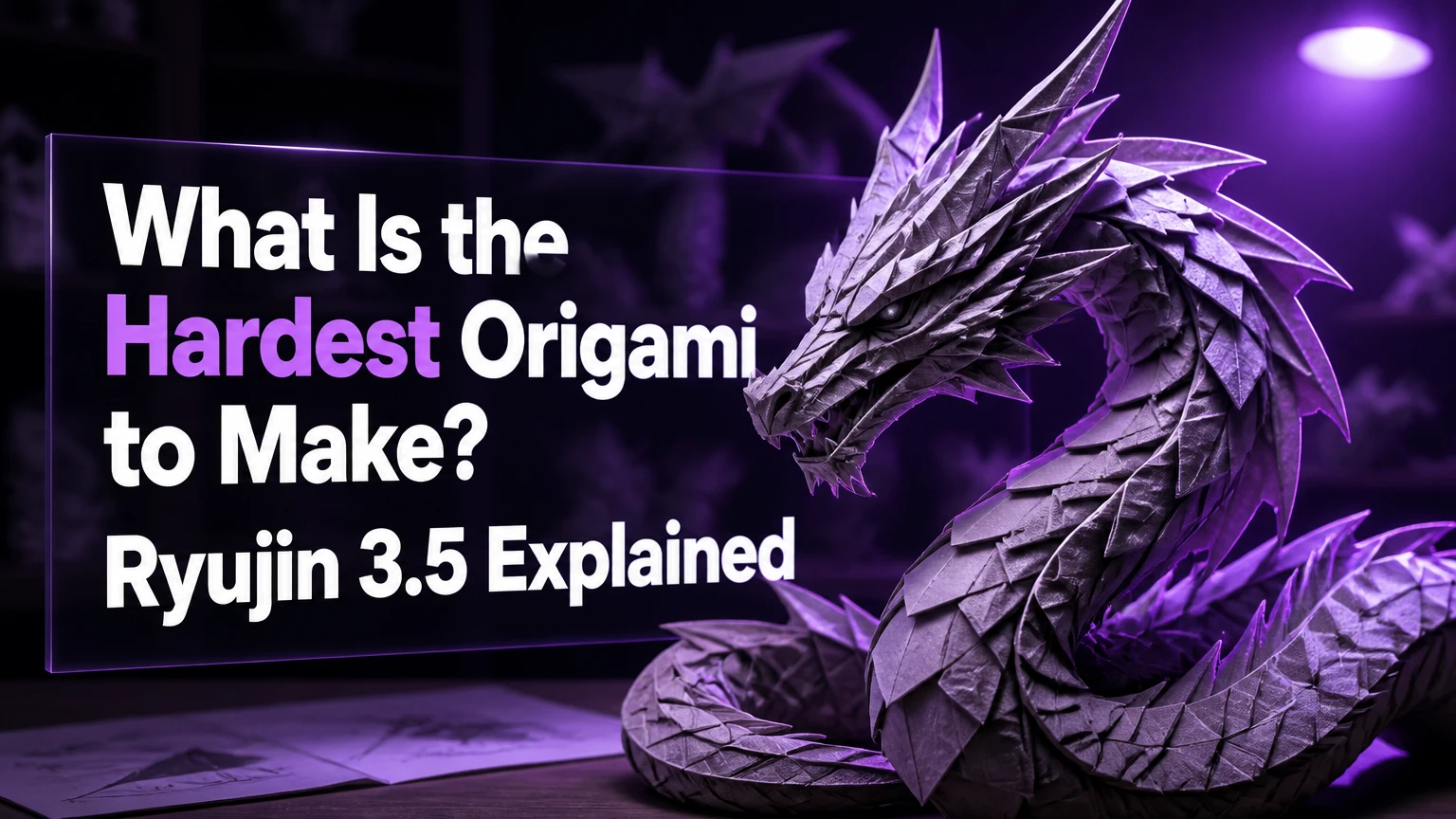
The hardest origami model commonly identified by experienced folders is Ryujin 3.5, or Dragon God 3.5, designed by Satoshi Kamiya. Its extreme scale density, thousands of precreases, complex crease pattern, large paper requirement, and demanding final shaping place it beyond ordinary diagrammed origami. “Hardest” remains criteria-dependent, however, because other models can exceed Ryujin 3.5 in sequence length, thin-layer control, or mathematical difficulty.
Key Facts at a Glance
- Ryujin 3.5 by Satoshi Kamiya is the leading candidate for the hardest widely known origami model.
- Ryujin 3.5 uses one uncut square and represents thousands of scales through dense geometric planning.
- A typical serious attempt may require 1-2 metres of paper, dozens of hours, and specialized long-fiber material.
- Ancient Dragon, also by Satoshi Kamiya, is a more accessible extreme challenge because diagrammed steps exist.
- Complex origami uses circle packing, tree theory, layer allocation, and crease-pattern analysis to assign paper to body parts.
- A crease pattern is not a normal sequence of instructions. It is a geometric map that must be interpreted and collapsed in three dimensions.
What Is the Hardest Origami to Make?
Ryujin 3.5 is usually the strongest answer because it combines enormous scale density with a difficult collapse and prolonged shaping process. The model is hard in several independent ways: the folder must transfer or interpret a dense crease pattern, manage thousands of layers, prevent paper failure, and sculpt a recognizable dragon from a compressed base.
The title “hardest origami” has no official governing body or universal scoring system. A model may be hardest to design, hardest to understand from a crease pattern, hardest to fold from diagrams, or hardest to finish cleanly. Those categories produce different winners.
Ryujin 3.5 is especially difficult because its scales consume paper throughout the body and limbs. The challenge is therefore architectural rather than merely sequential. A folder can understand every geometric step and still fail when thickness, paper memory, or flap placement prevents the base from collapsing.
Robert J. Lang has described origami as “a way of thinking with your hands.” That phrase captures the difference between recognizing a crease pattern and successfully converting it into a stable three-dimensional form.
How should difficulty be measured?
A useful difficulty assessment scores six factors: geometric density, layer thickness, collapse complexity, shaping precision, paper size, and available instructions. This prevents a short but technically vicious model from being unfairly compared with a 300-step diagrammed model.
| Difficulty factor | What increases difficulty | Typical extreme value |
|---|---|---|
| Geometric density | More packed features and creases | 64×64 to 128×128 grid regions |
| Layer management | More layers converging in one area | 20 or more layers at thick junctions |
| Collapse complexity | More simultaneous folds and hidden flaps | One major CP collapse |
| Shaping demand | Smaller organic details and curves | Individual claws, whiskers, or scales |
| Paper scale | Larger sheet with greater handling area | 1-2 metres square |
| Instruction access | CP instead of sequential diagrams | Zero intermediate checkpoints |
Why Is Ryujin 3.5 So Difficult?
Ryujin 3.5 is difficult because the design distributes a huge number of small features across a single sheet, then requires those features to collapse into a compact, layered structure without tearing or losing flap control. The design challenge begins before folding, since every misplaced crease can alter the geometry of several later structures.
The model’s scales create a distinctive problem. A dragon with a few large plates can reserve broad paper regions for the torso, but thousands of scales consume narrow strips and dense pleats. The remaining material must still produce legs, horns, claws, wings or membranes, and a head with enough structural strength.
The largest models also create a handling problem that diagrams cannot solve. A two-metre sheet cannot be rotated and supported like a 15-centimetre square. Folders often work on a clean floor or large table, using assistants, temporary weights, protective coverings, and carefully controlled humidity.
The final appearance depends on shaping as much as folding. Water or methylcellulose can soften fibers and allow curves to hold after drying, but too much moisture weakens already-thin layers and can erase useful crease memory.
What is a crease pattern?
A crease pattern, or CP, is a complete geometric map of mountain and valley folds on a flat sheet. A CP usually does not tell the folder which flap to lift first, where hidden layers should travel, or how the finished form should be sculpted, so solving it requires spatial reasoning beyond ordinary diagram following.
A successful CP must satisfy flat-foldability conditions at appropriate vertices. Kawasaki’s theorem states that the alternating sum of sector angles around a flat-foldable vertex is 180 degrees, while Maekawa’s theorem states that the number of mountain and valley folds at a flat-foldable vertex differs by two.
Those theorems do not automatically make a model foldable in practice. Paper has thickness, fibers have directional behavior, and a mathematically valid pattern may still become physically impossible when hundreds of layers occupy the same region.
What do circle packing and tree theory do?
Circle packing allocates circles or polygons within a square to represent major body parts and appendages. Tree theory then translates those allocations into branching paper structures, allowing a designer to assign branches for legs, antennae, claws, wings, or individual fingers.
In a complex insect, the body might receive one large circle, while each leg receives a narrow branch that splits into toes. In Ryujin 3.5, scale rows require repeated, tightly controlled allocation along the body and tail. The method explains how one sheet can contain many anatomically distinct structures.
Which Origami Models Rival Ryujin 3.5?
Ryujin 3.5 is the strongest overall candidate, but Ancient Dragon, Cicada Nymph, and highly detailed insect models rival it under narrower definitions of difficulty. Ancient Dragon is harder for sequential endurance, Cicada Nymph for geometric compression and thickness management, and insect models for proportional precision in thin appendages.
| Model and designer | Main difficulty | Typical paper | Typical folding time |
|---|---|---|---|
| Ryujin 3.5, Satoshi Kamiya | Scale density and CP collapse | 1-2 m mulberry or back-coated Wenzhou | 40-60 hours |
| Ancient Dragon, Satoshi Kamiya | Long sequence and layered asymmetry | 50-70 cm strong thin paper | 10-20 hours |
| Cicada Nymph, Kota Imai | Dense CP and thin structural layers | About 70 cm ultra-thin paper | 20-30 hours |
| Insect designs, Brian Chan | Legs, wings, and proportional accuracy | 50 cm or larger fine paper | 12-20 hours |
| Complex insect designs, Robert Lang | Circle packing and appendage allocation | 35-60 cm treated paper | 8-20 hours |
These figures are typical practitioner estimates, not official specifications. Paper preparation, failed attempts, CP familiarity, and whether the result is a display model can change the total substantially.
Is Ancient Dragon harder than Ryujin 3.5?
Ancient Dragon is usually easier to access but can remain brutally difficult to complete cleanly. Its diagrammed sequence gives the folder checkpoints, layer maps, and directional guidance that Ryujin 3.5’s CP does not provide.
Ancient Dragon may be the harder choice for someone who struggles with endurance or dense sequential instructions. Ryujin 3.5 is generally harder for someone who can follow diagrams but has never solved a large CP or managed a simultaneous collapse.
| Model | Instruction format | Best comparison category | Main limitation |
|---|---|---|---|
| Ryujin 3.5 | Crease pattern and collapse knowledge | Overall complexity | Few beginner-friendly checkpoints |
| Ancient Dragon | Diagrammed sequence | Long folding endurance | Many layers become difficult to reverse |
| Cicada Nymph | CP-led technical folding | Geometric compression | Small errors spread through the base |
| Brian Chan insect | CP or advanced diagrams | Thin appendages | Legs and antennae tear easily |
| Robert Lang insect | CP and design theory | Mathematical structure | Finished realism depends on shaping |
Is the hardest model always the most detailed?
No. Detail count measures only one part of difficulty. A simple-looking model can be harder if its collapse has poor error tolerance, its layers are tightly trapped, or its paper must reverse direction repeatedly without stretching.
A highly detailed model may also use wet folding and surface shaping to create visual complexity after the main collapse. Conversely, a less realistic model may demand more exact geometry because every structural feature must emerge directly from the fold pattern.
How Does Ultra-Complex Origami Work?
Ultra-complex origami combines geometric design, material control, folding mechanics, and post-collapse shaping. The folder first creates or transfers a dense pattern, precreases important lines, collapses the sheet into a base, then compresses and sculpts the layers into the intended subject.
The process differs from conventional modular or beginner origami because the folder cannot rely on one visible flap at a time. A CP may contain thousands of lines that interact across the sheet. Some lines define final features, while others exist to distribute stress, create thickness transitions, or guide hidden layers.
A practical workflow has six phases:
- Prepare the square. Check diagonal and edge accuracy before adding any pattern.
- Transfer the CP. Mark mountain and valley information with a consistent notation system.
- Precrease progressively. Work from major structural lines toward smaller detail groups.
- Organize paper flow. Trace where major flaps must emerge from the compressed center.
- Collapse the base. Coordinate several regions instead of forcing one flap in isolation.
- Shape and stabilize. Use controlled moisture, clips, wires, and drying intervals.
The collapse is often the point of failure. A precreased sheet can look perfect while flat, yet become unusable if a hidden layer enters the wrong pocket or a thick junction buckles away from its intended path.
What paper is needed for the most difficult models?
The hardest origami models need thin, strong, flexible paper with long fibers and enough internal sizing to survive repeated manipulation. Ordinary 15-centimetre kami paper is usually too thick, too weak, or both for a massive, densely layered CP.
| Paper or treatment | Typical price | Suitable scale | Strength and limitation |
|---|---|---|---|
| Standard kami | $0.10-$1 per sheet | 15-30 cm | Cheap, but weak for dense multi-layer bases |
| Kraft or Tant | $1-$5 per sheet | 25-50 cm | Stronger, though stiffness limits fine shaping |
| Unryu or mulberry | $3-$20 per sheet | 40-80 cm | Long fibers, uneven surface, variable thickness |
| Wenzhou roll | $20-$40 per roll | 70 cm-2 m | Large format, often needs backing or sizing |
| Origamido | $30-$100 or more per sheet | 35 cm-1 m | Very thin and strong, expensive and scarce |
| Back-coated tissue | $5-$20 in materials | 50 cm-2 m | Custom strength, but preparation takes hours |
Origamido is associated with demanding representational origami because handmade mulberry fibers can provide high tensile performance at low thickness. Back-coated Wenzhou or double-tissue paper is more practical for very large sheets, where a single expensive handmade sheet may be difficult to source.
Methylcellulose, often abbreviated MC, is used as a sizing and wet-shaping medium. It can improve handling and help a dried curve retain its form, but it cannot repair a fundamentally unsuitable paper or rescue a badly collapsed base.
How much does a serious attempt cost?
A serious attempt typically costs $50-$150 before tools, with the largest variables being paper size, imported specialty sheets, MC, and the number of failed attempts. A folder preparing several large sheets can exceed $200 without purchasing any new tools.
| Expense | Typical quantity | Typical cost | Cost driver |
|---|---|---|---|
| Large mulberry or Wenzhou paper | 1-3 sheets or one roll | $20-$100 | Sheet size and fiber quality |
| Methylcellulose | 100-250 ml prepared | $10-$15 | Brand and concentration |
| Tissue or foil backing | 1-2 packs | $5-$25 | Number of layers and sheet area |
| Clips, wire, and weights | 10-30 pieces | $10-$40 | Shaping complexity |
| Replacement sheets | 2-5 attempts | $20-$150 | Collapse failures and tears |
How Long Does the Hardest Origami Take?
Ryujin 3.5 typically requires 40-60 hours for a serious attempt, excluding design work, paper preparation, and practice collapses. Ancient Dragon often takes 10-20 hours, while a complex insect may take 8-30 hours depending on the CP and the folder’s experience.
Time estimates are difficult to standardize. A first attempt may end after 15 hours with no finished model, while an experienced folder can spend 40 hours producing a display-quality result. Precreasing a two-metre sheet may itself take several sessions.
| Task | Ryujin 3.5 typical range | Ancient Dragon typical range | Complex insect typical range |
|---|---|---|---|
| Paper preparation | 2-6 hours | 1-3 hours | 1-3 hours |
| CP transfer or study | 4-12 hours | 1-2 hours | 2-8 hours |
| Precreasing | 15-30 hours | 3-7 hours | 4-12 hours |
| Collapse | 4-10 hours | 2-4 hours | 2-6 hours |
| Final shaping | 10-25 hours | 3-8 hours | 3-12 hours |
| Total successful attempt | 40-60 hours | 10-20 hours | 8-30 hours |
A practitioner rule of thumb is to spend more time understanding the paper flow before collapse than trying to force the base after it starts to fail. Pressure applied at the wrong location can lock a flap inside the model and make later correction impossible.
Should You Attempt Ryujin 3.5?
Most folders should not begin with Ryujin 3.5. The model is appropriate only after the folder can reverse-fold accurately, manage thick multi-layer junctions, interpret advanced diagrams, and solve smaller CPs without losing track of flap destinations.
The most useful progression is structural rather than chronological. Start with advanced animal bases, move to diagrammed complex models, then study simple insect CPs before attempting large-scale dragon patterns.
| Experience level | Recommended model type | Paper size | Readiness checkpoint |
|---|---|---|---|
| Intermediate | Advanced animal or bird diagrams | 30-40 cm | Clean multi-layer sinks |
| Advanced | Ancient Dragon or Bahamut | 50-70 cm | Stable collapse with 20-plus layers |
| CP learner | Small insect crease patterns | 25-40 cm | Can identify major flap flow |
| Expert | Large insect or cicada CP | 50-80 cm | Can recover from partial collapse errors |
| Grandmaster attempt | Ryujin 3.5 | 1-2 m | Has completed practice CPs and large wet folds |
Juho Könkkölä’s highly detailed figures, Brian Chan’s insects, Robert Lang’s advanced insects, and Satoshi Kamiya’s dragon designs each teach different skills. A folder who wants realistic anatomy should not assume that another dragon is the only useful preparation.
What is the best alternative for an advanced folder?
Ancient Dragon is the best diagrammed alternative for an advanced folder who wants a recognizable extreme model without beginning with a massive unsolved CP. The diagrams provide intermediate validation, while the model still demands layer control, sequence memory, and careful shaping.
A complex insect is the better alternative for someone interested in mathematical design. Insects expose circle packing and tree allocation clearly, but their legs, antennae, and wing edges create severe thickness and tearing problems at smaller scales.
What Are the Main Failure Modes?
The most common failures are paper bursting, wrong crease interpretation, trapped layers, uncontrolled thickness, and premature shaping. Each failure has a different cause, so adding more force rarely fixes the model.
Why does the paper burst?
Paper bursts when tensile stress and thickness exceed the material’s ability to bend around a junction. Standard craft paper fails quickly because its fibers and thickness cannot accommodate repeated reversals in densely packed regions.
Use thinner long-fiber paper, enlarge the model, soften the sheet gradually, and avoid sharpening every tiny crease with excessive pressure. Tissue foil can increase flexibility for some designs, but aluminum foil does not remove the need for careful layer management.
How do trapped layers happen?
Trapped layers happen when a flap enters an internal pocket during collapse and cannot reach its planned exit. CP solvers reduce this risk by marking major paper-flow routes before folding and by identifying which layers must remain on the outside of each junction.
If a model begins to deviate, stop immediately. Flattening the entire base may damage crease memory, but continuing can bury the error permanently. Photographing each major collapse stage helps compare the current structure with a reference model or CP interpretation.
Why does crease memory become unreliable?
Crease memory becomes unreliable when paper is reversed repeatedly, overworked, or exposed to uncontrolled moisture. Weak fibers can produce soft valleys that compete with the intended crease during collapse.
Make important creases in a controlled direction, use moderate pressure, and allow damp paper to dry between shaping stages. MC can restore some stiffness after drying, but heavily damaged fibers usually require a new sheet.
Crease Patterns or Diagrams: Which Is Harder?
Crease patterns are harder to interpret, while diagrammed instructions are usually harder to execute over long sequences. The better format depends on whether the folder’s weakness is spatial reasoning or sustained precision.
| Decision criterion | Crease pattern | Diagrammed sequence | Better choice |
|---|---|---|---|
| Intermediate guidance | Major lines only | Step-by-step images | Diagrams |
| Mathematical insight | High | Low to moderate | CP |
| Error detection | Difficult after collapse | Frequent checkpoints | Diagrams |
| Design transfer skill | Directly applicable | Limited | CP |
| Learning curve | Months to years | Weeks to months | Diagrams |
| Best first extreme model | Small insect CP | Ancient Dragon | Diagrams |
CP folding does not mean folding faster. A skilled folder may save time by precreasing directly from the pattern, but a learner can spend hours determining mountain-valley orientation and hidden-layer order.
Diagrams also have limitations. A diagrammed model can conceal why a fold works, and a small drawing may not reveal the thickness problem that appears in real paper. The strongest education combines both methods.
What Do the Most Difficult Models Have in Common?
The hardest origami models share high feature density, narrow appendages, difficult layer transitions, and low tolerance for measurement errors. Their visual realism comes from allocating paper efficiently, not from adding cuts, glue, or separate pieces.
The most counterintuitive fact is that a larger sheet is often easier than a smaller one. Larger scale gives the paper more bending radius and provides more material around stress points, although handling and precreasing become substantially harder.
A second practitioner insight is that wet folding is a shaping method, not a substitute for geometric accuracy. Moisture can create a beautiful curve from a sound base, but it cannot move a misplaced leg flap to the correct location.
A third insight concerns detail. More scales or hairs do not automatically create a harder model than a clean, sparse design. Difficulty rises sharply when the model combines detail with thin paper, crowded junctions, and a collapse that offers no safe intermediate state.
Frequently Asked Questions
What is the hardest origami dragon to fold?
Ryujin 3.5 is generally considered the hardest origami dragon to fold because it combines extreme scale density, a large single sheet, dense crease-pattern collapse, and extensive shaping. Ancient Dragon is also exceptionally difficult, but its diagrammed sequence makes it more approachable than Ryujin 3.5 for experienced folders.
Can a beginner make Ryujin 3.5?
A beginner should not start with Ryujin 3.5. The model requires advanced layer management, CP interpretation, large-sheet handling, specialized paper, and a tolerance for failed attempts. A safer route begins with 30-40 centimetre diagrammed animals, followed by Ancient Dragon or small insect crease patterns.
What is the hardest origami model with instructions?
Ancient Dragon by Satoshi Kamiya is one of the strongest candidates for the hardest widely available diagrammed model. Its sequential instructions reduce CP-solving difficulty, but the long sequence, dense layers, thin appendages, and shaping demands still require advanced folding experience.
How big should paper be for complex origami?
Complex models commonly need 35-70 centimetre paper, while Ryujin 3.5 may require approximately 1-2 metres. The correct size depends on the design, paper thickness, and desired detail. A larger sheet improves bending tolerance but increases precreasing time, storage needs, and handling difficulty.
Is origami harder than kirigami?
Origami is often harder for models that must create many details from one uncut sheet because every feature must be allocated through folds. Kirigami permits cuts, which can simplify silhouettes and thin appendages, although large kirigami structures may introduce different engineering problems involving hinges, cuts, and material strength.
The Bottom Line
The best answer to what is the hardest origami to make is Ryujin 3.5 by Satoshi Kamiya, especially when difficulty means total geometric density, collapse complexity, scale count, paper handling, and finishing time. The answer changes under narrower criteria: Ancient Dragon is a leading diagrammed challenge, Cicada Nymph tests dense CP solving, and advanced insects test proportional precision.
Ryujin 3.5 is therefore a benchmark, not a sensible first project. Build toward it through large diagrammed models, small crease patterns, strong thin paper, and controlled wet shaping before committing a two-metre sheet and 40-60 hours to a single attempt.
