

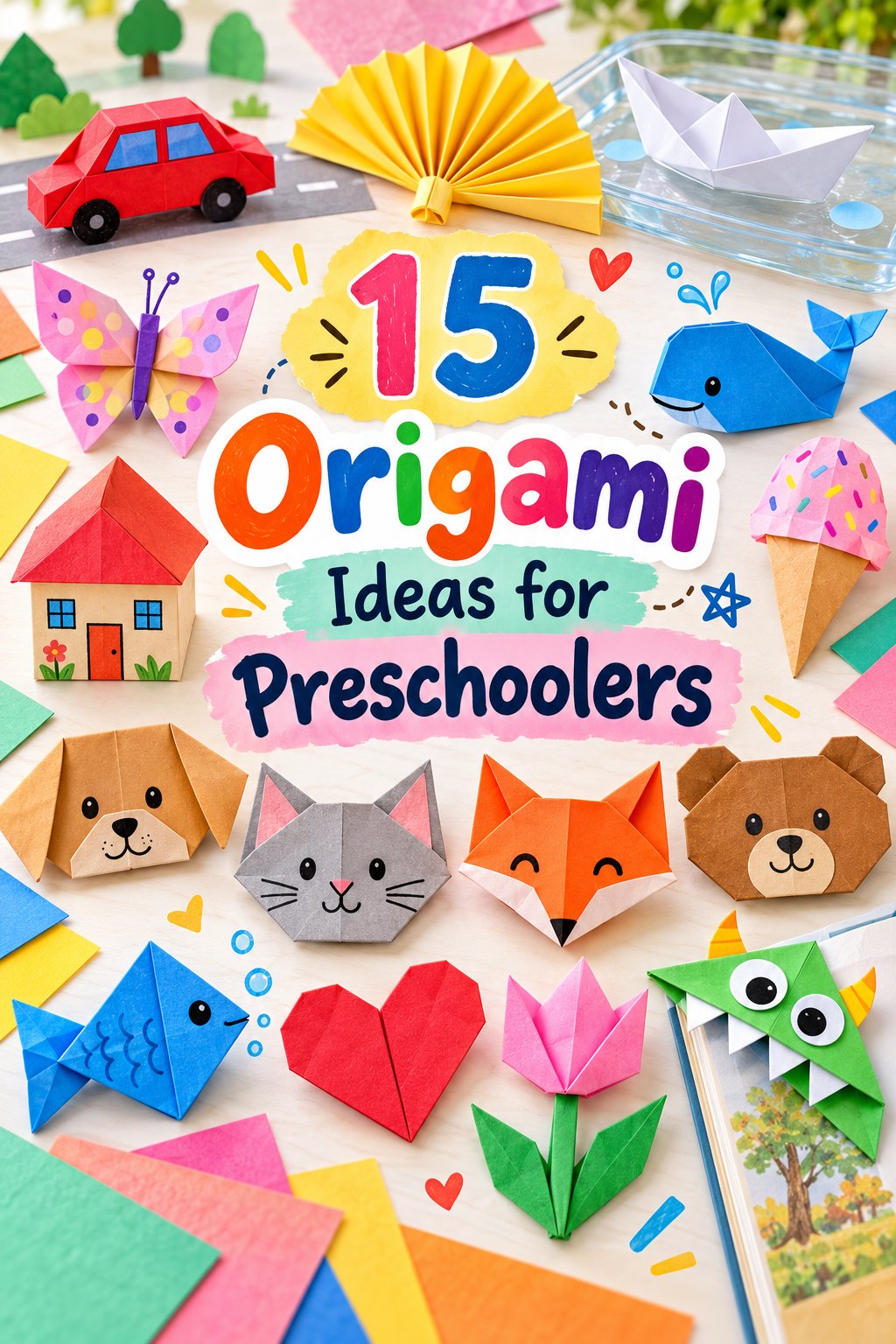
The Simple Dog Face is the best starting point among these 15 origami ideas for preschoolers because it takes about three folds, needs one square sheet, and becomes recognizable before frustration builds. I compared every model for motor demand, adult help, material cost, play value, and durability, then ranked them for real preschool use rather than visual appeal alone.
Our Top Picks
Best overall: Simple Dog Face, fastest recognizable result with three main folds.
Best budget: Accordion Hand Fan, one ordinary rectangular sheet and optional tape.
Best for imaginative play: Origami House, a freestanding prop for stories and small-world play.
Best for reading: Corner Monster Bookmark, a paper craft children can use afterward.
Best for advanced preschoolers: Easy Paper Whale, a manageable introduction to center-guideline folding.
Best for symmetry: Simple Origami Butterfly, clear wings that invite pattern decoration.
Best for sensory play: Traditional Paper Boat, provided an adult supervises the water.
How We Chose
A preschool origami model should create progress quickly, tolerate imperfect creases, and produce a result children can recognize or use. I treated “easy” as more than a low step count, because a four-fold model with confusing layers can be harder than a six-fold model with obvious landmarks.
- Fold count and layer thickness
- Adult assistance
- Typical completion time
- Extra materials
- Finished-model durability
- Play, literacy, or early-learning value
Standard origami paper usually costs about $3-$8 per pack, while ordinary printer or construction paper can reduce the material cost to a few cents per sheet. For this age group, 6-inch square paper is a practical starting size.
1. Simple Dog Face: Best for First-Time Folders
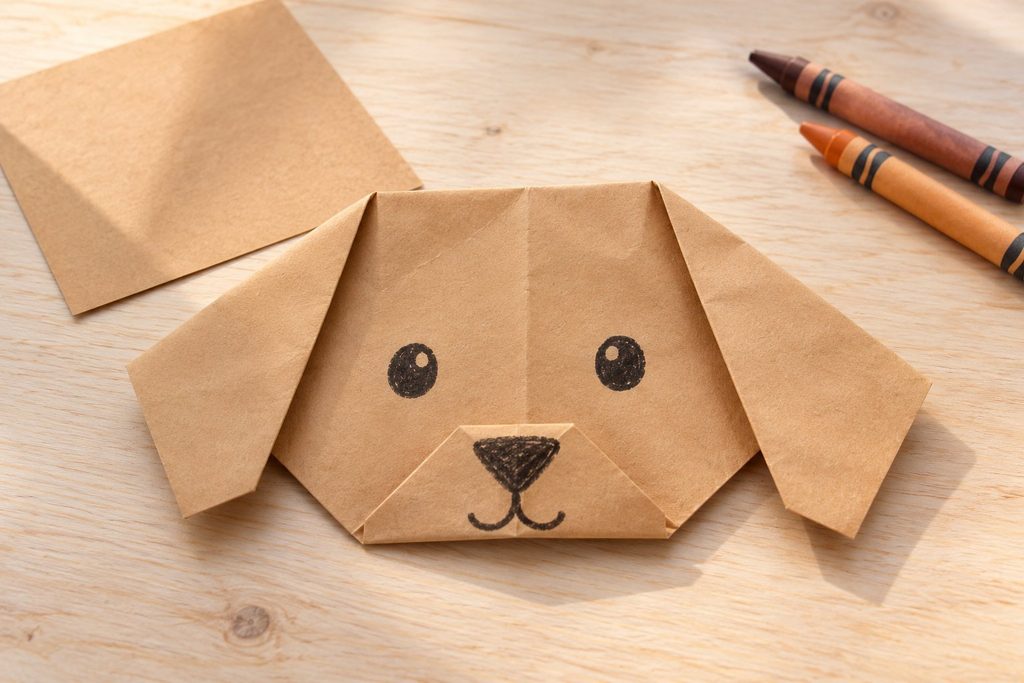
Simple Dog Face is the strongest first project because one square sheet becomes a floppy-eared animal in roughly three main folds. It suits children around age three who need a quick result, and it remains forgiving when the ear angles are uneven.
Key specs: 1 square sheet, about 6 inches, 3 main folds, 3-5 minutes, paper only, low adult help.
The child folds the square diagonally, lowers the side points for ears, and lifts the lower point slightly for the muzzle. Those landmarks are easy to describe without complicated diagram language. Crayons, washable markers, or adhesive eyes add personality after folding, which gives children a second activity when the paper shape is complete.
The model also works well in a small group because adults can demonstrate it from the same orientation. The main weakness is structural: the ears do not lock. Firmly pressing the creases helps, but rough play can flatten or flip them.
Choose this if a child needs success in under five minutes. Skip it if you want a freestanding model.
2. Simple Cat Face: Best for Animal-Loving Toddlers
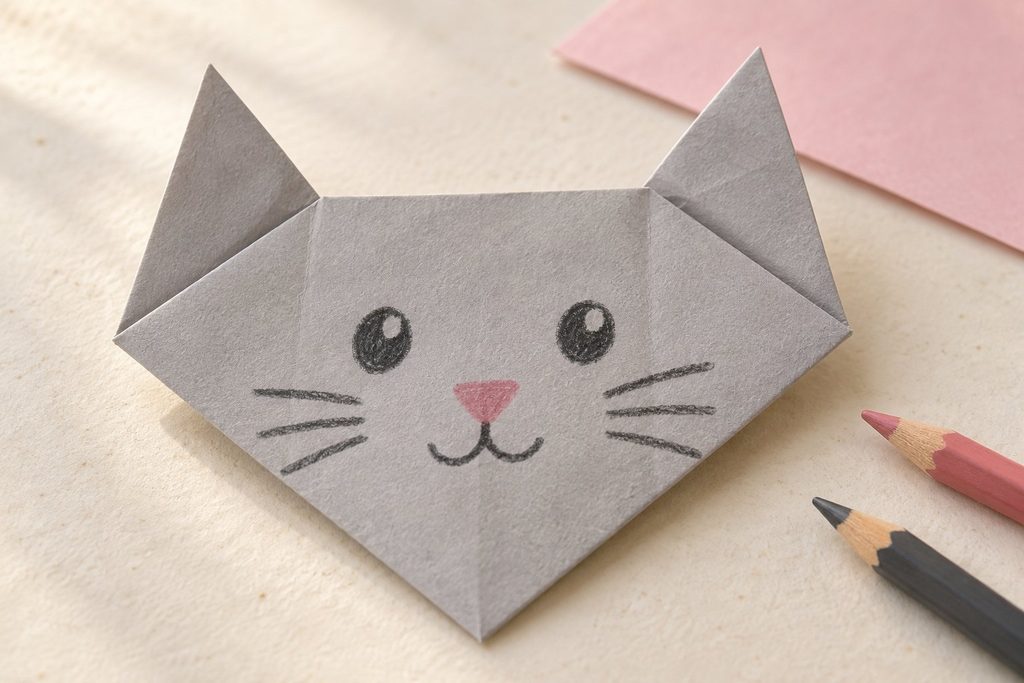
Simple Cat Face gives children a slightly more controlled animal project, with upward corner folds that create pointed ears. It is especially suitable for children who already understand a diagonal fold and want to draw whiskers or facial expressions.
Key specs: 1 square sheet, 6 inches, 3-4 main folds, 5 minutes, paper and drawing tools, low-to-moderate help.
The cat face differs from the dog face through ear direction. That small change makes it useful for teaching spatial language such as up, down, corner, and point. Children can compare two finished faces and decide which features make an animal look like a cat or dog.
Symmetry matters more here. If one corner rises higher than the other, the ears look lopsided, although that is usually acceptable at preschool age. The folds remain exposed rather than locked, so the face is better for display or storytelling than energetic handling.
Choose this if a child enjoys pets and drawing details. Skip it if uneven ears may cause immediate frustration.
3. Easy Origami Fox Face: Best for Storytelling
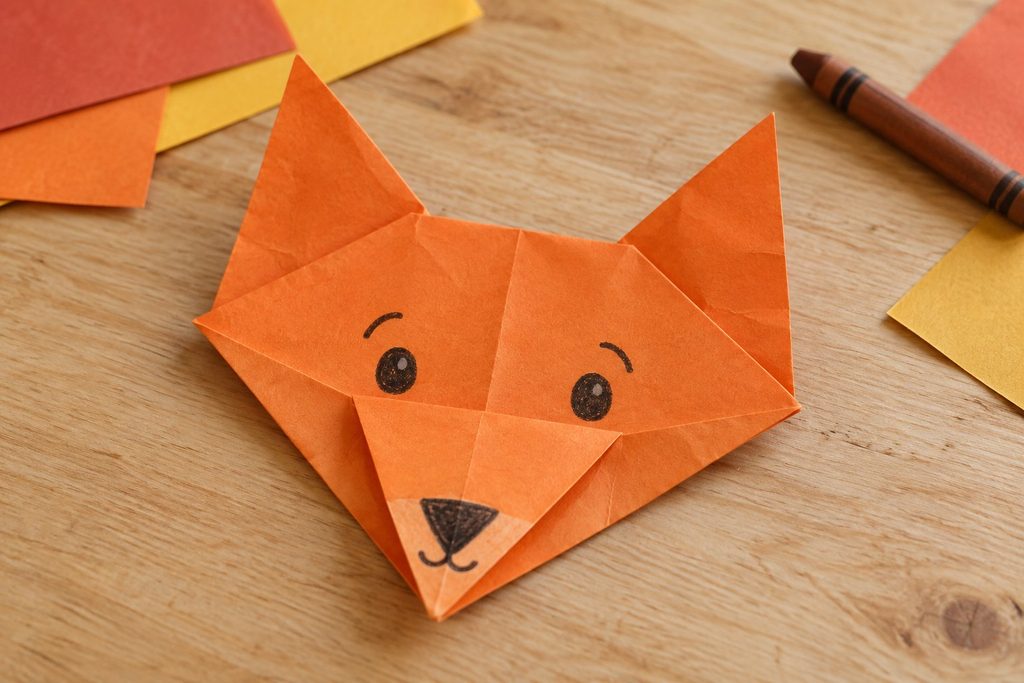
Easy Origami Fox Face adds a forward snout to the cat-style face, giving children a clear character for woodland stories, autumn displays, or animal sorting activities. The extra layer makes it a better challenge for older preschoolers.
Key specs: 1 square sheet, 6 inches, 4-5 folds, 7-10 minutes, paper and crayons, moderate help.
Orange or red paper makes the fox instantly recognizable, but color is not essential. The forward snout introduces a layered fold, so children experience how one flap can change the depth and identity of a model. A teacher can connect the activity to a fox tale, forest vocabulary, or a discussion of animal habitats.
The snout becomes thick when several layers meet. Small fingers may struggle to crease it tightly, and the finished face can open at the center if the fold is shallow. This is not the first project I would hand to a three-year-old.
Choose this if the craft will become a story character. Skip it if the child is still learning how to align corners.
4. Easy Origami Bear Face: Best for Guided Folding
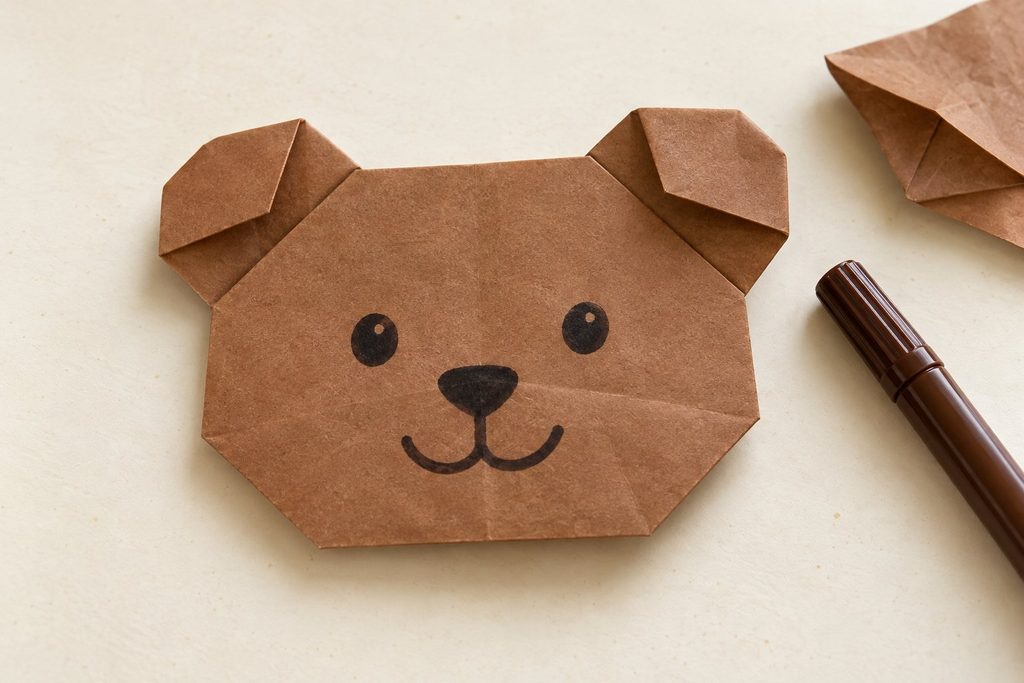
Easy Origami Bear Face is a useful adult-and-child project because its backward ear-tip folds show how a small adjustment can change a character. It fits children who enjoy bears but still need a demonstration for reverse folding.
Key specs: 1 square sheet, 6 inches, 4-5 folds, 8 minutes, paper and markers, moderate-to-high help.
The base resembles the cat and fox, but the ear tips fold backward to soften the points. That difference creates a good comparison lesson: pointed ears suggest a cat, while rounded ears suggest a bear. Brown, black, or white paper supports teddy bear and polar bear themes.
The reverse fold is the problem. Adults often need to hold the model while the child presses the tip, especially with thin paper that bends rather than creases. The result is also fairly flat, so it works better as a mask-like face, card decoration, or story prop than as a toy.
Choose this if an adult can fold alongside the child. Skip it if independent completion is the priority.
5. Simple Origami Fish: Best for Ocean Collages
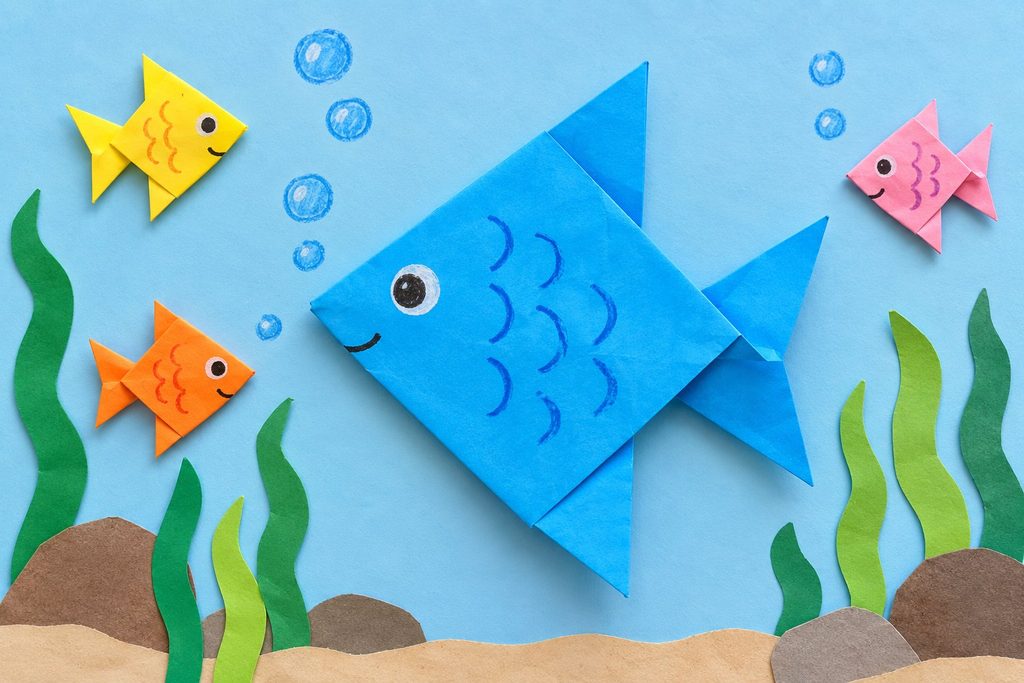
Simple Origami Fish turns a diagonal triangle and overlapping tail folds into a shape that works especially well in group ocean scenes. It offers strong visual payoff without requiring a dense sequence of folds.
Key specs: 1 square sheet, 6 inches, 3-4 folds, 5-7 minutes, paper and glue optional, low help.
Children can make schools of fish in different colors, then add eyes, scales, bubbles, and seaweed to a large paper background. The activity supports counting, color grouping, and conversations about fins and habitats. Because the tail depends on overlapping flaps rather than a secure lock, the adult can add a small glue dot for a classroom display.
That same overlap makes the model less satisfying as a hand-held toy. Some children also find the tail shape abstract until an eye and mouth are added. It is best treated as a collage component, not a standalone origami animal.
Choose this if you need a fast group mural. Skip it if the finished model must survive repeated play.
6. Easy Paper Whale: Best for Advanced Preschoolers
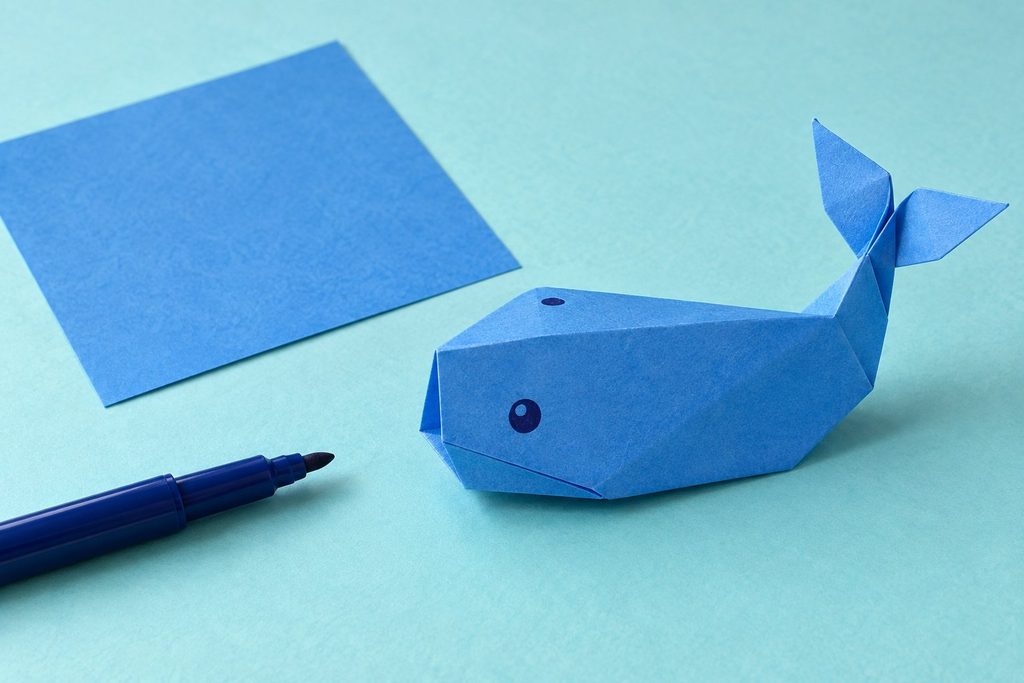
Easy Paper Whale is the most worthwhile step up for four- to five-year-olds because it introduces a center guideline and several directional changes without becoming a full complex model.
Key specs: 1 square sheet, 6 inches, 6-7 folds, 10-15 minutes, paper and marker, moderate help.
The child first creases a diagonal, folds both sides toward that line, lowers the tip, folds the shape in half, and raises the tail. This sequence teaches a useful planning habit: a crease can become a reference line for later folds. Blue paper and a drawn blowhole make the whale more recognizable.
The tail requires a reverse-style fold that many preschoolers cannot complete alone. The model also becomes thick near the body, so lightweight paper works better than cardstock. Its higher learning value is balanced by a slower success curve.
Choose this if a child is ready for center-line folding. Skip it if the activity must finish in five minutes.
7. Simple Origami Butterfly: Best for Symmetry Practice
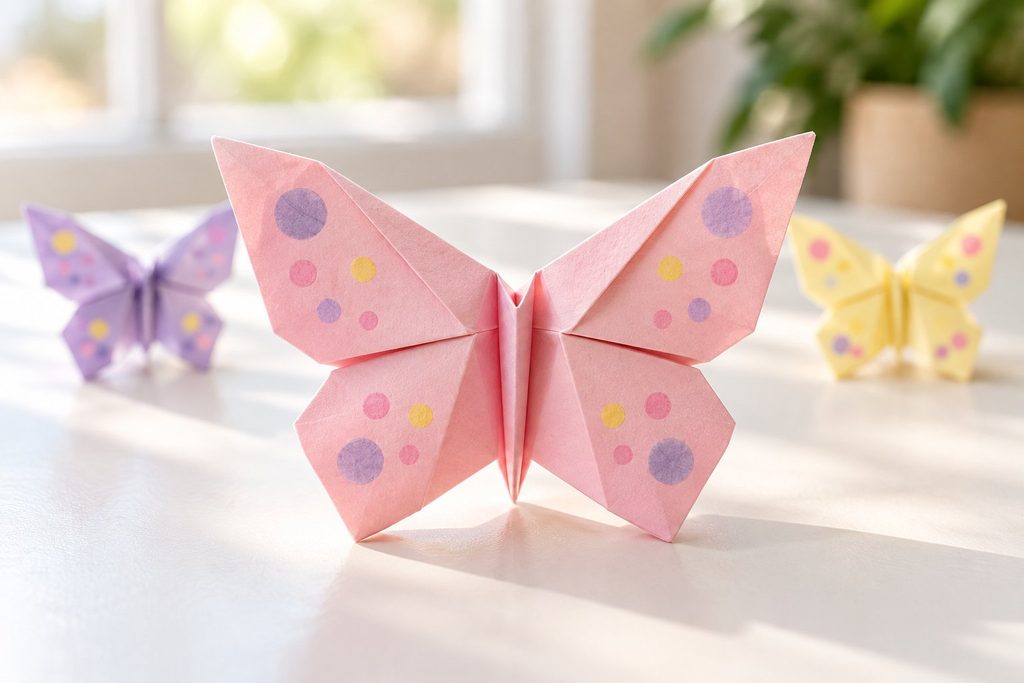
Simple Origami Butterfly is the clearest choice for children learning symmetry because both wings invite comparison, decoration, and pattern-making. It suits spring displays and children who enjoy coloring as much as folding.
Key specs: 1 square sheet, 6 inches, 4-5 folds, 8-10 minutes, thin paper and crayons, moderate help.
The raised corners form the wings, while backward folds spread them outward. A child can draw matching dots on both sides, create a color pattern, or place several butterflies from small to large. The model also supports vocabulary such as left, right, same, and different.
Thin paper is important because multiple wing layers can become bulky. If the folds are not pressed well, the wings spring open or lose their shape. The butterfly is visually appealing but less durable than a bookmark or boat.
Choose this if symmetry and decoration matter. Skip it if your available paper is thick construction stock.
8. The Origami House: Best for Pretend Play
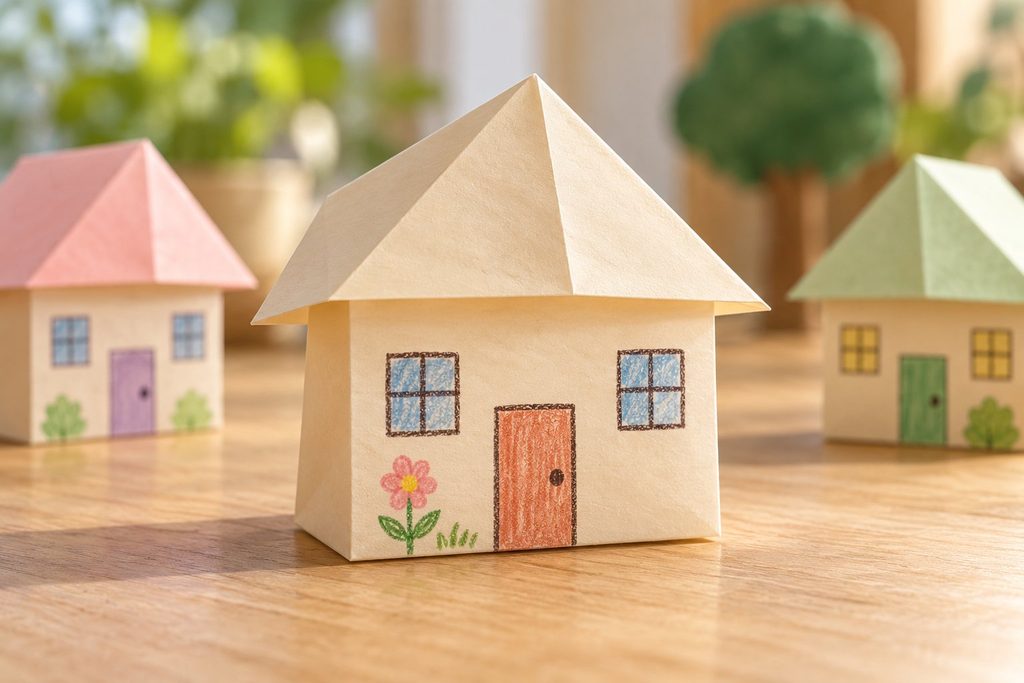
The Origami House earns its high ranking because it stands upright and immediately becomes part of a paper town, doll scene, or retelling of The Three Little Pigs. It offers more sustained play than most flat faces.
Key specs: 1 rectangular sheet, approximately 8.5 by 11 inches, 5-6 folds, 10 minutes, paper and crayons, moderate help.
The rectangular format feels familiar because children fold the sheet in half before bringing the sides inward. The roof uses a squash fold, where a flap opens and presses flat into a triangle. Once built, the house can receive windows, a door, a family name, or a paper garden.
The squash fold is the main obstacle. Adults should demonstrate it slowly rather than expect verbal instructions to work. The roof can also collapse during rough play, although folding heavier printer paper often improves stability.
Choose this if the craft needs to continue into imaginative play. Skip it if a child has not yet mastered opening and flattening a flap.
9. Traditional Paper Boat: Best for Supervised Water Play
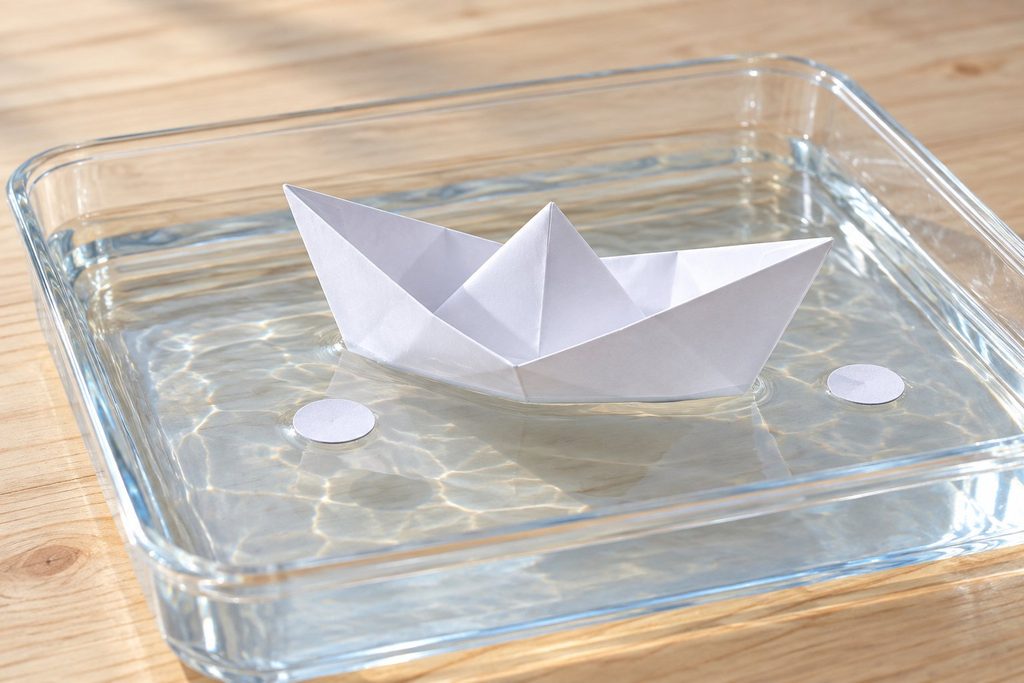
Traditional Paper Boat is the only choice here that can become a short water experiment, making it memorable for children who prefer action to decoration. It is better for a guided small group than independent preschool work.
Key specs: 1 rectangular sheet, 8.5 by 11 inches, 6-7 folds, 10-15 minutes, paper and water tray, high adult help.
The sequence moves from a folded rectangle to a hat-like shape, then to a diamond, and finally to an open boat. That transformation offers useful language about inside, outside, corners, and balance. A shallow basin lets children test whether the boat floats and how much weight it carries.
The diamond-opening stage is difficult to explain and easy to tear. Ordinary paper also softens quickly in water, so the activity has limited duration. Supervision matters because water play can create slips and distractions.
Choose this if you can supervise a short science-and-sensory activity. Skip it if you need a dry, independent craft.
10. Corner Monster Bookmark: Best for Reading Motivation
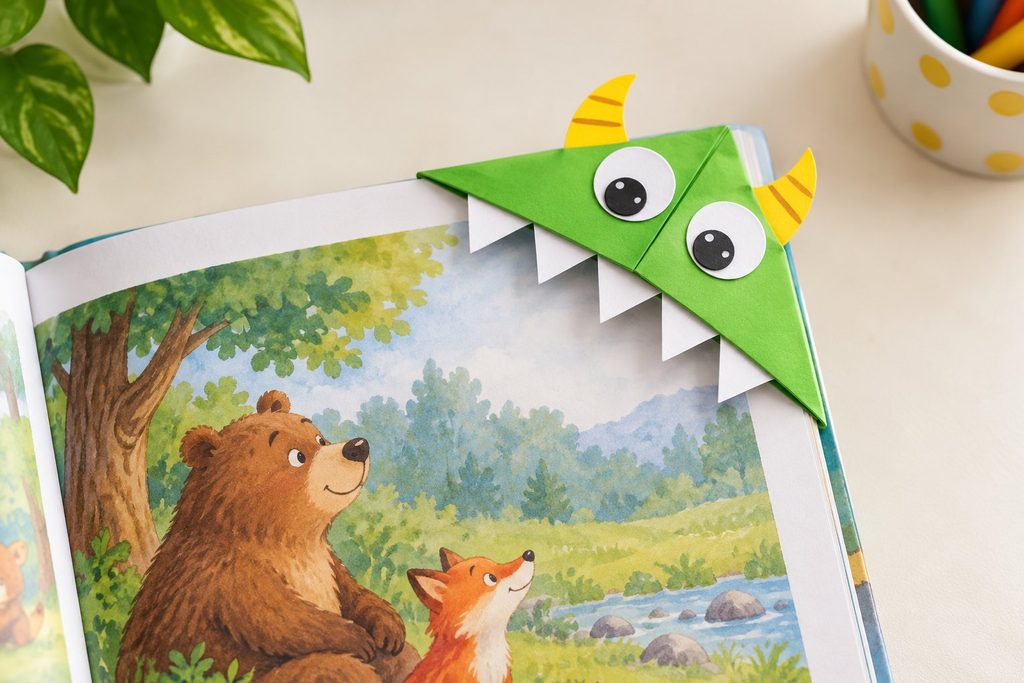
Corner Monster Bookmark is the most useful finished object in the group. The folded pocket slips over a book corner, and teeth, eyes, or horns turn reading equipment into a character.
Key specs: 1 square sheet, 6 inches, 4-5 folds, 8-12 minutes, paper and glue optional, moderate help.
The child folds a triangle, brings the corners upward, opens them, and tucks the flaps into the pocket. That tuck teaches a different skill from simply pressing one corner down. Adding paper teeth creates a clear reason to use the model afterward, especially during story time.
The pocket can fail when folds are not aligned, and children may need several attempts before it stays closed. Glue is optional but can reduce durability if used excessively. The bookmark also depends on access to a book, so it has less appeal during an open-ended art station.
Choose this if you want the craft to lead directly into reading. Skip it if the child dislikes repeated alignment attempts.
11. Accordion Hand Fan: Best for Rhythmic Motor Practice
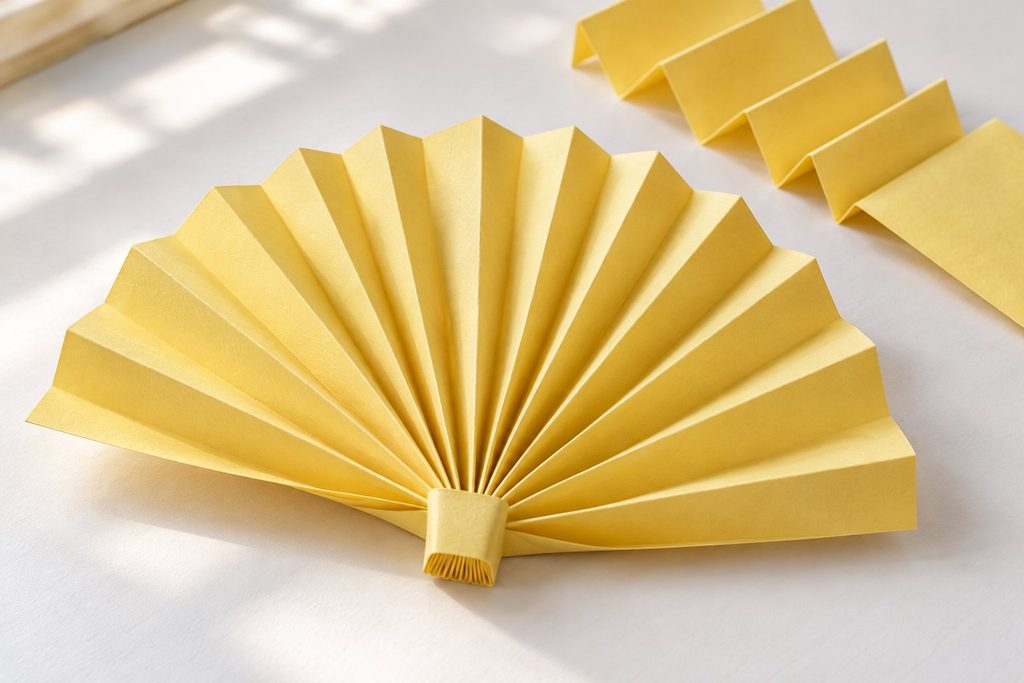
Accordion Hand Fan is not a traditional geometric origami model, but its repeated back-and-forth folds make it one of the best warm-ups for hand control. It works with paper scraps and needs very little explanation.
Key specs: 1 rectangular sheet, 8.5 by 11 inches, 10-20 repeated folds, 5-8 minutes, optional tape or clip, low help.
The child alternates the paper direction, building a steady rhythm: forward, turn, press, repeat. That repetition can help children who find single precise folds intimidating. Adults can vary the strip width to make the task easier, with wider folds requiring less accuracy.
The fan usually needs tape, a clip, or a folded handle to stay open. It also offers less geometric learning than the house, butterfly, or heart. Its value lies in repetition and movement, not in a complex finished form.
Choose this if the goal is hand warm-up or summer play. Skip it if you want a strict origami sequence.
12. Simple Origami Tulip: Best for Cards and Gifts
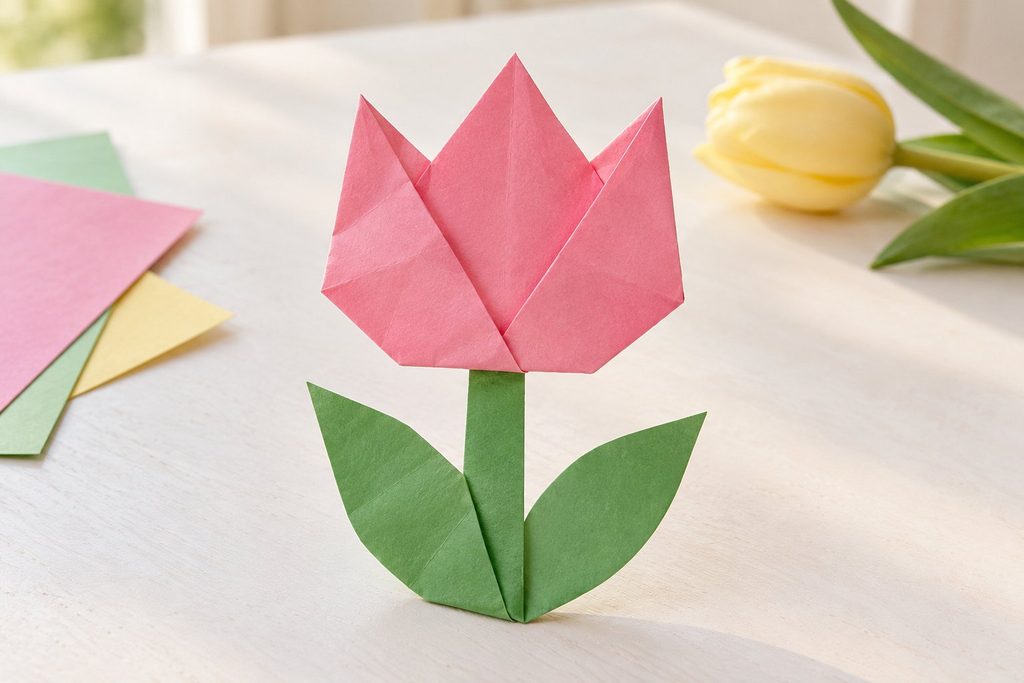
Simple Origami Tulip is a flat, low-frustration project that works well when children want to make something for a parent or display. The angled petals introduce direction without the thick layers found in animal faces.
Key specs: 1 square sheet, 6 inches, 3-4 folds, 5-8 minutes, paper, glue, and optional stem, low-to-moderate help.
The flower head can be attached to a drawn or paper stem, then placed on a card or spring poster. Children can compare colors, count petals, and make a garden from several flowers. The glued presentation also hides small alignment errors better than a freestanding model.
The tulip does not stand independently and usually needs glue to become a finished scene. The flower shape can look more like a kite if the upper corners are folded too narrowly. It is therefore strongest as a decorated craft rather than pure folding practice.
Choose this if the outcome is a card or wall display. Skip it if you need a three-dimensional object.
13. Easy Origami Heart: Best for Guided Gift-Making

Easy Origami Heart gives children a meaningful gift shape, but it is more position-sensitive than the dog, tulip, or fan. It suits a child working beside an adult who can track each reference point.
Key specs: 1 square sheet, 6 inches, 6-8 folds, 10-15 minutes, paper and markers, high help.
The diagonal guidelines establish orientation before the top and bottom points move into place. Later side folds create the heart’s width, while small adjustments soften the upper corners. Children can write a name or message on the finished shape, connecting folding with early mark-making.
The number of positioning steps makes this a poor first project. A misplaced bottom point can create a narrow or uneven heart, and adults may need to pre-crease the guidelines. The emotional value is high, but the independent success rate is lower.
Choose this if a child is making a supervised gift. Skip it if you need a quick classroom rotation.
14. Simple Origami Car: Best for Vehicle Fans
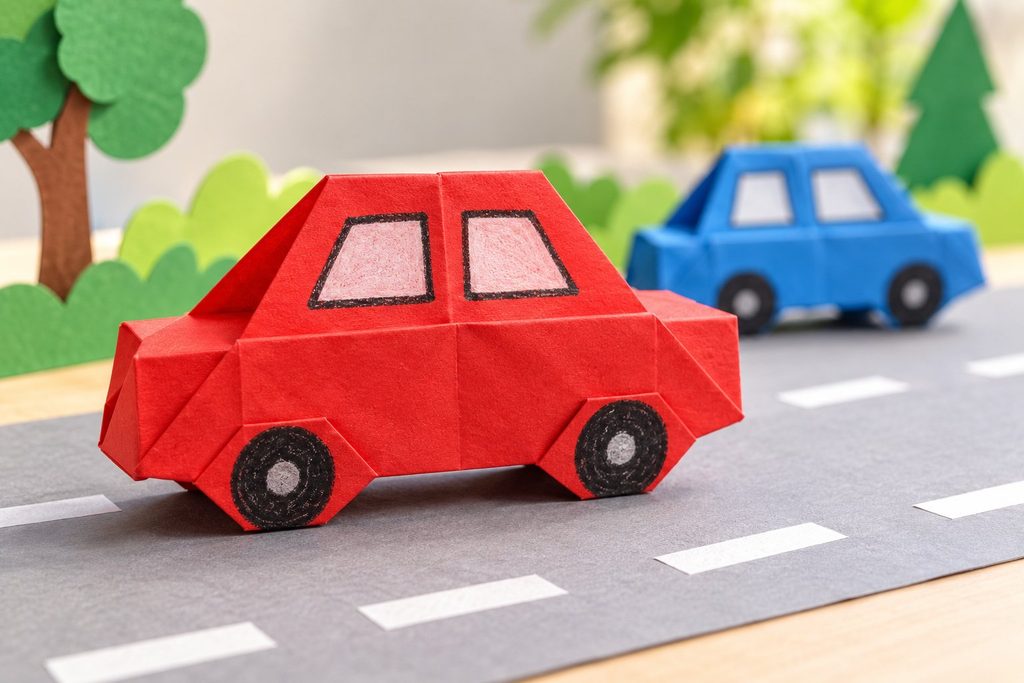
Simple Origami Car connects folding with an object children already understand, which makes abstract instructions easier to follow. It fits vehicle-themed classrooms and pretend roads made from paper or tape.
Key specs: 1 rectangular or square sheet, about 6 by 8 inches, 5-6 folds, 8-10 minutes, paper and markers, moderate help.
The horizontal fold creates the body, while folded roof corners suggest the cabin. Inward lower tips become wheel areas, although drawn or pasted circles make the car much clearer. Children can create a fleet, sort vehicles by color, or place the cars on a map.
The wheels do not roll realistically because they are folded into the body rather than attached as rotating parts. The model can also lose its shape when pushed across a table. Its strength is thematic engagement, not mechanical function.
Choose this if a child already plays with toy cars. Skip it if the child expects a working vehicle.
15. Origami Ice Cream Cone: Best for Color and Layer Practice
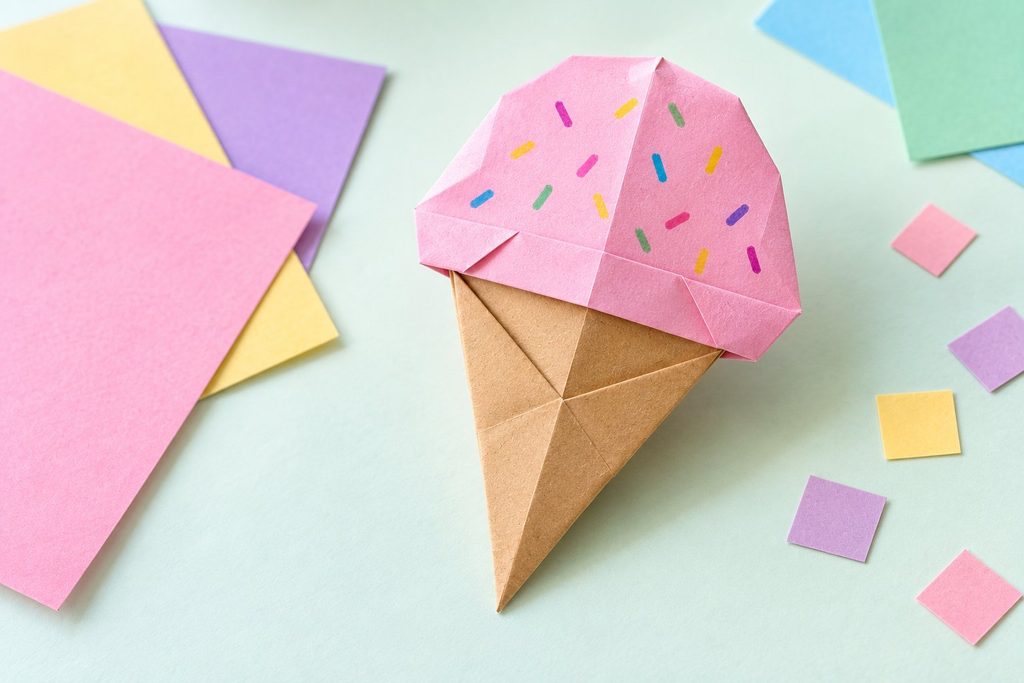
Origami Ice Cream Cone gives children a playful way to explore contrast, flavor colors, and layered folding. It is best placed near the end of a preschool sequence because the cone tip demands controlled pressure.
Key specs: 1 square sheet, 6 inches, 4-6 folds, 8-12 minutes, thin two-sided paper preferred, moderate-to-high help.
The kite-like fold narrows one end into the cone, while the top folds backward and forward to suggest a scoop. Two-sided paper creates a clear difference between cone and ice cream, and children can draw sprinkles or label flavors afterward.
The narrow tip is difficult for small fingers to crease without crushing the layers. A finished cone also tends to remain flat, so it works better on a pretend menu, shop sign, or collage than as a toy. The color lesson is stronger than the three-dimensional result.
Choose this if the activity includes color sorting or pretend shop play. Skip it if the child struggles with tight corner folds.
Materials and Cost Guide
| Material choice | Typical cost | Best use | Limitation |
|---|---|---|---|
| Basic origami paper pack | $3-$8 | Square faces, butterfly, heart | Thin sheets can tear |
| Printer paper | About $0.05-$0.15 per sheet | House, boat, fan, car | Must be cut for square models |
| Construction paper | About $0.05-$0.25 per sheet | Large displays and collage | Often too thick for layered folds |
| Two-sided origami paper | About $5-$10 per pack | Ice cream cone and decorative models | Higher cost per sheet |
| Markers or crayons | About $3-$8 per set | Faces, flowers, vehicles | Ink can soften thin paper |
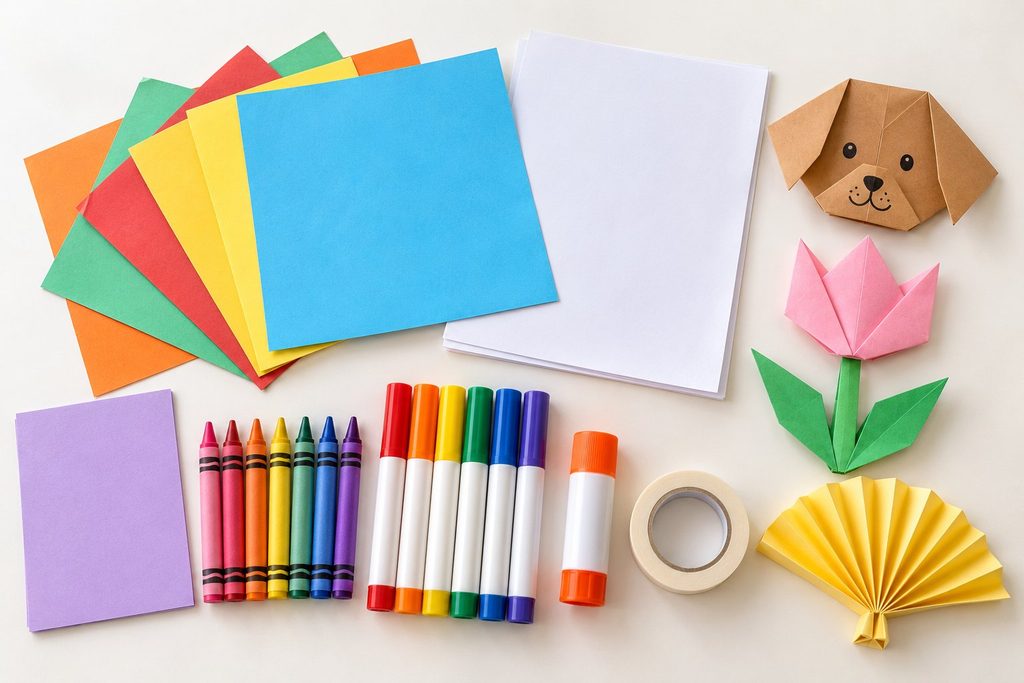
| Glue or tape | About $2-$5 | Fish displays, tulips, fans | Adds cleanup and drying time |
Comparison Table for 15 Origami Ideas for Preschoolers
| Rank | Model | Best for | Main folds | Time | Adult help | Extra supplies | Durability |
|---|---|---|---|---|---|---|---|
| 1 | Simple Dog Face | First success | 3 | 3-5 min | Low | None | Low |
| 2 | Simple Cat Face | Pet lovers | 3-4 | 5 min | Low-moderate | Markers | Low |
| 3 | Easy Fox Face | Storytelling | 4-5 | 7-10 min | Moderate | Markers | Low |
| 4 | Easy Bear Face | Guided folding | 4-5 | 8 min | Moderate-high | Markers | Low |
| 5 | Simple Origami Fish | Ocean collage | 3-4 | 5-7 min | Low | Optional glue | Low-moderate |
| 6 | Easy Paper Whale | Advanced preschoolers | 6-7 | 10-15 min | Moderate | Marker | Moderate |
| 7 | Simple Origami Butterfly | Symmetry | 4-5 | 8-10 min | Moderate | Crayons | Low |
| 8 | Origami House | Pretend play | 5-6 | 10 min | Moderate | Crayons | Moderate |
| 9 | Traditional Paper Boat | Water play | 6-7 | 10-15 min | High | Water tray | Low in water |
| 10 | Corner Monster Bookmark | Reading | 4-5 | 8-12 min | Moderate | Optional glue | High |
| 11 | Accordion Hand Fan | Motor warm-up | 10-20 repeats | 5-8 min | Low | Tape or clip | Moderate |
| 12 | Simple Origami Tulip | Cards | 3-4 | 5-8 min | Low-moderate | Glue | Moderate |
| 13 | Easy Origami Heart | Gift-making | 6-8 | 10-15 min | High | Markers | Moderate |
| 14 | Simple Origami Car | Vehicle play | 5-6 | 8-10 min | Moderate | Markers | Low-moderate |
| 15 | Origami Ice Cream Cone | Color practice | 4-6 | 8-12 min | Moderate-high | Thin paper | Low |
Which Should You Pick for 15 Origami Ideas for Preschoolers?
- A three-year-old trying paper folding for the first time: Choose the Simple Dog Face, then offer the Cat Face if the child wants another animal.
- A child who needs a story activity: Choose the Origami House for a paper setting, or the Easy Fox Face for a character.
- A mixed classroom with limited supplies: Choose the Accordion Hand Fan, Dog Face, or Simple Origami Fish because each uses one sheet.
- A child who loves books: Choose the Corner Monster Bookmark, since the finished model has a clear practical purpose.
- A four- or five-year-old ready for more challenge: Choose the Easy Paper Whale before attempting the Heart or Paper Boat.
- A parent planning sensory play: Choose the Traditional Paper Boat, but keep the water shallow and supervise continuously.
- A child making a gift: Choose the Simple Origami Tulip for an easier result, or the Easy Origami Heart for a guided challenge.
Frequently Asked Questions
What is the easiest origami idea for a preschooler?
The Simple Dog Face is usually the easiest because it uses one square sheet and about three main folds. The result becomes recognizable quickly, and children can add eyes, whiskers, or a name afterward. The folds do not lock firmly, so it is better for display and storytelling than rough play.
What paper is best for preschool origami?
Lightweight origami paper or ordinary printer paper works best for most preschool models. Six-inch squares suit faces, butterflies, hearts, and flowers, while letter-size rectangular paper works better for houses, boats, fans, and cars. Avoid thick cardstock for models with several layers because small fingers cannot crease it easily.
Which models need the most adult help?
The Traditional Paper Boat, Easy Origami Heart, Easy Paper Whale, and Origami Ice Cream Cone need the most guidance. Their difficulty comes from opening pockets, aligning reference points, or pressing thick layers. Adults should sit beside the child and orient both sheets in the same direction.
Can preschoolers use scissors or glue with origami?
They can use glue with supervision, especially for tulips, fish displays, and accordion fans. Scissors are not required for the 15 models listed here, although an adult may cut printer paper into squares before the activity. Keep adhesive away from mouths and use washable supplies where possible.
How can adults prevent origami frustration?
Pre-crease difficult guidelines, demonstrate one fold at a time, and avoid correcting every uneven corner. A child can press a fold with a fingertip while an adult reinforces it. If a model becomes confusing, finish the fold together and let the child decorate the result.
Which origami models last the longest?
The Corner Monster Bookmark usually lasts longest because its pocket structure is reinforced by the book corner during use. The Origami House and Accordion Hand Fan can also survive gentle handling. Paper boats, animal faces, butterflies, and ice cream cones lose their shape faster when children squeeze or carry them repeatedly.
