

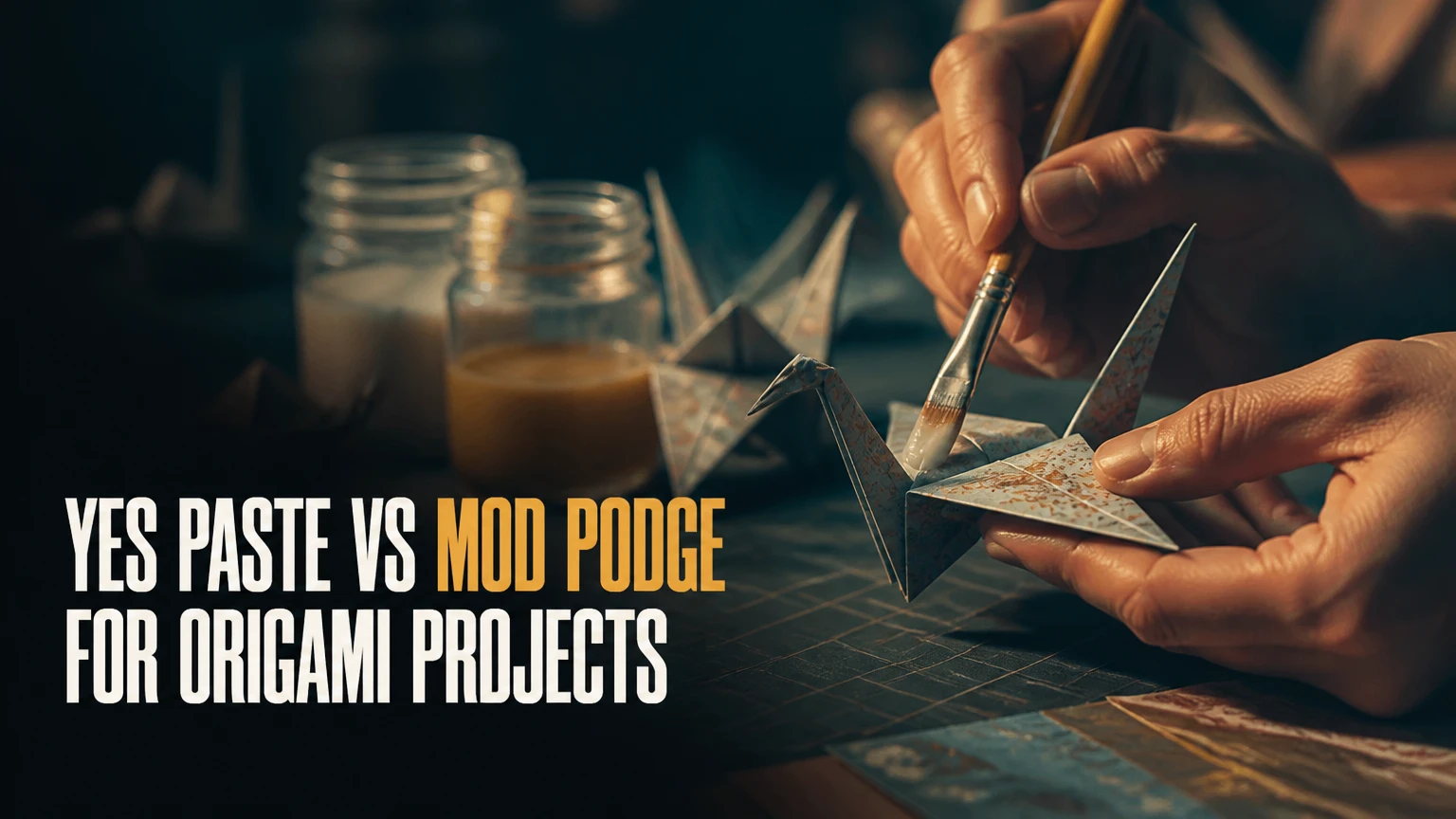
Yes Paste is better for mounting origami paper flat to board, while Mod Podge is better for attaching, sealing, and protecting decorative origami on wood, canvas, or other rigid surfaces. For folded origami that must remain flexible, neither product is automatically ideal: both can stiffen paper, and Mod Podge adds more moisture and wrinkle risk.
Key Facts at a Glance
Yes Paste is a thick, water-based starch or dextrin paste intended primarily for paper mounting and paper-to-board adhesion.
Mod Podge is a liquid, water-based PVA craft medium that functions as glue, sealer, and finish.
Yes Paste usually causes less paper distortion than a liquid adhesive when spread in a very thin layer.
Mod Podge can seal an origami surface, but wet brushing may wrinkle, stain, or tear lightweight paper.
Neither adhesive is a substitute for a specialized folding medium when the finished model must open, flex, or be refolded.
A thin coat, compatible substrate, controlled humidity, and a test sample determine the result more reliably than brand reputation.
What Is the Difference Between Yes Paste and Mod Podge?
Yes Paste and Mod Podge differ mainly in viscosity, moisture behavior, and intended function. Yes Paste is a dense paste for making a structural bond beneath paper, whereas Mod Podge is a liquid medium designed to bond materials and leave a continuous surface film after drying.
Yes Paste is commonly selected for collage, book arts, print mounting, and paper-to-board work. Its thick consistency gives the user time to position a sheet and scrape the adhesive into a thin film. The product is not engineered to become a clear protective varnish over artwork.
Mod Podge is sold in multiple finishes and specialist formulas. Classic Matte, Gloss, and Satin versions attach porous materials while leaving different surface appearances. Plaid, the manufacturer, presents Mod Podge as an all-in-one glue, sealer, and finish, but the exact water resistance, hardness, and surface feel depend on the formula.
Material and Performance Comparison
| Attribute | Yes Paste | Mod Podge |
|---|---|---|
| Product type | Thick starch or dextrin paste | Liquid PVA-based craft medium |
| Main job | Paper mounting and structural bonding | Gluing, sealing, and finishing |
| Typical appearance | Opaque or creamy paste during application | Milky liquid that dries clear in standard formulas |
| Moisture exposure | Low to moderate when spread thinly | Moderate to high because it is liquid |
| Surface topcoat | Not recommended | Designed for topcoat use |
| Final handling | Can leave paper more rigid | Leaves a polymer film that may stiffen paper |
| Cleanup | Water while wet | Soap and water while wet |
| Best substrate pairing | Paper to paper, board, or panel | Paper, fabric, wood, canvas, and some ceramics |
| Reversibility | Water-sensitive bond | Water-sensitive film, especially before full cure |
| Finish choices | Generally no decorative finish system | Matte, Gloss, Satin, Hard Coat, Fabric, and specialty formulas |
The practical distinction is simple: Yes Paste belongs underneath a flat paper element, while Mod Podge can exist underneath and above a decorative element. That difference controls the choice for most origami projects.
How Do the Adhesives Work?
Yes Paste forms a thick adhesive layer that grips porous paper fibers as the water component leaves the paste. Mod Podge deposits PVA-based polymer in and over porous materials, producing a flexible or semi-flexible film after evaporation and curing.
The low-flow behavior of Yes Paste helps prevent a sheet from immediately soaking up a large volume of liquid. That advantage matters when mounting a print, folded motif, or origami composition to a rigid backing. The bond still contains moisture, so “zero moisture” and “zero wrinkling” are inaccurate descriptions.
Mod Podge spreads easily with a foam brush or synthetic brush, but the liquid can penetrate thin washi, tissue, kami, newsprint, and printer paper. Paper fibers swell when wetted and contract as they dry. Uneven application creates uneven shrinkage, which appears as buckling or wrinkles.
A useful practitioner rule is to test the adhesive on the exact paper before beginning the final model. Paper weight, sizing, fiber direction, pigments, coatings, and humidity can change the result more than a general product category.
What Does Drying Change?
Drying removes water; curing describes the longer period during which the adhesive film reaches its intended handling properties. Yes Paste may become usable within hours, while Mod Podge can feel dry to the touch long before its surface reaches maximum hardness.
Typical workshop conditions are 20-24°C and 40-55% relative humidity. At higher humidity, Mod Podge may remain tacky longer, and thick layers may stay cloudy. A sealed container, poor airflow, or a heavily coated object extends the drying period.
| Stage | Yes Paste, typical | Mod Podge Classic, typical | Practical implication |
|---|---|---|---|
| Working time | 5-15 minutes | 3-8 minutes | Yes Paste usually allows more repositioning |
| Dry to touch | 30-90 minutes | 15-30 minutes | Surface dryness does not equal full cure |
| Safe light handling | 1-3 hours | 1-2 hours | Use longer times for thick or humid applications |
| Full cure | About 24 hours | Several days; longer for heavy coats | Avoid stacking or folding coated pieces early |
| Thick-layer risk | Ridges and soft spots | Cloudiness, tackiness, and trapped moisture | Thin application is the controlling variable |
These are typical craft-room ranges, not guaranteed manufacturer specifications. Plaid’s instructions and product labels should control for the particular Mod Podge formula, while the Yes Paste label should control for storage and application conditions.
Which Wins in Yes Paste vs Mod Podge?
Yes Paste wins for flat mounting, low-distortion paper adhesion, and paper-to-board work. Mod Podge wins when the project needs a visible protective coating, a selectable sheen, fabric adhesion, or a durable decorative surface.
| Decision criterion | Yes Paste | Mod Podge | Winner by situation |
|---|---|---|---|
| Flat paper mounting | Very thick, thinly spread | Liquid and more penetrating | Yes Paste |
| Surface sealing | Not suitable as a final coat | Standard function | Mod Podge |
| Lightweight origami paper | Lower wetting risk, still requires testing | Higher wrinkle risk | Yes Paste |
| Decorative finish | Limited | Matte, Gloss, Satin, specialty effects | Mod Podge |
| Repositioning | Longer open time | Shorter open time | Yes Paste |
| Fabric attachment | Not the usual choice | Fabric formula available | Mod Podge |
| Rigid backing board | Strong fit | Works, but may wet the paper | Yes Paste |
| Flexible finished surface | Can become rigid | Formula-dependent polymer film | Mod Podge, with testing |
| Conservation-sensitive work | Better starting point if label claims fit | Standard formulas are not automatically archival | Yes Paste |
| Water exposure | Re-softens more readily | Some formulas resist limited moisture after cure | Mod Podge |
The winner changes with the desired end state. A flat origami collage attached to mat board needs a controlled bond. A paper crane mounted to a decorative plaque and protected from fingerprints needs an adhesive plus topcoat.
Which Adhesive Is Best for Origami?
For folding origami, use the smallest possible amount of adhesive and apply it only where the design requires attachment. Yes Paste is usually easier to control for a flat origami collage, while Mod Podge is more useful after folding when the model will become a sealed decorative object.
Traditional origami normally relies on paper folds rather than adhesive. Glue is appropriate for modular origami locks, quilling-style paper sculpture, mounted display pieces, altered books, and mixed-media compositions. Glue inside a crease can prevent a clean fold and create a hard ridge.
Origami Situation Guide
| Origami situation | Recommended choice | Application amount | Main risk |
|---|---|---|---|
| Modular unit connection | Precision PVA or glue stick | One pinhead per tab | Excess glue at the fold |
| Flat model on mat board | Yes Paste | Very thin scraped film | Uneven ridges beneath paper |
| Crane on a wooden plaque | Mod Podge Matte or Satin | 1 base coat plus 2 thin topcoats | Wrinkling and brush marks |
| Lightweight tissue model | Minimal PVA or methyl cellulose | Test-defined micro-amount | Tearing and cockling |
| Paper sculpture needing stiffness | Mod Podge or acrylic medium | Several thin coats | Loss of fold definition |
| Archival display | Conservation adhesive after testing | Controlled, reversible layer | Product incompatibility |
| Outdoor or wet location | Neither standard product alone | Use a tested exterior system | Moisture failure |
| Reusable folded model | No surface coating | No adhesive on fold lines | Stiffness and cracking |
The counterintuitive point is that the adhesive with less visible wrinkling can still be wrong for a folded model. Yes Paste may preserve a flat sheet well but dry too rigidly for a model that must flex. Flat mounting and folding performance are different engineering requirements.
How to Use Yes Paste for Flat Origami Art
Use Yes Paste by spreading a very thin, uniform layer on the backing board or paper, positioning the origami sheet, burnishing from the center outward, and weighting the assembly for at least one hour. The process is easiest when the board is clean, square, and slightly larger than the artwork.
Step 1: Prepare the Materials
Use a clean backing board, Yes Paste, a palette knife or old plastic card, wax paper or release paper, a brayer, and a flat weight. Let the paper and board acclimate in the same room for several hours, especially when the paper is handmade or highly absorbent.
Step 2: Spread a Thin Film
Scoop a small amount of paste and scrape it until the surface shows a thin, continuous sheen. A practical starting quantity is approximately 1-2 teaspoons for an area near 8 by 10 inches, although absorbency changes the amount.
You will know the layer is ready when no raised ridges remain. The common mistake is applying paste thickly because the product looks too sparse; thick paste creates bumps, slow drying, and edge squeeze-out.
Step 3: Position the Origami
Lower the paper gradually from one edge rather than dropping the full sheet at once. Align the major edges first, then use the open time to correct small shifts without dragging the paper across the paste.
Step 4: Burnish and Weight
Place clean release paper over the origami and work from the center outward with a brayer or bone folder. Leave the piece under a flat weight for 1-2 hours, then allow approximately 24 hours before framing or stacking.
A successful mount has no hollow sounds, lifted corners, or visible paste ridges. Do not sand dried adhesive beneath delicate paper because abrasion can tear the fibers and create a visible depression.
How to Use Mod Podge on Origami
Use Mod Podge in thin coats, allow each coat to dry before adding another, and avoid repeatedly brushing wet paper. A base coat attaches the origami, while one or more topcoats create the protective film that Yes Paste cannot provide.
Step 1: Test the Formula
Apply the chosen formula to a scrap made from the same paper. Test Matte, Gloss, or Satin separately because sheen changes how color, metallic ink, and paper texture appear.
Step 2: Apply the Base Coat
Use a foam brush or soft synthetic brush to spread a thin layer on the substrate. For delicate paper, applying the medium to the board first often reduces direct wetting of the paper, but the edge bond still requires testing.
Step 3: Lay Down the Origami
Place the paper into the wet medium with minimal sliding. Press from the center outward through release paper, using light pressure that removes air without crushing raised folds.
Step 4: Add Topcoats
Wait roughly 15-30 minutes between thin coats under ordinary room conditions. Apply two to four coats for a decorative display piece, changing direction between coats only if the finish instructions allow it.
Mod Podge should appear clear after drying. Milky areas usually indicate excessive thickness, retained moisture, or high humidity. Do not use a hair dryer close to lightweight origami because forced heat can curl paper, disturb pigment, or set a wrinkle permanently.
Can Yes Paste Replace Mod Podge as a Topcoat?
Yes Paste should not replace Mod Podge as a topcoat. Yes Paste is designed to bond paper beneath a project, and a surface application can remain tacky, attract dust, show texture, or soften again with moisture.
Use Yes Paste for the structural layer and a compatible varnish or acrylic medium for protection when the project needs both archival mounting and surface sealing. Test the combination on scraps because a topcoat can introduce gloss, darkening, or edge staining even when the mounting paste performs well.
Mod Podge is the more direct choice when the same product must attach paper and create a finish. The compromise is greater moisture exposure during application and a surface film that changes the paper’s original feel.
Is Yes Paste Archival and Is Mod Podge Waterproof?
Yes Paste is commonly marketed as acid-free and pH-neutral for paper-related applications, but archival suitability depends on the full assembly, including the paper, board, pigments, backing, and storage environment. Standard Mod Podge is water-based and should be described as water-resistant in selected formulas after curing, not waterproof.
The term archival has a narrower meaning than non-toxic or acid-free. A conservation framing project may require documented material testing, reversible attachment, stable backing board, and protection from light and humidity. A product label alone cannot certify the longevity of an entire artwork.
Mod Podge formulas vary. Dishwasher Safe is intended for certain decorative objects and requires the manufacturer’s curing directions, while Hard Coat targets a tougher surface than Classic Matte. Neither label should be generalized to every Mod Podge product.
| Requirement | Yes Paste | Mod Podge Classic | Better practice |
|---|---|---|---|
| Acid-free claim | Commonly listed by sellers or product materials | Not automatically an archival claim | Verify current packaging |
| Limited water exposure | Bond may soften | Cured film resists limited moisture | Keep both away from soaking |
| Long-term artwork | Suitable starting adhesive for paper mounting | Use only after compatibility testing | Consult a conservator for valuable work |
| Surface protection | Not its intended function | Matte, Gloss, or Satin topcoat | Select finish by display requirement |
| Humid room | Softening and mold risk if poorly stored | Possible tackiness and longer cure | Control humidity and airflow |
How Much Do They Cost?
Typical retail prices fall near $12-$15 for a 19-ounce jar of Yes Paste and $6-$9 for an 8-ounce bottle of standard Mod Podge, although retailer, country, promotions, and formula affect the final price.
Price per container does not equal cost per project. Yes Paste contains more material by weight and spreads as a thin mounting film. Mod Podge may require several coats, increasing consumption when a project needs a complete sealed surface.
| Product or formula | Typical size | Typical US retail range | Main cost driver |
|---|---|---|---|
| Yes Paste | 19 oz jar | $12-$15 | Specialty paper-mounting paste |
| Yes Paste | 1 quart tub | $22-$28 | Larger-volume purchase |
| Mod Podge Classic | 8 oz bottle | $6-$9 | Entry-size craft container |
| Mod Podge Classic | 16 oz bottle | $13-$17 | Larger project volume |
| Mod Podge specialty | 8-16 oz | $8-$20 | Formula-specific additives |
| Archival PVA alternative | 8-16 oz | $8-$25 | Conservation or bookbinding grade |
For occasional origami, an 8-ounce Mod Podge bottle may be economical if the project needs a finish. For repeated flat mounting, the larger Yes Paste container can reduce unit cost and waste.
What Are the Best Alternatives?
Methyl cellulose is often a better choice when reversibility and low-strength paper attachment matter, while neutral-pH PVA is useful for precise tabs and bookbinding. Acrylic medium can replace Mod Podge when a stronger or more controllable surface film is required.
| Alternative | Best application | Typical working behavior | Limitation |
|---|---|---|---|
| Neutral-pH PVA | Modular tabs and bookbinding | Precise, strong, fast-setting | Can stiffen folds |
| Methyl cellulose | Delicate paper and reversible work | Long open time, low-strength bond | Weaker than PVA |
| Wheat paste | Conservation-style paper work | Reversible, traditional paste | Preparation and storage demands |
| Acrylic medium | Sealing and mixed media | Clear film, finish options | Can alter paper flexibility |
| Glue stick | Temporary light paper assembly | Clean and low-moisture | Lower durability |
| Spray adhesive | Large flat mounting | Even coverage on broad areas | Overspray and ventilation concerns |
A glue stick is often the least disruptive option for temporary layout, but its long-term bond and aging behavior vary widely. Spray adhesive can produce a flat mount, yet overspray, inhalation concerns, and limited repositioning make it unsuitable for many home workspaces.
Can You Use Both on One Project?
You can use Yes Paste beneath a flat origami composition and Mod Podge above it, provided the paste has dried fully and the paper passes a compatibility test. The two products should not be mixed in the jar or combined wet as an improvised formulation.
A reliable hybrid sequence is: mount the paper with a thin layer of Yes Paste, weight it for at least 24 hours, then brush a very thin Mod Podge coat on a test corner. Look for darkening, tide lines, lifting, tackiness, and loss of fold definition before coating the entire piece.
The hybrid method makes sense for a rigid display panel. It is usually a poor choice for a freestanding folded model because both layers add stiffness and can bridge moving creases.
Common Problems and Fixes
Why Does Mod Podge Wrinkle Thin Paper?
Mod Podge wrinkles thin paper because its liquid water phase temporarily swells paper fibers, while uneven drying creates different amounts of contraction across the sheet. Use a thin base coat, limit brushing, support the paper on a rigid substrate, and let the surface dry without manipulation.
If the wrinkle is minor, leave the piece undisturbed until fully dry. Repeated brushing while wet usually tears fibers or locks the distortion into the film. Severe buckling may require lifting the paper before the medium sets, cleaning the substrate, and restarting with a test-proven method.
Why Does Mod Podge Stay Tacky?
Mod Podge can remain tacky when the coat is too thick, humidity is high, airflow is poor, or the surface is naturally soft and plastic-like. Move the piece to a dry, ventilated room and allow several additional days before deciding that the coating has failed.
Do not add another coat to hide tackiness. Additional liquid can trap the original moisture and extend the problem. If the surface remains sticky after extended drying, remove or abrade the coating only when the substrate can tolerate that treatment.
Why Does Yes Paste Leave Bumps?
Yes Paste leaves bumps when the film is too thick, unevenly scraped, or contaminated with dried fragments from the jar. Strain or remove hardened particles, use a clean card, and burnish through release paper immediately after positioning.
Dried ridges are difficult to correct under delicate origami. Prevention is more effective than repair because sanding can damage the paper and lifting can split the mounted fibers.
Can the Adhesive Be Removed?
Both products are water-sensitive to some degree before complete cure, but removal can damage paper, pigment, sizing, or board. A conservator should handle valuable or historically significant origami rather than soaking the artwork.
For a recent craft project, test removal on an edge or duplicate first. Use controlled moisture, a lifting tool, and patience. Never assume that a removable adhesive will leave the original paper unchanged.
Which Should You Choose?
Choose Yes Paste for Flat Origami Collage
Choose Yes Paste when the origami will be permanently mounted to mat board, chipboard, illustration board, or a wood panel and the priority is a flat paper bond. Spread it thinly, burnish through release paper, and weight the piece.
Skip Yes Paste when the model must remain soft, repeatedly fold, or receive a glossy protective surface. The paste’s strength and thickness do not solve those requirements.
Choose Mod Podge for Decorative Display
Choose Mod Podge when the origami is part of a decoupage project, needs a matte or gloss finish, or must attach to wood, canvas, fabric, or another porous craft substrate. Select the formula by the material and final exposure rather than by color alone.
Skip standard Mod Podge for extremely thin paper unless a scrap test confirms acceptable wrinkling and color behavior. Use multiple thin coats, not one heavy coat.
Choose a Specialized Adhesive for Fine Folding
Choose neutral-pH PVA, methyl cellulose, or wheat paste when the model is delicate, valuable, reversible, or dependent on precise crease movement. The best adhesive for origami is often the one that performs a tiny task without coating the entire model.
Skip both Yes Paste and Mod Podge when the project will live outdoors, face repeated washing, or require guaranteed conservation performance without documented testing. Standard craft adhesives cannot provide those guarantees.
Frequently Asked Questions
Can You Use Mod Podge on Origami Paper?
You can use Mod Podge on origami paper, but thin sheets require a test because the liquid medium can cause wrinkles, pigment bleed, darkening, or edge curl. Apply the medium sparingly, avoid wet brushing, and use Mod Podge mainly for mounted or decorative models rather than models that must keep folding.
Is Yes Paste Good for Cardstock?
Yes Paste is well suited to cardstock mounted on board or bonded to another paper surface because its thick consistency gives good control and reduces rapid soaking. It may be excessive for tiny tabs or temporary layouts, where a neutral-pH PVA or glue stick can provide cleaner placement.
Does Mod Podge Make Paper Rigid?
Mod Podge can make paper rigid because dried PVA and acrylic components leave a film across the surface and inside porous fibers. Multiple coats increase stiffness. That effect benefits decorative plaques and paper sculpture but can prevent clean movement in an origami model.
Can Yes Paste Be Used on Wood?
Yes Paste can adhere paper to a smooth, prepared wood surface, but the wood should be clean, dry, sealed when appropriate, and free from active oil or dust. Mod Podge is usually more convenient for wood decoupage because it is formulated to glue, seal, and finish the substrate.
How Long Should Mod Podge Cure Before Handling?
Allow Mod Podge to dry to the touch for at least 15-30 minutes between thin coats and wait at least 24 hours before ordinary handling. Heavy applications, enclosed surfaces, cool temperatures, and high humidity can extend curing to several days or longer.
Can You Fold Paper After Applying Mod Podge?
You can make limited folds after applying Mod Podge, but the coating may crack, crease white, or resist movement as it hardens. Fold the paper before coating whenever possible, and keep adhesive away from hinges, valley folds, and mountain folds that must remain mobile.
The Bottom Line
Yes Paste vs Mod Podge is primarily a choice between controlled paper mounting and all-in-one surface finishing. Choose Yes Paste for flat, low-distortion origami artwork on board; choose Mod Podge for decorative attachment and protective topcoats; choose a specialized paper adhesive when the origami must remain flexible, reversible, or conservation-sensitive.
