


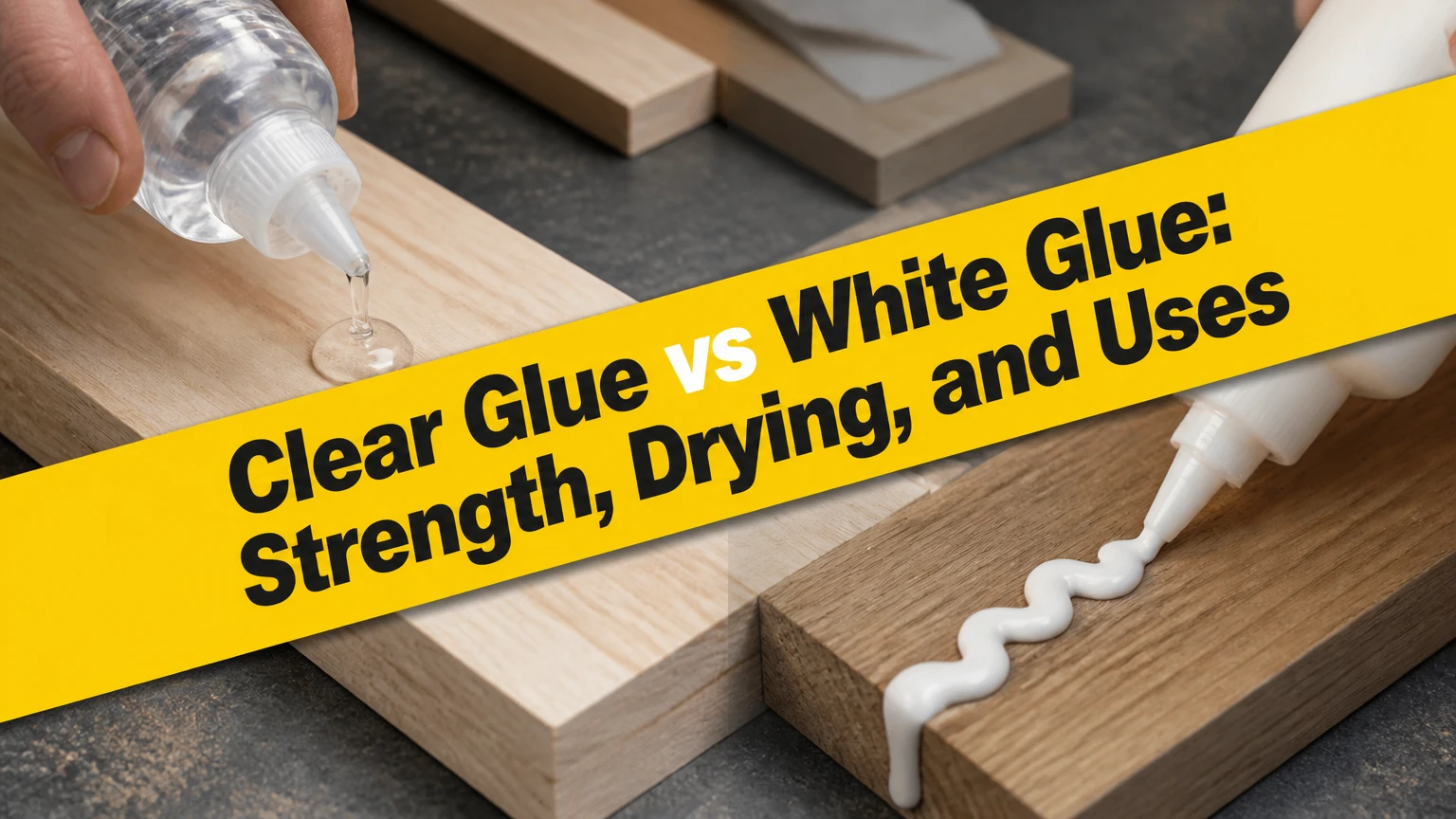
Clear glue is usually a transparent-drying, water-based craft adhesive, while white glue is usually an opaque-drying polyvinyl acetate, or PVA, emulsion. Clear glue is preferable when appearance, flexibility, slime, or light crafts matter; white glue is usually better for paper, cardboard, and wood because its higher-solids formulations create a more substantial bond.
Key Facts at a Glance
- Clear glue dries transparent only when the product is designed to form a clear film and the applied layer is thin enough for moisture to escape.
- White school glue and professional woodworking PVA are different products, even though both may appear white in the bottle.
- White glue generally provides better paper and wood bonding than low-solids clear school glue.
- Neither ordinary clear school glue nor ordinary white school glue should be treated as waterproof without a manufacturer’s waterproof rating.
- Thin application reduces paper wrinkling, clear-glue cloudiness, shrinkage, and excessive drying time.
- For origami, a glue stick, methylcellulose, or a very thin layer of PVA can outperform either thick liquid adhesive.
What Is the Difference Between Clear Glue and White Glue?
Clear glue is formulated to dry with a transparent film, whereas white glue is formulated as a white or milky PVA emulsion that usually remains translucent or opaque after drying. The visible difference comes from the adhesive formulation, solids, additives, particle structure, and thickness of the cured film, not simply from the bottle color.
Most clear school glues are water-based polymer dispersions intended for paper crafts, slime, glitter, and lightweight assembly. Many white school glues also use PVA, but professional white or yellow wood glues contain more resin and additives designed for stronger timber joints. Product labels therefore matter more than color.
A clear construction adhesive, UV resin, cyanoacrylate, or silicone sealant may also dry clear, but those adhesives do not behave like clear school glue. “Clear” describes appearance, not a universal chemical family.
How Do Clear and White Glue Cure?
Clear and white school glues cure mainly as water leaves the adhesive through evaporation and absorption into porous materials. As the water content falls, polymer particles or dissolved polymers form a continuous film that holds the joined surfaces together.
Paper, cardboard, unfinished wood, and fabric absorb water readily, so they often allow faster initial setting than glass or plastic. Nonporous surfaces retain moisture at the bond line, which can leave either adhesive soft for hours.
Clear Glue Curing Mechanism
Clear glue commonly contains a low-to-moderate concentration of polymer, water, plasticizers, preservatives, and optical or formulation additives. The film becomes transparent when the polymer has coalesced and the remaining moisture has escaped.
A thick puddle can stay cloudy because its center dries slowly. Heating the surface aggressively is a poor fix because heat can wrinkle paper, deform plastic, or create bubbles while the interior remains wet.
White Glue Curing Mechanism
White school glue forms a polymer film as its PVA particles coalesce after water evaporation and substrate absorption. Woodworking PVA contains a more concentrated adhesive system and may include cross-linking chemistry that improves moisture resistance and joint performance.
White appearance does not mean that the cured joint is always weak. The bottle’s solids content, resin type, open time, substrate fit, and clamp pressure determine performance.
Clear Glue vs White Glue: Master Comparison
| Criterion | Clear school glue | White school glue | Woodworking PVA |
|---|---|---|---|
| Typical appearance when wet | Transparent or translucent | White or milky | White, cream, or yellow |
| Typical cured appearance | Clear in thin films | Translucent to opaque | Usually translucent, white, or yellow |
| Typical retail cost | $0.40-$1.20 per fluid ounce | $0.20-$0.70 per fluid ounce | $0.30-$1.00 per fluid ounce |
| Surface-dry time on paper | 10-30 minutes | 10-30 minutes | 15-45 minutes |
| Typical handling time | 30-90 minutes | 30-90 minutes | 30-120 minutes |
| Typical full-cure window | 24-48 hours | 24-48 hours | 24 hours, sometimes longer |
| Best common substrates | Paper, glitter, craft foam | Paper, cardboard, fabric | Wood, plywood, porous joinery |
| Moisture resistance | Usually low | Usually low | Product-specific, often Type II or Type III |
These ranges are typical retail and workshop values, not universal specifications. Elmer’s School Glue, Elmer’s Clear Glue, Mod Podge, Titebond Original, and Titebond III illustrate why product labels should be compared individually.
Which Glue Forms the Stronger Bond?
White glue usually forms the stronger bond than low-solids clear school glue on porous paper, cardboard, and wood. The advantage comes from resin concentration and product design, not from white color alone. A high-quality clear construction adhesive can outperform ordinary white school glue, so the exact formulation remains decisive.
Typical clear school glue may contain roughly 15%-30% nonvolatile material, while many white craft or woodworking adhesives contain more. Exact solids figures vary by manufacturer and are often not printed on consumer labels. PSI figures from generic comparisons should not be applied to every bottle.
For wood joints, a fitted woodworking PVA is normally the correct choice. Clear school glue is not a substitute for a wood adhesive in chairs, shelves, structural frames, or load-bearing repairs.
| Project condition | Clear school glue result | White school glue result | Recommended decision |
|---|---|---|---|
| Bonding printer paper | Adequate, with low visibility | Adequate, visible until dry | Clear for appearance, white for economy |
| Laminating cardboard | Moderate bond, more shrinkage | Moderate bond, better body | White glue for broad surfaces |
| Joining unfinished wood | Weak to moderate | Moderate | Use woodworking PVA |
| Attaching glitter | Transparent carrier | Visible residue risk | Clear glue |
| Making slime | Common base | Usually unsuitable for clear results | Clear slime-rated glue |
| Repairing a book hinge | Flexible in thin film | Can become stiff | Neutral PVA or bookbinding adhesive |
| Joining metal to plastic | Usually unreliable | Usually unreliable | Use a substrate-specific adhesive |
Winner: White glue wins for ordinary porous-material strength, while clear glue wins when an invisible bond matters more than load capacity.
Which Glue Dries Faster?
Clear glue and white glue often have similar surface-drying times, typically 10-30 minutes on absorbent paper, despite common claims that clear glue always dries faster. Thin layers, airflow, humidity, temperature, and substrate porosity matter more than color.
A bond may feel dry while still holding substantial water. Handling strength commonly develops within 30-90 minutes, but full cure often takes 24-48 hours for school adhesives. Woodworking PVA may become clamp-free sooner, yet a joint should not receive heavy stress immediately.
| Condition | Clear glue, typical | White glue, typical | Practical effect |
|---|---|---|---|
| Thin layer on paper | 10-20 minutes | 10-20 minutes | Fastest setting |
| Thick layer on cardboard | 30-120 minutes | 30-90 minutes | Moisture remains trapped |
| Bond on glass | 1-4 hours | 1-4 hours | Low absorption slows drying |
| Light handling | 30-60 minutes | 30-60 minutes | Avoid peeling or flexing |
| Full cure | 24-48 hours | 24-48 hours | Maximum practical strength |
| Wood joint under clamp | 30-60 minutes | 30-60 minutes | Follow product instructions |
A fan can improve evaporation around the assembly, but it cannot remove moisture efficiently from a sealed, thick bond line. The most reliable speed improvement is a thinner adhesive layer.
Winner: Neither adhesive has a universal speed advantage. Clear glue may feel faster in some craft formulas, but application thickness controls the result.
What Finish Does Each Glue Leave?
Clear glue leaves the least visible residue when it cures in a thin layer, but “clear” does not guarantee glass-like transparency. Some formulas dry slightly hazy, glossy, or yellowish, especially over dark colors or after ultraviolet exposure.
White glue usually dries translucent or opaque, making squeeze-out more visible on dark paper, photographs, and finished wood. On unfinished wood, dried PVA can block stain penetration and create pale patches around the joint.
| Finish requirement | Clear glue | White glue | Better choice |
|---|---|---|---|
| Invisible paper overlap | Usually clear | Often visible | Clear glue |
| Matte archival artwork | May dry glossy | May dry matte or cloudy | Archival medium |
| Glitter suspension | Preserves color | Can mute color | Clear glue |
| Clear plastic assembly | May haze or craze plastic | Often visibly cloudy | Plastic-specific adhesive |
| Staining wood afterward | Poor unless removed | Poor unless removed | Mask and remove squeeze-out |
| Thick decorative coating | Shrinkage and clouding risk | Whitening and cracking risk | Decoupage or resin medium |
The practitioner rule is simple: test a drop on the actual material, allow it to cure for 24 hours, and inspect it under the intended lighting.
Which Glue Is Better for Paper and Origami?
For origami, neither liquid adhesive should be the default for broad folds because water can wrinkle thin paper and change crease geometry. A glue stick, methylcellulose, wheat paste, or archival bookbinding adhesive is often easier to control, while clear or white PVA works best for small tabs and precise repairs.
Use clear glue when the bond must disappear on colored or patterned paper. Use white glue when paper color is light and a stronger, more economical bond is useful. Apply with a fine-tip nozzle, toothpick, or needle tool rather than pouring directly from the bottle.
| Origami or paper task | Suitable adhesive | Application amount | Main risk |
|---|---|---|---|
| Temporary positioning | Removable glue stick | 1-2 mm dot | Residue after repositioning |
| Thin paper tabs | Clear PVA | 0.5-1 mm dot | Wrinkling |
| Heavy cardstock tabs | White PVA | 1-2 mm dot | Visible squeeze-out |
| Bookbinding hinge | Methylcellulose or neutral PVA | 0.1-0.3 mm film | Excess stiffness |
| Metallic paper | Clear PVA, tested first | Tiny spot | Staining or dulling |
| Large paper lamination | Glue stick or spray adhesive | Even film | Bubbles and curl |
For a paper model, place adhesive on the tab, wait 5-15 seconds for excess water to settle, then align the parts. Hold the joint for 20-40 seconds and keep the model supported until the adhesive has set.
Winner: A controlled clear PVA dot is better for visible origami tabs, but methylcellulose or glue stick is better for broad paper surfaces.
Which Glue Is Better for Wood?
Woodworking PVA is better for wood than clear school glue or white school glue. A proper wood adhesive has higher solids, better wetting, suitable open time, and performance data intended for wood joints.
White school glue can hold lightweight wood craft pieces, but it is not the right choice for furniture, structural boxes, cutting boards, or joints exposed to repeated stress. Clear school glue can shrink substantially and may leave a soft or weak bond line.
Wood Bonding Rules
- Fit the joint before applying glue. Adhesive is not a substitute for accurate contact.
- Spread a thin, continuous film across both mating surfaces.
- Assemble within the product’s open time, commonly 5-10 minutes.
- Clamp firmly without crushing soft wood or starving the joint.
- Remove squeeze-out while wet or pare it away before finishing.
- Allow at least 24 hours before heavy loading.
Titebond Original is an interior woodworking PVA, while Titebond III provides greater water resistance for suitable applications. The ANSI/HPVA Type I and Type II classifications concern water resistance for wood adhesives, not ordinary school glue. Always verify the product label.
Winner: Use white or yellow woodworking PVA for wood. Ordinary clear glue belongs in lightweight craft work, not structural joinery.
How Does Material Compatibility Change the Choice?
Clear and white PVA adhesives perform best on porous, absorbent materials such as paper, cardboard, unfinished wood, and some fabrics. Both types often perform poorly on polyethylene, polypropylene, silicone, oily surfaces, and smooth low-energy plastics because the cured film cannot form a reliable mechanical or chemical grip.
| Material | Clear glue | White glue | Better approach |
|---|---|---|---|
| Printer paper | Good for small areas | Good for broad areas | Choose by visibility |
| Cardboard | Good, but can warp | Good, with stronger body | White PVA |
| Unfinished wood | Craft-level only | Craft-level to strong | Woodworking PVA |
| Cotton fabric | Flexible in thin layers | Can stiffen fabric | Fabric adhesive or clear PVA |
| Glass | Weak without special formulation | Weak without special formulation | Glass adhesive |
| ABS or acrylic plastic | Unreliable | Unreliable | Plastic cement or epoxy |
| Metal | Poor | Poor | Epoxy or cyanoacrylate |
| Foam board | Often compatible | Often compatible | Test for surface damage |
| Sealed or painted wood | Moderate at best | Moderate at best | Sand and test first |
“Clear” should never be interpreted as “safe for every transparent surface.” Some solvent-based clear adhesives can damage acrylic, polycarbonate, vinyl, or polystyrene even when the cured bead looks attractive.
How Should You Apply Clear or White Glue?
Apply either adhesive to clean, dry surfaces in the thinnest continuous layer that covers the joint. Align the pieces immediately, apply even pressure, remove squeeze-out while wet, and keep the assembly immobile until the initial set has passed.
Step 1: Prepare the Surfaces
Remove dust, grease, loose fibers, and old adhesive. Lightly sand glossy wood or rigid surfaces with approximately 180-220 grit abrasive, then remove sanding dust.
Success checkpoint: The surfaces feel clean and make full contact without rocking.
Common mistake: Applying glue over oil, wax, or a glossy coating.
Step 2: Test the Adhesive
Place a small amount on scrap material and let it cure for 24 hours. Check transparency, flexibility, staining, paper curl, and adhesion.
Success checkpoint: The cured test spot matches the intended finish.
Common mistake: Testing only whether the wet glue looks clear.
Step 3: Spread a Thin Layer
For paper, use approximately 0.1-0.3 milliliters per 100 square centimeters. For wood craft joints, apply a continuous film without puddles. A brush, card edge, fine nozzle, or toothpick provides better control than the bottle opening.
Success checkpoint: The surface has wet coverage without ridges or pools.
Common mistake: Adding more glue to compensate for a poorly fitting joint.
Step 4: Join and Align
Bring the parts together while the adhesive remains wet. Slide them slightly to distribute the film, then stop moving once alignment is correct.
Success checkpoint: A small, even bead of squeeze-out appears around a wood joint.
Common mistake: Allowing the glue to skin over before assembly.
Step 5: Hold, Clamp, or Weight
Use hand pressure for 20-60 seconds on small paper tabs. Use clips, clamps, or a flat weight for larger assemblies, typically for 30-60 minutes unless the label specifies otherwise.
Success checkpoint: The parts do not shift when released gently.
Common mistake: Applying excessive clamp pressure that squeezes nearly all adhesive from the joint.
Step 6: Clean and Cure
Wipe wet squeeze-out with a damp cloth, taking care not to spread diluted glue into surrounding paper fibers. Leave the assembly undisturbed for 24 hours before testing full strength.
Success checkpoint: The joint remains aligned and the exposed adhesive has formed a continuous film.
Common mistake: Flexing the piece because the surface feels dry.
How Much Do Clear and White Glue Cost?
Clear school glue typically costs about $0.40-$1.20 per fluid ounce, while white school glue commonly costs $0.20-$0.70 per fluid ounce. Woodworking PVA usually costs $0.30-$1.00 per fluid ounce, with larger bottles lowering the unit price.
Price alone does not identify value. A low-solids clear glue may require more product per bond and shrink more during drying, while a concentrated woodworking PVA may cost more but create a stronger joint with less adhesive.
| Package type | Clear school glue | White school glue | Woodworking PVA |
|---|---|---|---|
| 4-oz bottle | $2-$5 | $1-$3 | $3-$6 |
| 8-oz bottle | $4-$9 | $2-$5 | $5-$10 |
| 16-oz bottle | $7-$16 | $4-$9 | $8-$18 |
| 32-oz bottle | $12-$30 | $7-$18 | $15-$35 |
| Bulk classroom gallon | $25-$55 | $18-$40 | Not typical |
| Specialty clear adhesive, 1 oz | $3-$10 | Not typical | Not typical |
These are typical United States retail ranges and vary by retailer, brand, season, and formulation. Specialty clear adhesives can cost several times more than school glue.
When Should You Choose Clear Glue?
Choose clear glue for lightweight craft projects where a transparent or flexible film has more value than maximum strength. Clear school glue is particularly useful for glitter, slime, decorative paper, sequins, small model details, and visible joints on colored surfaces.
Clear glue is also useful when white residue would be visually distracting. Its limitations matter: thick applications shrink, slow-drying puddles become cloudy, and many formulas provide little moisture resistance.
Best Clear-Glue Uses
- Small paper-model tabs on dark or patterned stock.
- Glitter adhesion where white residue would dull the surface.
- Slime recipes that specify clear PVA.
- Lightweight fabric decoration where stiffness must remain limited.
- Transparent decorative craft layers, after a 24-hour test.
- Temporary-looking visual repairs where the joint carries little load.
Do not select ordinary clear school glue for furniture, outdoor repairs, high-temperature assemblies, or bonds that must resist repeated peeling.
When Should You Choose White Glue?
Choose white glue for economical bonding of paper, cardboard, porous craft materials, and light wood projects when a translucent or opaque glue line is acceptable. Choose a labeled woodworking PVA instead of school glue when the joint must withstand sustained mechanical stress.
White glue has another practical advantage: its wet coverage is easy to see. That visibility helps beginners identify missed areas, although it also makes squeeze-out more noticeable on finished work.
Best White-Glue Uses
- Cardboard construction and paperboard laminating.
- School projects on light-colored materials.
- Collage and general craft assembly.
- Lightweight wood shapes and unfinished timber crafts.
- Fabric stiffening where increased body is acceptable.
- Wood joinery using a dedicated woodworking formula.
White glue is not automatically waterproof, archival, flexible, or suitable for every fabric. Those properties require a product-specific claim.
What Problems Occur During Drying?
The most common problems are paper wrinkling, cloudy clear glue, weak joints, visible white residue, and yellowing. Each problem usually results from excessive water, an unsuitable substrate, movement during setting, or a mismatch between adhesive and project demands.
| Problem | Likely cause | Immediate fix | Prevention |
|---|---|---|---|
| Wrinkled paper | Excess water or thick film | Flatten under weight after partial drying | Use 0.1-0.3 ml per 100 cm² |
| Cloudy clear glue | Thick trapped moisture | Allow 24-48 hours; avoid high heat | Spread a thinner layer |
| Joint opens | Movement or poor contact | Reclean and rebond | Clamp or hold 30-60 minutes |
| White halo | Squeeze-out spread into fibers | Remove while wet; trim when dry | Use a fine applicator |
| Yellowing | UV exposure, aging, additives | Replace visible adhesive if possible | Use tested archival or UV-rated product |
| Brittle film | Thick dried PVA or low flexibility | Rework the joint | Select flexible adhesive |
| Mold in slime | Contamination and moisture | Discard contaminated material | Use clean tools and sealed storage |
A hairdryer is not a universal remedy for cloudy clear glue. Gentle, moving airflow may shorten surface drying, but concentrated heat can warp paper and soften plastic.
Is Clear or White Glue Waterproof?
Ordinary clear school glue and ordinary white school glue are generally not waterproof. Water-resistant woodworking PVA can perform better, but the label must specify the resistance level and intended exposure.
Short contact with a damp cloth is different from immersion, condensation, rain, or repeated wet-dry cycles. PVA bonds can soften when moisture penetrates the cured film, particularly at edges and on poorly prepared surfaces.
| Exposure | School clear glue | School white glue | Rated woodworking PVA |
|---|---|---|---|
| Dry indoor room | Suitable | Suitable | Suitable |
| Occasional damp wipe | Limited | Limited | Usually better |
| Bathroom humidity | Unreliable | Unreliable | Product-specific |
| Outdoor rain | Unsuitable | Unsuitable | Use rated product |
| Continuous immersion | Unsuitable | Unsuitable | Use marine or epoxy system |
| High heat above 60°C | Performance declines | Performance declines | Check technical data |
For outdoor, structural, submerged, or high-temperature work, compare an epoxy, polyurethane, construction adhesive, marine adhesive, or specialty plastic adhesive instead of choosing solely by clear or white color.
When Should You Choose Another Adhesive?
Choose another adhesive when the substrates are nonporous, the joint is load-bearing, the assembly faces water or heat, or the finished piece requires archival performance. Clear and white PVA are convenient, but their convenience does not overcome substrate incompatibility.
| Alternative | Best use | Typical set time | Main limitation |
|---|---|---|---|
| Glue stick | Dry paper assembly and origami | 1-10 minutes | Lower bond strength |
| Methylcellulose | Conservation and paper repair | 30-120 minutes | Slow drying and low initial tack |
| Wheat paste | Traditional paper and book work | 30-180 minutes | Requires preparation and preservation |
| Cyanoacrylate | Small rigid repairs | 5-60 seconds | Brittle, may fog plastics |
| Two-part epoxy | Metal, plastic, heavy repairs | 5-60 minutes | Mixing, mess, and long cure |
| Silicone adhesive | Flexible seals and glass | 10-30 minutes skin time | Weak for many structural joints |
| Polyurethane adhesive | Moisture-resistant assembly | 30-120 minutes | Expansion and difficult cleanup |
For archival paper, neutral-pH bookbinding PVA or methylcellulose is more appropriate than generic school glue. For acrylic or polycarbonate, use an adhesive specifically rated for that plastic.
Which Glue Should You Choose?
For Students and General Crafts
Choose white school glue for the lowest typical cost and visible application control. Choose clear school glue when glitter, dark paper, slime, or an invisible film matters more than maximum bond strength.
For Woodworkers
Choose dedicated white or yellow woodworking PVA. Verify interior or exterior rating, open time, clamp time, and water-resistance classification before beginning the joint.
For Origami Artists
Choose glue stick, methylcellulose, or neutral PVA for broad paper work. Use clear glue in tiny amounts for tabs, embellishments, or repairs where a white mark would remain visible.
For Fabric and Soft Materials
Choose a fabric adhesive when the seam must remain washable and flexible. Clear PVA can work for lightweight decoration, but white PVA often stiffens fabric and may crack when repeatedly bent.
For Slime Makers
Choose clear glue when the recipe requires transparency or bright pigment appearance. Confirm that the product is a washable PVA suitable for slime, because some clear adhesives contain additives that alter texture or irritate skin.
Expert Rules That Prevent Most Failures
A transparent adhesive is not necessarily a transparent bond. Porous paper can absorb the water and leave a faint halo, while a thick application can remain cloudy even after the surface feels dry.
More adhesive usually weakens craft results. PVA gains little from a thick layer on paper because the extra water increases curl, shrinkage, and drying time without creating a proportional increase in bond strength.
A strong adhesive cannot compensate for poor joint geometry. On wood, clean mating surfaces and adequate contact area matter more than applying a large bead of school glue.
The label’s use category matters more than the color. A clear woodworking adhesive and a clear school glue may look similar but differ substantially in solids, additives, flexibility, and moisture resistance.
FAQ
Can Clear Glue Replace White Glue?
Clear glue can replace white glue for lightweight paper, glitter, decoration, and some fabric crafts when a transparent finish is required. Clear school glue should not replace woodworking PVA, waterproof adhesive, or a substrate-specific product where the joint carries significant load.
Can You Mix Clear and White Glue?
Clear and white PVA-based school glues can sometimes be mixed for craft use, but the final transparency, viscosity, drying time, and flexibility are unpredictable. Mix a small test batch, cure it for 24 hours, and inspect the result before applying it to the finished project.
Does White Glue Turn Clear?
White glue may become translucent as it dries, but it usually does not become optically clear. A thin residue can appear nearly transparent on pale paper, while a thicker layer remains visibly milky or white.
Why Is My Clear Glue Still Cloudy?
Clear glue usually remains cloudy because the layer is too thick, moisture is trapped against a nonporous surface, the formula is naturally hazy, or the adhesive has not fully cured. Wait 24-48 hours before judging the final appearance, then test a thinner layer on scrap.
Is Clear Glue Better for Glitter?
Clear glue is usually better for glitter because its cured film does not leave a white background between particles. Apply a thin layer, distribute glitter evenly, and allow the piece to dry flat so excess water does not pool beneath the decorative coating.
Can White Glue Be Used for Origami?
White glue can be used for origami tabs and model assembly, especially on light-colored cardstock. A thin layer is essential because excess water wrinkles paper, softens creases, and can distort a carefully folded structure.
The Bottom Line
Clear glue vs white glue is primarily a choice between visible finish and formulation-specific performance. Select clear school glue for transparent, flexible, lightweight craft bonds; select white school glue for economical paper and cardboard work; and select dedicated woodworking PVA for wood joints. For origami, use either liquid glue sparingly, and prefer glue stick or methylcellulose for broad paper surfaces.
