

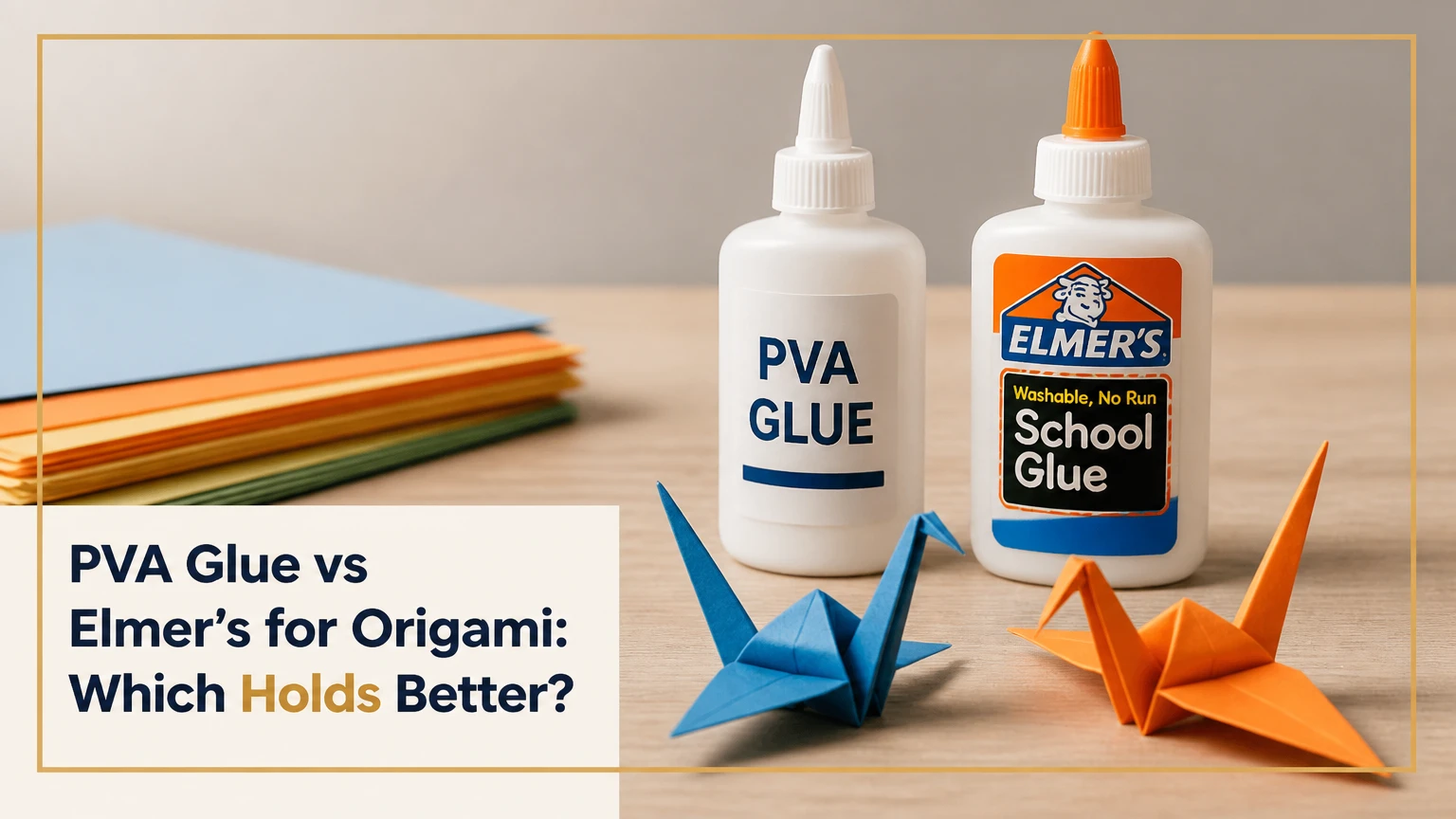
PVA glue is a chemical category, while Elmer’s is a brand that sells several PVA-based and modified adhesive formulas. For origami, thin professional or bookbinding PVA usually gives cleaner, stronger seams, while Elmer’s School Glue offers easier washing and lower risk for children. Elmer’s Glue-All sits between those choices.
PVA Glue vs Elmer’s: The Short Answer
PVA glue and Elmer’s are not equivalent categories. Polyvinyl acetate, or PVA, is the primary polymer used in many white glues; Elmer’s is a manufacturer whose products may contain PVA alongside water, stabilizers, preservatives, plasticizers, and other formulation components.
For folded paper, the best choice depends on the joint. Use a very thin layer of neutral or bookbinding PVA for permanent origami models, Elmer’s School Glue for washable classroom projects, and Elmer’s Glue-All for general paper crafts where moderate adhesion and easy availability matter.
Key Facts at a Glance
- PVA identifies an adhesive chemistry; Elmer’s identifies a brand and product range.
- Elmer’s School Glue is washable and convenient, but its dried film is less water-resistant than many professional PVAs.
- Elmer’s Glue-All is a stronger general-purpose option than School Glue, but it is not automatically archival or waterproof.
- Origami fails most often because of excess adhesive, paper moisture, or a thick glue film, not because PVA lacks adhesion.
- Standard PVA bonds porous paper, cardboard, wood, and fabric more reliably than smooth polyethylene, polypropylene, or silicone.
- A thin adhesive film normally dries in 15-60 minutes, while thicker applications can require 24 hours.
What Is PVA Glue?
PVA glue is a water-based emulsion or solution whose principal adhesive polymer is polyvinyl acetate. The polymer is dispersed in water before application, then forms a continuous plastic film as water leaves the adhesive and the particles coalesce.
The term covers products with very different properties. White craft glue, bookbinding adhesive, woodworking glue, school glue, and some construction emulsions can all be described as PVA products, yet their solids content, viscosity, additives, pH, flexibility, and water resistance differ.
PVA is not one standardized strength grade. A professional woodworking adhesive may be optimized for shear strength and press time, whereas a school adhesive is optimized for safe handling, low staining, and wet washability. Product technical data therefore matters more than the word “PVA” on a label.
Is Elmer’s Glue PVA?
Many Elmer’s liquid glues are PVA-based, but Elmer’s does not represent one single formula. Elmer’s Glue-All, School Glue, CraftBond products, and Carpenter’s Wood Glue target different substrates and drying behavior.
Ingredient lists and technical claims vary by product and market. Elmer’s School Glue should not be treated as chemically identical to a neutral bookbinding PVA, and Elmer’s Carpenter’s Wood Glue should not be selected for delicate origami simply because it is stronger on wood.
How Do PVA Adhesives Dry?
PVA adhesives generally dry through physical water loss rather than a separate curing reaction. After application, water evaporates into the air or migrates into porous paper, while polymer particles move together and fuse into a flexible film.
Porosity controls the process. Uncoated paper absorbs some water, which can speed surface dryness but also cause cockling; coated paper absorbs very little, so the adhesive remains wet longer and may peel from the surface. High humidity slows evaporation, while a thick bead creates a soft interior beneath a dry skin.
A practical workshop rule is to judge drying by film thickness, temperature, humidity, and substrate rather than by brand name alone. Most PVA products perform best near ordinary room temperature, commonly about 18-25°C, and many can form poor films in cold conditions near or below their stated minimum film-forming temperature.
PVA Drying and Handling Times
| Application | Typical initial set | Typical handling time | Practical full drying |
|---|---|---|---|
| One thin line on origami paper | 5-15 minutes | 20-40 minutes | 2-6 hours |
| Thin paper-to-paper coating | 10-25 minutes | 30-60 minutes | 6-12 hours |
| Cardboard or layered paper | 15-30 minutes | 45-90 minutes | 12-24 hours |
| Thick bead on porous wood | 20-45 minutes | 1-2 hours | 24 hours or longer |
| Damp, humid workspace | 20-60 minutes | 1-3 hours | 24-48 hours |
“Dry” does not mean “waterproof.” A dried PVA film can soften again when exposed to water, especially when the formula is designed to be washable.
Which Glue Works Best for Origami?
For permanent origami, neutral bookbinding PVA or a high-solids paper adhesive generally performs better than Elmer’s School Glue because it permits a thinner, less watery application. For temporary practice models and children’s activities, Elmer’s School Glue is often the safer practical choice because wet spills can be cleaned more easily.
Origami uses thin paper, sharp creases, and small contact areas. Those conditions punish excess adhesive. A watery formula can wrinkle kami paper, soften a crease, or leave a visible glossy patch, while an overly thick woodworking PVA can add weight and remain flexible at the fold.
The ideal origami adhesive has four properties: controlled viscosity, low water migration, a clear or nearly clear dry film, and enough flexibility to avoid cracking at a narrow seam.
Origami Glue Choices by Project
| Project situation | Recommended formula | Application amount | Main reason |
|---|---|---|---|
| Traditional permanent model | Neutral bookbinding PVA | 0.02-0.10 mL per seam | Thin film and paper compatibility |
| Children’s classroom model | Elmer’s School Glue | 1-2 tiny dots | Washable cleanup and low cost |
| Modular origami unit | Elmer’s Glue-All or craft PVA | 1-3 tiny dots | More grab than school glue |
| Foiled or glossy paper | Tackier craft adhesive or double-sided tape | 5-15 mm strip or tiny dot | Better surface hold than watery PVA |
| Paper sculpture with cardboard | High-solids PVA | 0.1-0.5 mL per joint | Stronger bond and reduced shrinkage |
| Archival artist project | Labeled neutral, acid-free PVA | Thin brushed film | Documented paper-conservation suitability |
For delicate models, apply adhesive with a needle-tip bottle, toothpick, or fine brush. A useful rule is that the glue should wet the seam without visibly soak-through on the opposite side.
How Do Elmer’s Products Compare With Professional PVA?
Elmer’s products prioritize convenience, availability, and predictable consumer use. Professional PVA products offer more specialized control over pH, solids content, viscosity, open time, flexibility, or water resistance, but the label must confirm the claimed property.
| Product or category | Typical best use | Water resistance | Washability after drying | Origami suitability |
|---|---|---|---|---|
| Elmer’s School Glue | Classroom paper and slime | Low | High, depending on fabric and time | Good for temporary or child-made models |
| Elmer’s Glue-All | Paper, cardboard, fabric, selected crafts | Low to moderate | Lower than School Glue | Good for sturdy paper assemblies |
| Elmer’s Carpenter’s Wood Glue | Wood joints | Product-specific, usually higher than school glue | Low | Poor for thin folded paper |
| Neutral bookbinding PVA | Books, paper conservation, artwork | Usually low unless specified | Low to moderate | Very good for permanent models |
| General craft PVA | Paper, fabric, craft surfaces | Usually low | Product-specific | Good when viscosity is controlled |
| D3 or D4 wood adhesive | Moisture-exposed woodwork | High under classification conditions | Low | Usually excessive for origami |
D3 and D4 refer to European wood-adhesive durability classifications under specific test conditions. They do not mean that every D3 or D4 product is suitable for paper, archival work, or flexible folding.
Strength, Finish, and Cost
Published bond-strength numbers cannot be compared responsibly unless products use the same substrate, specimen design, conditioning, and test method. A manufacturer’s wood-joint shear result does not predict how a glue will behave on thin tissue paper.
The typical retail ranges below are broad North American estimates, not fixed prices. Regional availability, bottle size, and professional packaging can change the cost substantially.
| Adhesive type | Typical retail price | Common package | Typical dry film | Main limitation |
|---|---|---|---|---|
| School glue | $2-$8 | 4-32 fl oz | Flexible, washable | Weak moisture resistance |
| Glue-All | $3-$12 | 4-16 fl oz | Clear to translucent | Not automatically archival |
| Craft PVA | $5-$18 | 8-16 fl oz | Often tackier | Formula varies widely |
| Bookbinding PVA | $10-$35 | 8-32 fl oz | Clear, flexible | Less washable and less common |
| Carpenter’s wood glue | $6-$25 | 8-32 fl oz | Harder wood-film bond | Too wet or heavy for fine paper |
| D3 or D4 wood PVA | $12-$40 | 8-32 fl oz | Durable wood adhesive film | Specialized and unnecessary for most paper |
For origami, a more expensive bottle does not guarantee a better result. A $4 bottle used in microscopic dots can outperform a $20 adhesive applied as a wet stripe.
Which Product Should Each User Choose?
For Origami Artists
Choose neutral bookbinding PVA when the model must remain stable, clean, and permanent. Select a product that states its pH or archival suitability, then test it on a paper offcut because “acid-free” can describe the adhesive while the paper itself remains acidic.
Avoid Carpenter’s Wood Glue for small origami seams. Its strength is useful in wood joints, but its viscosity and moisture content can distort thin paper.
For Teachers and Parents
Choose Elmer’s School Glue for children’s origami when cleanup matters more than maximum permanence. School Glue is appropriate for paper activities, but dried glue can still stain, stiffen fabric, or resist removal after extended contact.
Adult supervision remains appropriate for young children, especially when glue is transferred to skin, clothing, or the mouth. Follow the current package safety directions because formulas and labeling vary by region.
For General Crafters
Choose Elmer’s Glue-All when the project uses paper, cardboard, fabric, or selected porous craft materials and needs more holding power than classroom glue. Glue-All is a useful compromise, but it should not be confused with a tested conservation adhesive or waterproof construction adhesive.
Use a fine applicator for paper. The same bottle that works on cardboard can easily over-wet a sheet of 80-gram origami paper.
For Bookbinders and Conservators
Choose a dedicated neutral or acid-free bookbinding PVA with technical documentation. Elmer’s familiarity does not establish long-term paper stability, and consumer product pages may not provide the pH, aging, or reversibility information required for conservation decisions.
Conservation adhesives are also not automatically reversible. Some can be softened with moisture or solvents under controlled conditions, while others become difficult to remove after aging.
How Should You Apply PVA to Origami?
Apply a very thin, controlled film, align the pieces immediately, and hold the seam under light pressure for 30-120 seconds. Allow the finished model to dry for several hours before flexing it, because paper may feel firm while the adhesive beneath remains soft.
Step 1: Test the Paper and Adhesive
Cut two scraps from the same paper and apply the planned amount of glue. Check for bleed-through, cockling, gloss, color change, and loss of crease sharpness after 30 minutes.
Success checkpoint: The test seam holds without a dark wet halo or raised paper edge.
Common mistake: Testing on a different paper weight and assuming the result will transfer.
Step 2: Prepare a Fine Applicator
Use a toothpick, 00 brush, needle-tip bottle, or small silicone tool. Dispense a dot smaller than a grain of rice for most small seams, then spread it until the paper surface looks damp rather than flooded.
Success checkpoint: The adhesive covers the contact area with no puddle.
Common mistake: Applying a full brush stroke because the seam appears large before folding.
Step 3: Join the Surfaces
Place the folded edges together while the adhesive remains wet. Align the crease first, then press outward toward the seam ends to prevent trapped air and shifting.
Success checkpoint: The edges meet cleanly and no glue squeezes onto the visible face.
Common mistake: Waiting for the glue to become tacky, which can create a lumpy, uneven joint.
Step 4: Press Without Flattening the Model
Hold the seam with tweezers, a bone folder used gently, or clean fingertips protected by release paper. For flat units, place silicone release paper over the joint and add a light book weight.
Success checkpoint: The seam remains aligned after pressure is removed.
Common mistake: Using a heavy weight that crushes dimensional folds or squeezes out the entire adhesive film.
Step 5: Dry Before Final Shaping
Leave the model undisturbed for 2-6 hours after thin applications and up to 24 hours after layered construction. High humidity, coated paper, and larger glue deposits extend the drying period.
Success checkpoint: The seam feels firm and does not slide when lightly tested.
Common mistake: Reopening the joint repeatedly, which damages fibers and weakens the paper.
What Problems Occur With PVA and Elmer’s?
Most PVA failures come from excess water, unsuitable surfaces, insufficient contact, or premature handling. Elmer’s School Glue creates more risk of paper distortion because washability requires a relatively water-sensitive dried film.
| Failure | Likely cause | Corrective action | Prevention |
|---|---|---|---|
| Paper wrinkles | Excess glue or high water content | Flatten under release paper after partial drying | Use dots, not stripes |
| Seam peels | Too little contact or coated surface | Remove loose film and reapply after testing | Roughen only where appropriate |
| Joint stays white | Thick film or cold drying conditions | Allow more time in a warmer room | Use a thinner layer |
| Glossy patch appears | Adhesive reached the visible face | Let dry, then avoid sanding thin paper | Mask surrounding paper |
| Model becomes floppy | Water softened fibers | Dry completely under controlled pressure | Use lower-water adhesive |
| Wood joint will not stain | Dried PVA sealed the pores | Remove squeeze-out before curing or sand wood | Mask the joint area |
PVA is a poor gap filler. Water loss causes shrinkage, so a thick unsupported bead can crack, remain rubbery, or pull away from one side. Use a material designed for gaps when the joint has a measurable void.
Can PVA Bond Glossy Paper, Plastic, or Metal?
Standard PVA bonds porous paper and wood more reliably than glossy paper, plastic, and metal. Coated paper may accept a bond if the surface is lightly abraded and cleaned, but polyethylene, polypropylene, silicone, and oily metal usually require a different adhesive system.
| Surface | Standard PVA result | Preparation | Better alternative |
|---|---|---|---|
| Uncoated paper | Strong fiber-level bond | Dust-free and dry | Neutral PVA for archival work |
| Glossy paper | Variable, often peelable | Test, lightly abrade edge if safe | Double-sided adhesive or tacky craft glue |
| Cardboard | Strong if dry and flat | Remove dust and compress | High-solids PVA |
| Wood | Strong on close-fitting joints | Sand and dry-fit | Carpenter’s PVA |
| Polypropylene plastic | Poor mechanical adhesion | Specialized primer required | Plastic-specific adhesive |
| Glass or glazed ceramic | Poor without surface treatment | Clean and degrease | Epoxy or suitable hybrid adhesive |
| Metal | Usually poor | Abrasion and degreasing | Epoxy, cyanoacrylate, or metal adhesive |
For origami using foil-backed or laminated paper, adhesive tape can outperform PVA because the surface does not absorb water. Use a narrow strip and keep it away from visible folds.
Is PVA Waterproof?
Ordinary PVA glue is not waterproof. Some modified woodworking PVAs resist water under defined testing conditions, while washable school glue is intentionally easier to re-soften or remove than a water-resistant adhesive.
The label should state the actual water-resistance claim. Terms such as “water-resistant,” “washable,” and “waterproof” describe different performance targets, and none should be inferred from a white appearance.
For outdoor woodwork, choose an adhesive with a published durability classification or manufacturer test data. For origami, water resistance is usually less important than low moisture migration, a clear dry film, and controlled viscosity.
Is Elmer’s Good for Slime and Fabric?
Elmer’s School Glue is commonly chosen for slime because its polymer system can react with a borate-based or other activator, but the result depends on the exact glue formula, activator concentration, and recipe. Glue-All may behave differently and is not a guaranteed substitute.
On fabric, liquid Elmer’s products can penetrate fibers and may wash out more easily while wet than after drying. Test a hidden area first, especially on dyed, delicate, or heat-sensitive textiles.
Elmer’s School Glue is therefore practical for supervised craft activities and many slime recipes. It is not a structural textile adhesive, and dried PVA can stiffen fabric rather than preserve its drape.
How Do You Remove Dried PVA?
Remove dried PVA from porous materials by softening it gradually with warm water, lifting the softened film, and avoiding aggressive scraping that tears fibers or removes paint. Water-sensitive surfaces, dyed paper, wood finishes, and photographs require a hidden-area test first.
For paper, place a barely damp swab on the adhesive rather than soaking the sheet. Work from the edge with a blunt tool, then dry the paper flat between clean absorbent sheets.
For finished wood, water can damage the coating even when it softens the glue. Mechanical removal may be safer, but sanding can remove finish and alter the surface.
The Bottom Line
PVA glue vs Elmer’s is a category-versus-brand comparison, not a simple contest between two identical products. Choose neutral bookbinding PVA for permanent, refined origami; choose Elmer’s School Glue for washable classroom work; and choose Elmer’s Glue-All for general paper and cardboard projects that need moderate adhesion.
Use the smallest practical amount, test the paper first, and allow the seam to dry fully. For origami, application control matters more than maximum advertised strength.
Frequently Asked Questions
Is Elmer’s School Glue the Same as White PVA?
Elmer’s School Glue is a type of white craft adhesive that is commonly PVA-based, but it is not necessarily identical to professional white PVA. School Glue is formulated for washability, classroom handling, and easy cleanup, while professional PVA may prioritize higher solids, neutral pH, archival stability, or stronger dry-film performance.
Does PVA Glue Turn Yellow?
PVA glue may remain clear or become yellowish as it ages, depending on the polymer, additives, light exposure, contamination, and substrate. Archival products with documented aging performance are a better choice for valuable paper than assuming every white PVA has identical long-term stability.
Can You Use PVA Glue on Rice Paper?
You can use PVA glue on rice paper, but excess water can cause rapid wrinkling, cockling, and bleed-through. Apply a nearly dry micro-layer with a fine brush or toothpick, test first, and support the sheet on a flat release surface while the seam dries.
Does More Glue Make a Stronger Bond?
More glue does not usually make a stronger paper bond. A thick layer retains water longer, shrinks during drying, creates a visible ridge, and can separate from the substrate. A thin, continuous film with firm contact generally produces a cleaner and more reliable joint.
Can PVA Glue Be Reversed?
Some PVA films can be softened with water, heat, or specialized solvents, but reversibility depends on the formula, age, substrate, and additives. Do not assume that a consumer washable label makes an aged joint safely reversible, especially on artwork, photographs, or historic paper.
What Is Better for Origami, Glue or Tape?
Glue is better for discreet permanent seams when the paper is porous and the adhesive can be applied thinly. Double-sided tape is often better for glossy or laminated paper because it adds little moisture. Tape can create bulk, however, and may weaken sharply folded areas if it is too wide.
