
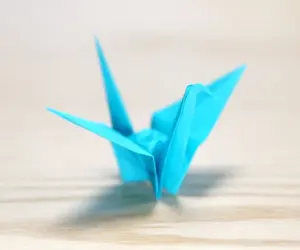

Senbazuru, the Japanese tradition of folding and connecting 1,000 origami cranes, represents sustained hope, longevity, healing, good fortune, and peace. Its modern global meaning was shaped strongly by Sadako Sasaki and Hiroshima, while the older symbolism comes from the Japanese crane’s association with long life and auspiciousness.
Key Facts at a Glance
- Senbazuru means “1,000 cranes” in Japanese, from sen meaning 1,000 and tsuru meaning crane.
- A traditional senbazuru contains 1,000 individual origami cranes, usually arranged on multiple strings.
- Japanese folklore says that a crane lives for 1,000 years, making the bird a symbol of longevity.
- The belief that 1,000 folded cranes automatically grant one wish is a popular interpretation, not a single universally documented religious rule.
- Sadako Sasaki, a Hiroshima atomic-bomb survivor who developed leukemia, became central to the tradition’s modern peace symbolism.
- A practical project commonly uses 40 strings of 25 cranes, lightweight square paper, nylon thread, a needle, and bottom anchor beads.
What Is the Legend of 1000 Paper Cranes?
The legend of 1000 paper cranes, known in Japan as senbazuru, says that folding 1,000 origami cranes can carry a heartfelt wish for healing, long life, peace, or good fortune. The crane’s traditional association with longevity supplies the symbolism, while each repeated fold expresses patience, discipline, and dedication.
The Japanese word senbazuru combines sen, meaning 1,000, with tsuru, meaning crane. The practice is not one single ritual with identical rules across Japan. Families, schools, temples, hospitals, community groups, and peace organizations use the same central form for different purposes.
The often-repeated “one wish” formula should therefore be treated as a modern summary rather than an absolute historical requirement. In practice, the cranes communicate intention through the labor of making them, the person or cause named by the group, and the circumstances in which the finished strings are offered.
A crane is called tsuru in Japanese, and cranes appear in Japanese art, textiles, wedding decorations, New Year imagery, and other auspicious settings. The Japanese government’s Web Japan material describes the crane as a bird “said to live for 1,000 years,” which explains why the number became symbolically important.
Why Does the Crane Represent Longevity?
The crane represents longevity because Japanese folklore associates the bird with a life span of 1,000 years, while its tall form, seasonal migration, pair bonding, and presence in traditional visual culture reinforce ideas of endurance and good fortune. The 1,000-crane practice translates that symbolic life span into repeated human action.
The number is metaphorical, not zoological. Wild red-crowned cranes do not live for 1,000 years; the legendary life span belongs to folklore and literary symbolism. Treating the claim as cultural meaning preserves its importance without presenting it as biological evidence.
Cranes also carry different associations depending on context. A wedding crane may signify fidelity and a long marriage. A crane sent to an ill person may communicate recovery and continued life. A public installation may focus on nonviolence, remembrance, or international solidarity.
| Element | Traditional association | Practical meaning in a senbazuru |
|---|---|---|
| Crane, or tsuru | Longevity and auspiciousness | Hope for a long, healthy life |
| Number 1,000 | Legendary crane life span | A sustained commitment or prayer |
| Repeated folding | Patience and concentration | Labor shared by one person or a group |
| Connected strings | Community and continuity | Many separate actions forming one offering |
| Color selection | Context-dependent symbolism | Personal, institutional, or visual theme |
How Did Sadako Sasaki Change the Tradition?
Sadako Sasaki helped transform senbazuru from a Japanese longevity symbol into a worldwide emblem of peace because her illness connected the crane directly with the human cost of nuclear war. Sadako survived the 1945 atomic bombing of Hiroshima, later developed leukemia, and died in 1955 at age 12.
Sadako began folding paper cranes during her hospitalization after learning about the crane tradition. Accounts differ about the exact number she completed and the precise circumstances of her folding, so a careful retelling should avoid claiming that every popular detail is fully documented.
After Sadako’s death, her classmates and other supporters worked to create a memorial. The Children’s Peace Monument in Hiroshima Peace Memorial Park, unveiled in 1958, honors children who died because of the atomic bombing. The monument’s design and the broader story connected Sadako with thousands of cranes and a continuing appeal for peace.
The story became internationally known through memorial activity, school education, children’s literature, museums, and peace exchanges. Eleanor Coerr’s 1977 children’s novel Sadako and the Thousand Paper Cranes played a major role in introducing the story to English-speaking readers, although the novel is a literary adaptation rather than a complete historical record.
Sadako’s legacy should not reduce her life to a wish that failed. Her story is also about friendship, illness, remembrance, and the political demand that children should not become victims of war. The cranes represent collective responsibility as much as individual hope.
What Does a Senbazuru Mean Today?
A senbazuru means different things according to its recipient and setting, but common meanings include healing, longevity, peace, remembrance, gratitude, and solidarity. The same physical form can function as a private gift, a hospital decoration, a wedding symbol, a classroom project, or a public memorial.
For a medical gift, the cranes express support rather than promise a cure. That distinction matters. A senbazuru can accompany medical treatment and emotional care, but it should never replace professional diagnosis, medication, therapy, or informed consent.
For a school or community project, the value often lies in participation. Dividing 1,000 cranes among 20 students changes the experience from a solitary vow into a shared educational activity. Participants can study Japanese vocabulary, Hiroshima history, paper engineering, peace education, and conservation at the same time.
For a memorial, the design should avoid turning grief into decoration without context. A small card explaining the honoree, the purpose, the number of participants, and the intended message gives the cranes a clearer social meaning.
How Many Cranes and Strings Should You Use?
A senbazuru requires 1,000 cranes, although makers sometimes fold 1,001 to protect against miscounts, damaged pieces, or a final spare. The most manageable standard arrangement is 40 strings with 25 cranes on each string, but 20 strings of 50 or 50 strings of 20 are also possible.
There is no universal requirement that every crane use identical paper or that every string contain the same number. Equal strings make counting and weight distribution easier, while color gradients and themed arrangements require sorting before assembly.
A practical counting system uses 10 batches of 100 cranes, with each hundred divided into four groups of 25. Marking completed batches prevents the common error of confusing folded cranes with already inspected or strung cranes.
| Arrangement | Crane count | Approximate string length | Best use |
|---|---|---|---|
| 50 strings × 20 | 1,000 | 0.9-1.2 m | Lower load per string and wide displays |
| 40 strings × 25 | 1,000 | 1.1-1.5 m | Standard classroom or wall display |
| 25 strings × 40 | 1,000 | 1.6-2.0 m | Narrow installation with extra ceiling height |
| 20 strings × 50 | 1,000 | 2.0-2.8 m | Tall, dramatic displays with strong support |
| 10 strings × 100 | 1,000 | 3.5-5.0 m | Stage or gallery installations, not ordinary walls |
These dimensions are typical planning ranges, not fixed specifications. Finished length changes with crane size, spacing knots, beads, and whether the cranes rest against one another.
Which Paper Size Works Best?
Seven-and-a-half-centimeter square paper, approximately 3 inches, is the most practical choice for a standard hanging senbazuru because it balances folding comfort, storage volume, and final weight. Five-centimeter paper saves space but increases dexterity demands, while 15-centimeter paper creates long, heavy strings that are difficult to display safely.
Use lightweight paper that holds a crease without becoming brittle. Extremely thin paper may tear when pierced, and thick handmade paper can make 1,000 cranes unnecessarily heavy.
| Paper size | Folding difficulty | Typical finished use | Main limitation |
|---|---|---|---|
| 5 × 5 cm | High for beginners | Compact art, jewelry-scale displays | Small folds tear easily |
| 7.5 × 7.5 cm | Moderate | Standard senbazuru, schools, gifts | Requires substantial sorting space |
| 10 × 10 cm | Low to moderate | Easier group folding and large rooms | Greater bulk and paper weight |
| 15 × 15 cm | Low | Demonstration cranes and installations | Long strings become heavy |
| Washi or chiyogami | Moderate to high | Formal gifts and framed work | Higher cost and variable thickness |
A flat, unpuffed crane is usually the safest choice for stringing. Blowing air into each body produces attractive standalone figures, but inflated cranes occupy more space, rub against neighboring pieces, and increase tangling.
How Long Does a Senbazuru Take?
A solo maker typically needs 35-90 hours for folding and another 3-8 hours for sorting and stringing, depending on paper size, folding speed, quality control, and spacing. A group of 10 people can often complete the folding in one or two weekends if each participant makes 50-100 cranes.
Typical folding speed ranges from 2-5 minutes per crane after practice. Beginners may take 7-12 minutes during their first session, so a project schedule based only on expert speed will usually fail.
| Project model | Folding workload | Assembly workload | Typical calendar |
|---|---|---|---|
| Beginner working alone | 70-120 hours | 6-10 hours | 2-4 months |
| Experienced solo folder | 35-60 hours | 3-6 hours | 4-8 weeks |
| Five-person group | 7-15 hours per person | 5-8 shared hours | 2-4 weekends |
| Ten-person group | 3.5-9 hours per person | 5-8 shared hours | 1-2 weekends |
| Classroom of 25 | 1-3 hours per student | 6-10 teacher or volunteer hours | 2-5 sessions |
The best schedule uses short, repeatable sessions. Folding 20 cranes per day for 50 days is easier on hands and attention than attempting 200 cranes in one sitting.
What Materials Do You Need?
A basic senbazuru requires at least 1,000 square sheets, 20-50 strong strings, one long needle, anchor beads, scissors, a ruler, labels, and a hanging ring or support bar. For a 40-string layout, prepare 40 pieces of thread approximately 1.5 meters long, then add extra length for knots and the top bundle.
| Material | Typical quantity | Recommended specification | Why it matters |
|---|---|---|---|
| Origami paper | 1,000-1,050 sheets | 7.5 × 7.5 cm, lightweight | Allows spares for tears and miscounts |
| Nylon thread | 60-70 m | Upholstery thread or 6-10 lb monofilament | Supports repeated handling |
| Bottom beads | 40-50 | Hole smaller than the stopper knot | Prevents cranes sliding off |
| Long needle | 1 | 7-12 cm embroidery or doll needle | Reaches through folded paper |
| Top support | 1 | Wood ring, rod, or ceiling hook | Carries the combined load |
| Labels or cards | 40-50 | Paper tags and permanent pen | Records count and destination |
Waxed dental floss can work for short-term indoor displays, but ordinary sewing thread is a poor choice for heavy or long-term installations because abrasion and humidity weaken it.
How Do You Fold and String 1,000 Cranes?
The process has two separate quality problems: producing consistent cranes and building safe, evenly loaded strings. Fold in batches first, inspect every crane, then assemble only after the count, color sequence, and support plan are fixed.
Before You Start
- Time: 35-90 folding hours, plus 3-8 assembly hours.
- Difficulty: Moderate for folding, high for repetitive quality control.
- Cost: About $15-$40 for a basic DIY project, excluding specialty paper.
- Tools: 1,000-1,050 sheets, 40 threads for a standard layout, 40 beads, one needle, scissors, labels, and a support ring.
- Prerequisite: Confirm where the finished structure will hang and how much weight the surface can hold.
Step 1: Choose the Layout and Count System
Select the string count before folding color batches. For most homes, schools, and hospital rooms, 40 strings of 25 cranes provides a practical compromise between width, length, and load.
Label ten containers from 1 to 10 and place 100 completed cranes in each. You will know the system works when every finished crane belongs to a marked batch and no folded crane remains in an untracked pile. The common mistake is counting paper sheets rather than completed cranes.
Step 2: Fold a Consistent Crane
Crease both diagonals and both horizontal or vertical center folds, collapse the sheet into a preliminary square base, and form the bird base by bringing the outer flaps toward the center. Narrow the lower points, reverse-fold the neck and tail upward, and fold one tip into the beak.
Keep the wings flat unless the design specifically requires puffed cranes. A successful crane has a recognizable head, tail, two wings, and a central bottom opening without major tears. The common mistake is tightening every fold aggressively, which can weaken small paper at the eventual piercing points.
Step 3: Inspect and Sort Each Batch
Separate damaged, undersized, badly torn, or visibly inconsistent cranes before assembly. Sort by color, pattern, or participant if the project requires a gradient or acknowledgment system.
A quality-control lead is valuable in group projects because assembly exposes errors that are easy to overlook during folding. The expert rule is simple: do not string a crane that you would not display individually, because removal becomes harder after knots and spacers are added.
Step 4: Prepare and Anchor Each Thread
Cut each thread to the planned length, usually 1.3-1.6 meters for 25 cranes with moderate spacing. Tie a secure stopper knot and place a bead above it, testing the knot with several firm pulls before adding paper.
You will know the anchor works when the bead cannot pass through the bottom knot and the thread does not fray at the knot. The common mistake is using a decorative bead with a hole large enough to slip over the knot.
Step 5: Pierce and Stack the Cranes
Insert the needle through the natural opening at the bottom center of the crane and guide it toward the top point of the folded back. Slide each crane down carefully, then add a small knot or spacer bead if you want visible gaps.
A successful string contains 25 stable cranes with no crushed wings and no paper splitting around the needle path. The common mistake is piercing off-center, which twists the crane and concentrates stress on one fold.
Step 6: Bundle and Test the Finished Strings
Tie the completed strings to a wooden ring, rod, or central cord, keeping the loads as even as possible. Hang the bundle temporarily at a low height and inspect for slipping, tangling, excessive bending, or strain at the support point.
The support is adequate when the top connection remains stable after a gentle movement test and each string hangs without pulling sharply against its neighbors. The common mistake is attaching all 40 strings to a weak decorative loop that was never designed to carry the combined weight.
Which Design Is Best for Your Display?
The best design for most first-time makers is 40 vertical strings of 25 flat cranes, because the format is countable, repairable, and easier to hang than very long columns. A color gradient suits a gallery or wedding, while a compact framed arrangement works when hanging space or dust protection is limited.
| Design | Typical structure | Display requirement | Main trade-off |
|---|---|---|---|
| Traditional vertical rows | 40 × 25 cranes | 1.2-1.8 m support width | Easy to count, can tangle |
| Dense vertical block | 20 × 50 cranes | Strong ceiling or wall anchor | Narrower, heavier strings |
| Color gradient | 40 × 25, sorted by shade | Preplanned color batches | Attractive, slower to organize |
| Participant-coded colors | 20-40 strings by group | Labels and a key card | Meaningful, less visually uniform |
| Shadowbox arrangement | Flat or semi-folded cranes | Large sealed frame | Dust protection, less traditional |
| Tabletop arch or hoop | Short strings on a frame | Stable freestanding base | Safer where drilling is prohibited |
A senbazuru is not suitable for every location. Avoid placing loose paper cranes outdoors in rain, near open flames, above patient beds without facility approval, or where children can pull down an unsecured bundle.
How Much Does a Senbazuru Cost?
A DIY senbazuru generally costs $15-$40 with ordinary paper and hardware, a prepared kit commonly costs $25-$60, and a commissioned assembled piece often costs $150-$500 or more. Specialty washi, chiyogami paper, custom color sorting, framing, shipping, and installation raise the final price.
Paper is usually the largest basic purchase. Buying exactly 1,000 sheets leaves no allowance for torn paper, failed folds, or counting mistakes, so 1,050 sheets is a more reliable working quantity.
| Project type | Typical price | Included materials | Best financial use |
|---|---|---|---|
| Basic DIY | $15-$40 | Paper, thread, beads, needle | Solo or school project |
| Premium DIY | $40-$100 | Washi, color sorting, better hardware | Formal gift or display |
| Folding kit | $25-$60 | Precut paper, thread, instructions | Faster preparation |
| Artisan assembly | $150-$500+ | Folded, strung, finished cranes | Gift without labor time |
| Framed commission | $250-$1,000+ | Design, frame, preservation materials | Permanent interior artwork |
These are typical retail and commission ranges, not fixed market prices. Confirm shipping, taxes, frame dimensions, and whether the stated count includes spare cranes.
What Are the Main Alternatives and Trade-Offs?
A senbazuru is the strongest choice when the maker wants a labor-intensive symbol of hope, community, or peace. A single crane, a smaller group of cranes, a paper lotus, or a donated artwork may be more appropriate when time, space, accessibility, or recipient preference limits a 1,000-crane project.
| Option | Typical scale | Time requirement | Best message |
|---|---|---|---|
| Senbazuru | 1,000 cranes | 35-98 total hours | Collective dedication and peace |
| Single origami crane | 1 crane | 2-10 minutes | Small gift or introduction |
| 100-crane installation | 100 cranes | 4-15 hours | Classroom or short memorial |
| Paper lotus arrangement | 10-50 flowers | 2-20 hours | Reflection and remembrance |
| Written peace banner | 1 banner | 1-5 hours | Direct public statement |
| Donation to a peace group | No fixed paper count | 15-60 minutes | Material or humanitarian support |
The counterintuitive point is that more cranes do not always communicate more care. A rushed, unsafe, or unwanted installation can burden a hospital or memorial site, whereas a smaller, well-explained offering may be more respectful.
What Problems Occur During Assembly?
The most common senbazuru failures are weak anchors, torn paper, inaccurate counts, tangled strings, and excessive weight. Each problem is preventable when the maker tests one complete string before repeating the method 20 or 40 times.
- Cranes slide off the bottom: Replace the knot with a larger stopper knot and a bead whose opening is smaller than the knot.
- Paper tears at the spine: Use a thinner needle, pierce the natural center opening, and reinforce only severely stressed cranes.
- Strings tangle: Keep finished strings in separate labeled bags and bundle them only after all strings are complete.
- The display bends or falls: Reduce the number of cranes per string, use a stronger support bar, and verify the wall or ceiling anchor.
- The count is wrong: Recount in groups of 25 and mark every inspected batch, rather than recounting one large pile.
- Colors appear uneven: Sort all 1,000 cranes on a table or floor before threading the first string.
- Cranes become dusty: Use a dry, low-airflow indoor location and consider a sealed frame for long-term preservation.
Do not glue every crane merely to prevent movement. Glue changes the paper, complicates recycling, and can make later repair impossible. Spacers, knots, and a stable support usually solve movement without permanently altering the origami.
How Should You Give or Display One Respectfully?
Give a senbazuru with a short explanation of its purpose, the number of contributors, and any practical care instructions. Ask before sending one to a hospital, school, temple, memorial, or public park because each institution may restrict hanging objects, paper materials, attachment methods, or deliveries.
For a private recipient, include the intended message rather than assuming the cranes speak for themselves. “These cranes represent our hope for your recovery” is more considerate than claiming they will guarantee a medical outcome.
For Hiroshima-related donations or displays, consult the receiving organization’s current instructions before shipping. Requirements may cover secure stringing, sender identification, packaging, prohibited glitter or plastic, and whether the organization accepts unsolicited submissions.
A senbazuru also requires accessibility planning. A large hanging installation may obstruct fire equipment, release paper dust, or become difficult for someone with limited mobility to view. Mount it at a safe height, keep paths clear, and use flame-resistant or facility-approved materials where required.
Frequently Asked Questions
Is senbazuru a religious ritual?
Senbazuru is a cultural practice with symbolic, personal, and community uses rather than one universally standardized religious ritual. People may fold cranes as a prayer, memorial act, peace project, gift, or artistic installation. The meaning depends on the maker’s intention and the social setting.
Does folding 1,000 cranes guarantee a wish?
No. The idea that folding 1,000 cranes guarantees one wish is a popular interpretation of crane folklore, not a measurable promise or universally binding Japanese rule. The cranes express hope and dedication, while healing, longevity, and good fortune remain beyond the paper object’s control.
Did Sadako Sasaki actually finish 1,000 cranes?
Historical accounts disagree about the exact number of cranes Sadako Sasaki folded before her death. The widely circulated story says she pursued 1,000 cranes while hospitalized, and later classmates and supporters completed cranes in her memory. The documented legacy is her peace memorial, not a verifiable tally alone.
Can children make a senbazuru?
Children can make a senbazuru with age-appropriate supervision, especially when adults handle needles, scissors, knots, and ceiling attachments. Younger participants can fold larger 10-centimeter paper, while experienced folders can use 7.5-centimeter sheets. A teacher should connect the activity with accurate Hiroshima history rather than presenting it as a simple craft contest.
How should old paper cranes be preserved?
Keep paper cranes indoors away from direct sunlight, moisture, smoke, and high-traffic contact. For long-term preservation, use archival mounting or a sealed shadowbox with sufficient depth and acid-free materials. Do not compress fragile cranes under glass, because pressure can deform wings and transfer dust into the folds.
Can I make fewer than 1,000 cranes?
Yes. A smaller group can carry the same message when the project’s time, space, or participants cannot support 1,000 cranes. Label the total accurately, because calling 100 cranes a senbazuru creates avoidable confusion. A complete senbazuru contains 1,000 cranes, while a smaller installation can be described as a crane display or peace project.
The Bottom Line
The legend of 1000 paper cranes, or senbazuru, joins Japanese crane folklore with the visible labor of folding, counting, and connecting paper figures. Its modern peace meaning is inseparable from Sadako Sasaki and Hiroshima, but its broader uses include healing wishes, longevity, remembrance, weddings, education, and community solidarity.
A successful project needs more than 1,000 sheets of paper. It needs an accurate count, consistent flat cranes, strong thread, tested anchors, a suitable display location, and an explanation of the intended message. Fold the cranes with cultural and practical care, and the finished senbazuru becomes a durable expression of shared hope rather than a decorative object detached from its history.
