

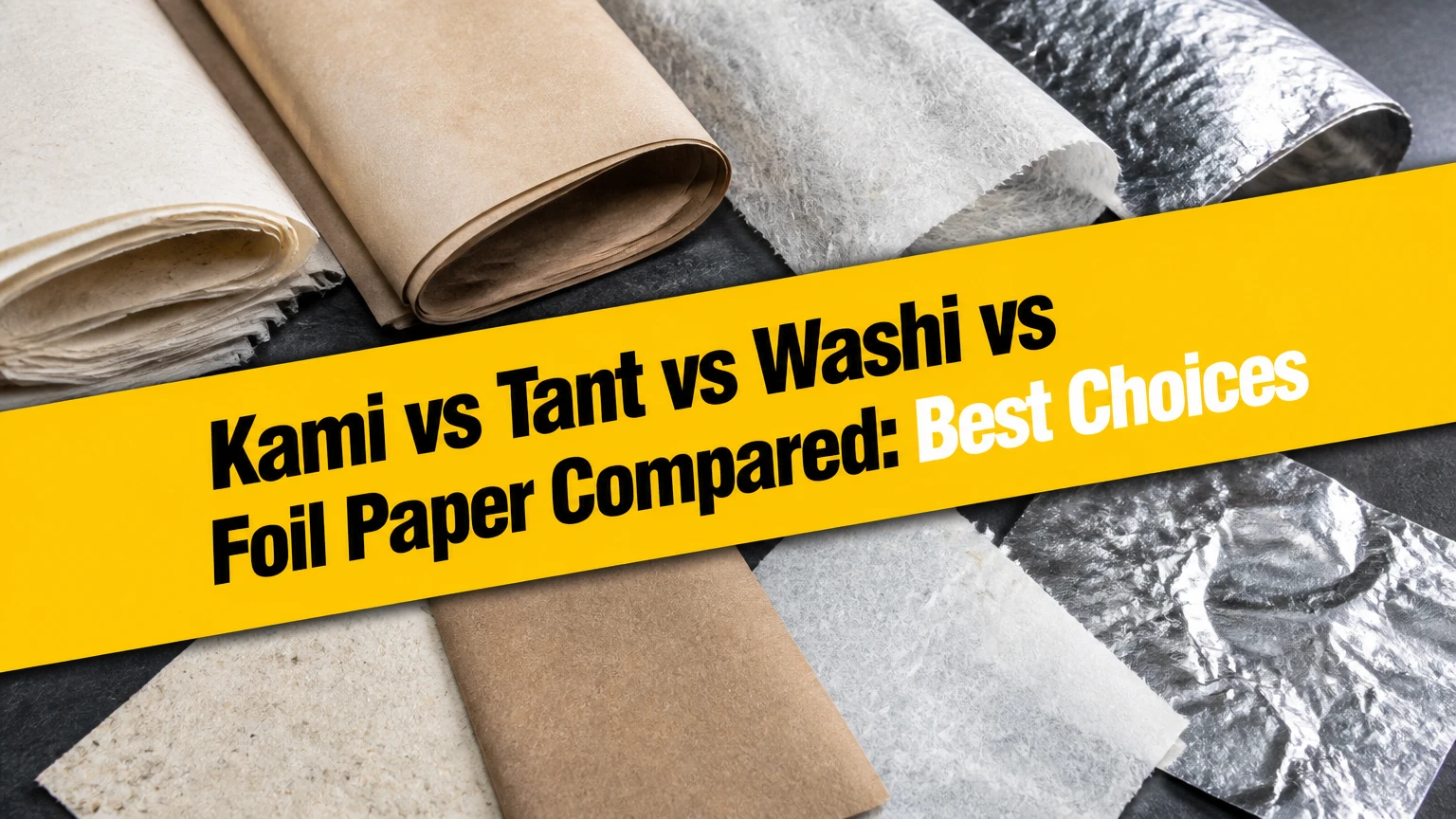
Kami, Tant, Washi, and foil paper suit different origami demands. Kami is the economical choice for beginners and color-change models, Tant offers solid color and structural stiffness for modular or sculptural work, Washi provides resilient long-fiber behavior for organic forms, and foil paper is best for dense, high-layer designs that must stay collapsed.
Key Facts at a Glance
- Standard kami usually weighs about 45-55 GSM and costs roughly $0.02-$0.08 per 15 cm sheet.
- Tant commonly weighs about 70-80 GSM, has color on both sides, and resists tearing better than standard kami.
- Washi is a paper family, not one uniform specification; kozo, gampi, and mitsumata papers differ substantially in fiber length, sizing, thickness, and stiffness.
- Paper-backed foil uses an aluminum layer to reduce springback, but the composite permanently records dents and aggressive creases.
- Tissue foil is usually more forgiving than many commercial foil papers because thin tissue distributes stress around dense fold intersections.
- For a first crane, use 15 cm kami; for a complex insect, choose tissue foil or a suitable thin foil sheet at 30-40 cm or larger.
What Are Kami, Tant, Washi, and Foil Paper?
Kami, Tant, Washi, and foil paper differ mainly in fiber structure, coating, thickness, and deformation behavior. Standard kami is machine-made wood-pulp paper with a colored face and white reverse; Tant is typically solid-colored paper with a lightly textured surface; Washi describes traditional Japanese fiber papers; foil paper combines paper with aluminum.
The names do not describe equivalent grades. “Washi” can mean a thin, soft, absorbent sheet or a strongly sized, machine-made paper, while “foil paper” can mean a commercially laminated sheet or homemade tissue foil. Those variants can behave more differently than kami and Tant do.
Traditional washi uses fibers such as kozo, gampi, or mitsumata. The Japan Paper Association identifies these plants as important raw materials, but fiber source alone does not determine folding performance. Sizing, beating, formation, density, and lamination also matter.
Why Does Paper Structure Matter in Origami?
Paper structure controls three visible outcomes: crease sharpness, springback, and resistance to tearing. Short, highly calendered wood fibers often make kami easy to crease, while long fibers in kozo-based washi tolerate repeated manipulation but may need sizing to hold a geometric edge.
Aluminum changes the mechanism again. A foil layer undergoes plastic deformation, so a fold can remain fixed rather than trying to reopen. The advantage becomes a liability when the folder makes a wrong crease, because aluminum retains dents and stress marks.
How Do the Four Papers Fold Differently?
The four papers differ because they balance elastic recovery against plastic deformation. Kami gives crisp initial creases, Tant gives stiffness and surface grip, Washi gives tensile resilience and flexible curves, and foil paper gives the lowest springback but the highest penalty for accidental dents.
A practical folder should evaluate a sheet using five tests before starting an important model:
- Fold a 2 cm preliminary crease and inspect whether the edge stays sharp.
- Reverse the crease twice and check for fiber whitening or splitting.
- Rub the surface with a dry fingertip to assess slipperiness.
- Bend the sheet into a shallow curve and observe springback.
- Press two layers together at a test corner to detect delamination.
Master Comparison Table
| Criterion | Kami | Tant | Washi | Foil paper |
|---|---|---|---|---|
| Typical weight | 45-55 GSM | 70-80 GSM | 30-90 GSM | 50-65 GSM |
| Typical 15-30 cm sheet cost | $0.02-$0.08 | $0.15-$0.40 | $0.50-$4.00 | $0.10-$0.50 |
| Surface | Smooth, calendered | Fine crepe-like texture | Fibrous, variable | Metallic, slippery |
| Color arrangement | Often one-sided | Usually solid through-color | Natural or dyed, variable | Metallic face with paper backing |
| Initial crease | Sharp and easy | Firm, slightly rounded | Soft to moderate | Very sharp |
| Springback | Moderate | Moderate to high | Low to moderate, grade-dependent | Very low |
| Reverse-fold tolerance | Low | Moderate | High | Moderate, with permanent scars |
| Best scale | 7.5-25 cm | 7.5-35 cm | 15-60 cm | 15-50 cm |
| Typical best use | Beginners, diagrams | Modules, solid-color sculpture | Organic and archival models | Dense insects and dragons |
These figures are typical retail ranges, not universal specifications. GSM measures mass per square metre, not exact thickness or folding quality. A dense 60 GSM sheet can feel stiffer than a porous 80 GSM sheet, so buying decisions should include caliper, sizing, and fiber direction whenever the supplier provides them.
Which Paper Gives the Sharpest Creases?
Kami and foil paper produce the sharpest apparent creases, but they achieve that result differently. Kami responds cleanly to light pressure because its smooth, thin sheet forms a defined fold; foil paper stays fixed because its aluminum layer plastically deforms.
Kami is usually the better choice for crease-pattern reading. The white reverse side exposes orientation changes, and its low cost allows a folder to test a model without risking expensive paper. Repeated reverse folds, however, quickly weaken intersections.
Foil paper creates finer permanent edges in complex models, particularly when many layers must collapse into a narrow appendage. The surface can slide during precreasing, and a metal-backed crease made too early may interfere with later adjustment.
Winner for clean beginner creases: kami. Winner for permanent micro-details: foil paper.
Which Paper Handles Complex Layers and Small Appendages?
Foil paper handles the densest layer stacks, especially when a model includes insect legs, antennae, claws, scales, or compressed sinks. The metal layer limits elastic reopening, allowing the folder to lock narrow structures after shaping.
Tissue foil often performs better than thick commercial foil for high-complexity work. A common homemade construction uses thin aluminum foil laminated to tissue, lightweight kozo, or unryu paper. The tissue side contributes flexibility, while the foil side gives shape retention.
Kami becomes unreliable when a design concentrates many creases at one intersection. The issue is not simply that kami is “weak”; repeated compression and reverse folding break or whiten short fibers at the same stress point.
Tant can fold complex models only when the design has sufficient layer separation and the sheet is thin enough. Its stiffness helps broad structural sections but resists tight closure in dense pleats.
Winner for dense layers: thin foil or tissue foil. Winner for moderately complex, broad structures: Tant.
Which Paper Is Strongest and Most Durable?
Washi generally offers the highest tear resistance because long plant fibers can bridge a developing split, but “strongest washi” depends on fiber species, sheet formation, sizing, and thickness. A soft unsized sheet may tear less readily than kami yet fail to hold a sharp display crease.
Kozo washi is often selected for demanding folding because its long bast fibers tolerate handling and sculptural shaping. Gampi tends to produce a smoother, more translucent sheet, while mitsumata is associated with fine, soft papers. These are tendencies, not guarantees for every commercial grade.
Tant is durable for ordinary folding and modular assembly. Its solid color avoids the white-core problem that appears when a coated or colored surface breaks along a crease.
Foil paper does not equal indestructible paper. The foil can split along a heavily stressed grid, and the paper backing can separate from aluminum if the laminate is bent sharply or handled with excessive friction.
Winner for tear resistance and repeated handling: suitable long-fiber washi. Winner for durable modular units: Tant.
How Do Surface, Color, and Texture Affect the Model?
Surface finish affects friction, visual depth, and the folder’s ability to control layers. Kami is smooth and predictable, Tant supplies grip and a textile-like visual texture, Washi exposes fibers and natural variation, and foil paper creates reflective highlights while making layers more slippery.
Tant is particularly effective for kusudama and Sonobe-style modules because its texture can reduce uncontrolled sliding during assembly. Its through-color construction also keeps folded edges visually consistent.
Kami’s white reverse is useful when diagrams rely on color orientation. It is less suitable when the final model must show a uniform color on every visible face unless the design deliberately hides the reverse side.
Washi produces attractive organic surfaces for animals, masks, flowers, and figures. Fibers may obscure tiny crease marks, so the sheet should be tested against the model’s crease density before committing to a large piece.
Foil provides shine but exposes every accidental indentation. A folder should handle the sheet with clean hands and avoid stacking tools on its surface.
Winner for visual versatility: Tant for solid color, Washi for fiber texture, and foil for metallic effects.
What Are the Typical Sizes, Costs, and Weight Differences?
Typical origami paper costs range from a few cents for standard kami to several dollars for specialty washi. Sheet size changes the practical cost substantially because large sheets require more raw material, careful packaging, and often specialty production.
| Paper | Common sizes | Typical GSM | Typical price per sheet | Practical purchase note |
|---|---|---|---|---|
| Kami | 7.5, 15, 25 cm | 45-55 | $0.02-$0.08 | Buy multi-color packs for practice |
| Tant | 7.5, 15, 35 cm | 70-80 | $0.15-$0.40 | Check thickness before complex models |
| Washi | 15, 30, 60 cm | 30-90 | $0.50-$4.00 | Buy samples from the same batch |
| Commercial foil | 15, 24, 50 cm | 50-65 | $0.10-$0.50 | Inspect laminate edges and backing |
| Homemade tissue foil | Custom | Often 25-60 | $0.20-$1.50 | Cost depends on foil, tissue, and adhesive |
Prices are typical specialist-retail estimates in the United States and vary by brand, import costs, pack size, and handmade production. For a 15 cm beginner model, paper cost matters little; for a 60 cm display model, shipping, wastage, and preparation time can exceed the sheet price.
Which Paper Should Each Origami Folder Choose?
The best paper depends on model complexity, surface appearance, and whether the folder values adjustability or permanent shape retention. Kami fits beginners, Tant fits modules and solid-color structures, Washi fits organic or archival work, and foil fits dense technical models.
| Folder or project | Recommended paper | Suggested size | Why it fits | Main limitation |
|---|---|---|---|---|
| First crane or box | Kami | 15 cm | Low cost and clear color contrast | Tears after repeated refolding |
| Sonobe modules | Tant | 7.5-15 cm | Texture and stiffness aid assembly | Thick layers resist tight closure |
| Geometric kusudama | Tant or kami | 7.5-15 cm | Tant adds grip; kami folds easily | Kami units may lose rigidity |
| Organic animal or figure | Kozo washi | 30 cm-plus | Long fibers support curves | Raw sheets may feel too soft |
| Complex insect or dragon | Tissue foil | 30-50 cm | Low springback and thin layers | Mistakes leave permanent marks |
| Archival display model | Sized washi | 30-60 cm | Durable fibers and refined surface | Higher cost and preparation time |
| Color-change model | Kami | 15-25 cm | White reverse makes changes visible | Exposed edges show white |
Which Paper Is Best for Beginners?
15 cm kami is the best beginner paper for most diagrams because it is inexpensive, widely available, and visually reveals inside-out color changes. A beginner should avoid very thin tissue, raw washi, and slippery foil until basic valley folds, mountain folds, sinks, and reverse folds feel controlled.
Tant is a reasonable second paper when the learner wants a sturdier finished object. Its added stiffness can make simple models feel more substantial, but it may make a tight squash fold harder than the same fold in kami.
Which Paper Is Best for Modular Origami?
Tant is usually the strongest choice for modular origami when units need friction, stiffness, and consistent solid color. Kami works for inexpensive practice and small units, while thin washi can work for premium modules if its surface is adequately sized.
Use 7.5 cm or 15 cm Tant for Sonobe units, but test one module first. If several layers must tuck into a narrow pocket, a lighter Tant grade may outperform a heavier sheet despite having less mass.
Which Paper Is Best for Wet Folding?
Tant and appropriately sized washi are the most practical wet-folding candidates. Moisture relaxes fiber bonds, allowing the folder to form rounded anatomy and then let the sheet stiffen as it dries.
A wet-folding trial should use a small offcut first. If the color bleeds, the surface becomes tacky, or the sheet loses its finish, switch to a different grade rather than increasing the water level.
Which Paper Is Best for Complex Insects and Dragons?
Thin tissue foil is usually the best choice for complex insects, dragons, and other models with many narrow appendages. Commercial foil can also work, but its thickness, adhesive layer, and foil brittleness vary enough that a test fold is necessary.
For a model designed around 40 cm paper, do not substitute a thick 80 GSM sheet simply because the package calls it “origami paper.” Layer count, not the label, determines whether the final collapse will close.
How Do You Wet-Fold Tant or Washi?
Wet folding uses controlled moisture to reduce springback, followed by drying that fixes the shaped form. Tant or sized washi should feel cool and flexible, never saturated, and the finished model usually needs clips or temporary support for 20-60 minutes.
- Prepare the sheet. Use a clean sponge, water, clips, and a stable work surface. Methyl cellulose can improve control, but use the paper manufacturer’s sizing guidance when available.
- Moisten lightly. Wipe the sponge across one side in a single even pass. Avoid puddles, glossy wet patches, and soaked corners.
- Fold promptly. Establish major creases while the sheet is flexible, then shape broad curves before the paper begins drying.
- Support the form. Use clips or soft bands on non-visible areas. Do not crush delicate points with hard clamps.
- Let the model dry fully. Allow 20-60 minutes for a small model and longer for thick or large sheets.
- Inspect the result. The model should retain its curve without wet-looking dark patches, detached layers, or fuzzy fibers.
A common error is using water to compensate for unsuitable paper. Wet folding can reduce elastic memory, but it cannot make a heavily laminated or overly thick sheet behave like tissue foil.
How Do You Make Tissue Foil?
Tissue foil combines a thin aluminum sheet with lightweight tissue or washi, producing a flexible composite with strong shape retention. A 20-30 minute lamination session typically requires aluminum foil, repositionable spray adhesive, tissue, a brayer, a cutting mat, and a sharp blade.
- Spray a thin, even adhesive coat onto the foil in a ventilated area.
- Align the tissue from one edge and roll it down gradually.
- Press from the center outward with a brayer to remove air pockets.
- Let the laminate rest according to the adhesive instructions, commonly 10-15 minutes.
- Trim the sheet square with a ruler and rotary cutter.
- Test a corner before folding the full sheet.
The tissue must remain thin enough to avoid excessive layer buildup. Heavy kozo or thick craft foil can create a composite that is harder to collapse than the original paper.
What Problems Occur With Each Paper?
Most paper failures come from a mismatch between fold density and material behavior. Kami fails through fiber breakdown, Tant fails through thickness and springback, washi fails through softness or absorbency, and foil fails through permanent dents or laminate stress.
| Symptom | Likely paper cause | Immediate fix | Better long-term choice |
|---|---|---|---|
| White lines along creases | Coated kami surface split | Reduce crease pressure | Tant or solid-color washi |
| Model repeatedly opens | Tant or thick washi springback | Wet-shape and clip | Lighter Tant or foil |
| Sheet feels floppy | Unsized washi lacks stiffness | Apply tested sizing | Sized washi or Tant |
| Silver crease scars | Foil received an unwanted fold | Recut or redesign the area | Tissue foil for adjustability |
| Layers will not close | GSM or caliper is too high | Increase sheet size | Thin foil or lighter paper |
| Foil separates at edges | Lamination bond failed | Flatten only if adhesive permits | Better-made commercial tissue foil |
What Is the Most Common Kami Mistake?
The most common kami mistake is using excessive pressure at a dense intersection. A bone folder can sharpen a simple crease, but repeated heavy scoring crushes short fibers and accelerates tearing.
Fold with controlled finger pressure first, then reinforce only the final visible edges. Kami is consumable practice material, not the ideal choice for a model that requires dozens of reversals.
Why Does Tant Spring Open?
Tant springs open because its thicker sheet stores more elastic energy than thin kami, especially after tight reverse folds and compressed pleats. Dry folding may leave enough residual stress to reopen pockets or rounded sections.
Use a lighter grade, enlarge the sheet, reduce unnecessary crease depth, or wet-shape the completed section. Clipping a model before it dries is more effective than forcing every crease harder.
Why Does Washi Refuse to Hold a Crease?
Raw or lightly sized washi may refuse to hold a crease because its long fibers bend without forming a firm compressed edge. That flexibility benefits organic curves but weakens geometric precision.
Test a small sample with a compatible sizing treatment. A thin methyl cellulose or starch layer can increase stiffness, although the treatment may change translucency, surface friction, and final color.
Why Does Foil Paper Tear at Fold Intersections?
Foil paper tears when repeated folds concentrate stress along the same metal grid or when too many layers are forced into a narrow sink. Aluminum does not recover elastically, so it can develop a sharp crack after repeated manipulation.
Use a larger sheet, precrease with less pressure, and avoid reopening a heavily compressed corner. Tissue foil spreads stress more gradually and often survives dense shaping better.
What Should You Check Before Buying?
Buy by measurable behavior rather than by the paper name. Check GSM, approximate caliper, sheet size, surface coating, color-through construction, sizing, grain direction, and whether the product is paper-backed foil or foil-coated paper.
| Buying question | Kami | Tant | Washi | Foil paper |
|---|---|---|---|---|
| Is the color through the sheet? | Usually no | Usually yes | Variable | Backing-dependent |
| Is the sheet pre-sized? | Usually | Usually | Variable | Adhesive laminate |
| Is grain information common? | Rarely | Sometimes | More likely | Rarely |
| Can you refold safely? | Limited | Moderate | Usually high | Very limited |
| Should you buy a sample? | Optional | Useful | Strongly recommended | Strongly recommended |
Grain direction matters most on large sheets. Fold parallel and perpendicular to the grain on a test strip, then choose the orientation that gives the required balance of crease resistance and curve control.
A practitioner rule of thumb is to choose paper by the final bottleneck. If the bottleneck is reading color changes, choose kami; if units slide apart, choose Tant; if curves tear or collapse, choose washi; if layers reopen, choose foil.
FAQ
Can Tant Replace Kami for Beginner Origami?
Tant can replace kami for simple beginner models, but it is less forgiving in tight folds because its typical 70-80 GSM weight creates more bulk. Tant is worthwhile when the learner wants solid color on both sides or a sturdier finished model. Standard kami remains cheaper and easier for practicing unfamiliar diagrams.
Is Washi Always Handmade?
Washi is not always handmade. The term identifies Japanese paper made from traditional plant fibers or methods, and modern mills produce machine-made washi alongside handmade sheets. Manufacturing method, kozo content, sizing, thickness, and surface finish determine folding behavior more reliably than the word “washi” alone.
Is Foil Paper Suitable for Children?
Foil paper is usually unsuitable for a child’s first folding session because sharp creases become permanent and thin aluminum edges can feel abrasive. Use 15 cm kami for supervised practice, then introduce foil after the child can place folds accurately without repeatedly reopening the same corner.
Can You Print on Tant or Washi?
You can print on Tant or washi, but ink adhesion and absorbency vary by finish. Test one offcut first, allow the ink to dry fully, and avoid wet-folding until the printed surface has been checked for bleeding or transfer. Smooth, sized sheets generally give cleaner results than raw fibrous grades.
What Is the Best Paper for Display Models?
The best display paper depends on the model’s form. Sized kozo washi suits organic, archival-looking sculptures, while tissue foil suits dense technical models that must retain narrow details. Tant works for sturdy geometric displays, and kami is best reserved for low-cost studies or models protected from handling.
How Large Should Origami Paper Be for a Complex Model?
A complex model commonly needs 30-50 cm paper, although the designer’s specification remains decisive. Use larger paper when the crease pattern has dense intersections, many layers, or thin appendages. Increasing sheet size reduces relative layer thickness and gives the folder more room to shape compressed sections.
The Bottom Line
Kami vs Tant vs Washi vs Foil Paper Compared reveals four different solutions rather than one universal winner. Choose 15 cm kami for learning and inexpensive prototypes, Tant for solid-color modules, sized long-fiber washi for durable organic sculpture, and thin foil or tissue foil for dense technical models. Test the exact grade before committing to an important fold.
