


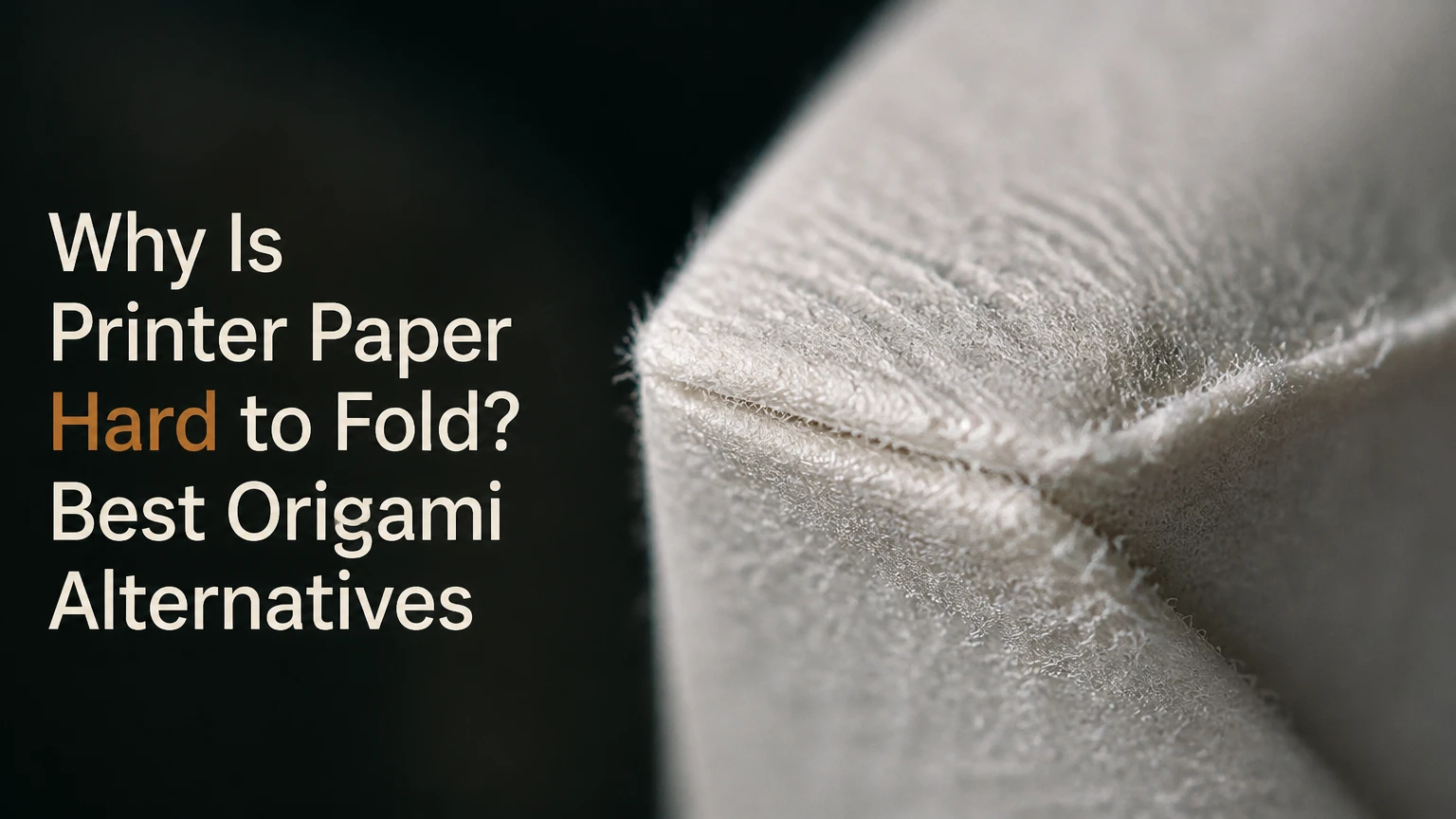
Printer paper is hard to fold cleanly because its 75-90 GSM wood-pulp sheet is engineered for stiffness, dimensional stability, smooth printing, and reliable machine feeding rather than repeated sharp creases. Shorter fibers, drying, surface sizing, fillers, and grain direction can make an origami fold spring open, look bulky, or crack. Thin kami is usually the best affordable replacement.
Key Facts at a Glance
- Standard office copy paper usually weighs 75-90 GSM, although lighter 70-75 GSM and heavier 100-120 GSM stocks are also common.
- Origami kami commonly weighs about 40-60 GSM and folds more easily because the sheet is thinner and designed for creasing.
- Paper grain matters: folds parallel to the grain usually resist cracking less than folds made across it.
- Calcium carbonate and clay fillers vary by paper grade, so the claim that every copy sheet contains 30% filler is too broad.
- Origami paper is not automatically better for every model; very thin kami can tear during tight reverse folds.
- Genuine kozo washi is strong and flexible, while some machine-made “washi” is simply decorative wood-pulp paper.
Why Is Printer Paper Hard to Fold?
Printer paper resists origami folding because manufacturing priorities favor stiffness, smoothness, opacity, and stable feeding through rollers. A typical office sheet contains a network of cellulose fibers that has been pulped, formed, pressed, dried, and often treated with sizing and mineral fillers. Those processes create a predictable printing surface, but they also reduce the soft, compliant behavior that helps origami paper take a crease.
GSM measures mass per square metre, not flexibility by itself. Two 80 GSM papers can fold very differently because fiber composition, calendering, moisture content, coating, and grain orientation change the sheet’s bending stiffness. Paper Science and Technology explains paper behavior through the interaction of fiber bonding, moisture, density, and formation, rather than through weight alone.
Printer paper also has elastic memory. After a fold, compressed fibers and the surrounding sheet tend to recover part of their original shape. That recovery is why an office-paper model can reopen several minutes after folding, especially when the crease is shallow or the paper has a smooth, highly calendared surface.
How Do Fibers and Fillers Affect a Crease?
Cellulose fibers bend and compress, but they do not all respond identically. Wood-pulp office paper often uses relatively short fibers compared with long-fiber specialty papers, and repeated sharp bending can rupture fiber bonds along the crease. The visible result is a fuzzy edge, a white line, or a split seam.
Mineral fillers improve opacity, smoothness, and print surface. Calcium carbonate is common in many alkaline papers, while clay may appear in particular grades and coatings. Filler content varies considerably, so “up to 30%” should be treated as a possible manufacturing range rather than a universal copy-paper specification. Brittle filler particles can contribute to cracking, but fiber bonding and coating design also matter.
Internal sizing, including products based on alkyl ketene dimer or alkyl succinic anhydride, helps control liquid penetration. ASA is used in some papermaking systems, but it is inaccurate to imply that every printer sheet uses the same sizing chemistry. The practical consequence is clearer: sized, dry, smooth paper absorbs less moisture and often feels stiffer during a sharp fold.
What Does Grain Direction Change?
Paper grain is the dominant direction in which fibers become aligned during machine production. Folding parallel to that direction normally produces a smoother crease, while folding across the grain can create more resistance, buckling, and cracking. Origami models with many diagonal folds expose this difference quickly.
A simple grain test works without special equipment. Bend the sheet gently in one direction, then rotate it 90 degrees and bend it again. The direction that bends more easily is usually parallel to the grain. The test is approximate, because paper also has cross-direction stiffness and may be affected by humidity or coating.
For a single card fold, grain alignment is useful. For complex origami, it is less important than paper size, thickness, and model geometry because the design may require folds in several directions. Kami is often manufactured in square sheets with manageable directional behavior, which is one reason it feels easier than letter-size office paper.
Which Paper Is Best for Origami?
Thin origami kami is the best overall alternative for most beginners and intermediate folders because it combines low cost, predictable creasing, accessible square sizes, and enough strength for common bases. Kozo washi is the better technical choice for wet folding and repeated manipulation, while kraft paper is better for structural prototypes than delicate traditional models.
The right paper depends on the model. A simple crane needs a sheet that holds a clean crease. A tessellation needs thin paper that tolerates many layers. A large box needs strength and dimensional stability. No single alternative wins all four conditions.
Top Origami Paper Choices
| Paper type | Typical GSM | Typical sheet size | Typical retail cost | Best origami use |
|---|---|---|---|---|
| Kami | 40-60 GSM | 15 x 15 cm | $0.05-$0.30 per sheet | Beginner models and modular units |
| Double-sided origami paper | 50-80 GSM | 15 x 15 cm | $0.15-$0.75 per sheet | Models needing visible color on both sides |
| Kozo washi | 25-80 GSM | 20 x 20 cm or custom | $1-$8 per sheet | Wet folding and durable display models |
| Kraft paper | 60-120 GSM | Letter, A4, or roll | $0.05-$0.50 per sheet equivalent | Prototypes, boxes, and large geometric forms |
| Glassine | 40-60 GSM | A4, letter, or custom | $0.15-$1 per sheet | Translucent decorative models |
| Vellum paper | 90-180 GSM | A4 or letter | $0.10-$0.75 per sheet | Invitations, overlays, and light architectural forms |
1. Kami: Best Overall for Everyday Origami
Kami is the most practical first purchase for most origami folders. Standard kami is commonly 40-60 GSM, often sold in 15 x 15 cm squares, and usually has a smooth colored face with a white reverse. The low sheet weight reduces layer buildup at model centers, where copy paper becomes noticeably bulky.
Kami works well for cranes, lilies, simple animals, masu boxes, modular units, and many instructional models. Beginner packs are inexpensive, so a failed fold costs little and the uniform dimensions make diagrams easier to follow. Some packs use thinner 35-45 GSM paper, while premium kami may approach 70-80 GSM.
The limitation is tensile strength. Very thin kami can tear at a sink fold, rabbit-ear fold, or narrow point when the folder presses too hard. Kami also has limited wet-folding performance because short or lightly bonded fibers lose strength when saturated.
Choose kami if: you want affordable 15 cm squares for standard origami.
Skip kami if: the model requires heavy wet shaping or repeated handling.
2. Kozo Washi: Best for Wet Folding and Durability
Kozo washi is the strongest specialist choice when long fibers and repeated manipulation matter. Kozo, the Japanese paper mulberry, produces long bast fibers that can create a tough sheet at a relatively low GSM. Genuine handmade washi varies substantially in thickness, formation, absorbency, and surface texture, so two sheets labeled washi may behave very differently.
Kozo washi is valuable for wet-folded animals, masks, curved forms, and display pieces that need a durable skin. Wet folding uses controlled moisture to soften fibers, allowing curves that dry into a more sculptural shape. The sheet must be damp rather than saturated, and drying may take 15-60 minutes depending on thickness and humidity.
Washi is not universally tear-proof. A porous handmade sheet can split at a sharply compressed point, and rough fibers may make tiny details less precise. It is also expensive compared with kami, with specialty sheets often costing several dollars each.
Choose kozo washi if: you need long-fiber strength, curves, or a display-grade model.
Skip kozo washi if: you are learning basic folds or need dozens of identical low-cost sheets.
3. Kraft Paper: Best for Structural Prototypes
Kraft paper is a useful printer-paper substitute for boxes, architectural forms, packaging mockups, and large models. The kraft pulping process retains strong cellulose fibers, and common craft grades range from about 60 to 120 GSM. Brown kraft offers a high-strength, low-cost sheet with predictable handling.
Kraft paper does not fold like kami. Its greater stiffness can produce strong geometric edges, but thick grades become difficult at multi-layer intersections. The brown color also hides pencil diagrams less effectively than white paper, and many rolls have a grain direction that makes square preparation inconvenient.
Choose 60-80 GSM kraft for medium-size prototypes. Reserve 100-120 GSM for structural forms with few layers. A bone folder can improve the crease, but scoring too deeply weakens the hinge and may cause tearing after repeated opening.
Choose kraft if: the model must support itself or simulate packaging.
Skip kraft if: you need soft color changes, tiny details, or traditional wet folding.
4. Glassine: Best for Translucent Models
Glassine is a smooth, translucent paper made by intensive calendering, which compresses and densifies the sheet surface. Typical glassine is about 40-60 GSM and resists grease and air more than ordinary uncoated copy paper. Its transparency creates attractive windows, wings, lampshades, and layered decorative models.
The same dense, slippery surface creates problems. Glassine shifts under a ruler, holds a crease less readily than kami, and can spring open after narrow folds. A clean result requires careful alignment and a blunt scoring tool used with light pressure.
Glassine is also more vulnerable to visible whitening or cracking when sharply folded against its grain. The sheet is best for broad geometric folds rather than dense insect models with many compressed layers.
Choose glassine if: translucency matters more than maximum crease retention.
Skip glassine if: you need a forgiving beginner sheet for complex bases.
5. Vellum: Best for Decorative Overlays
Vellum is a broad commercial label rather than one perfectly standardized fiber recipe. Modern vellum paper is usually translucent, smooth, and treated or highly refined, while true parchment-style vellum historically refers to animal skin. Craft-store vellum commonly weighs about 90-180 GSM, making it heavier than most kami.
Vellum works for folded invitations, overlays, lamps, architectural screens, and decorative envelopes. Its semi-transparent appearance can be more important than its origami performance. The sheet tends to resist crisp multi-layer folds and may show pressure marks from scoring.
Vellum should not be confused with glassine. Glassine is generally thinner and more glass-like because of supercalendering, while craft vellum is often thicker and more board-like. Both can slide during folding, but vellum usually requires more force.
Choose vellum if: the finished object needs translucency and presentation value.
Skip vellum if: the model has many reverse folds or narrow points.
How Do the Alternatives Compare?
Kami wins for general origami because its weight, price, and square format match common model requirements. Kozo wins for wet folding and durability, kraft wins for structural strength, and glassine wins for translucency. Printer paper remains useful for testing diagrams, but it is rarely the most efficient final material.
Prices below are typical retail ranges in the United States and vary by brand, sheet size, handmade production, and pack quantity. GSM comparisons are more useful than label names because “craft paper,” “washi,” and “vellum” cover multiple grades.
| Option | GSM range | Fold retention | Tear resistance | Typical cost per sheet | Best model category |
|---|---|---|---|---|---|
| Printer paper | 75-90 | Medium | Medium | $0.01-$0.06 | Practice diagrams and simple folds |
| Kami | 40-60 | High | Medium | $0.05-$0.30 | Cranes, flowers, modular origami |
| Kozo washi | 25-80 | High after drying | High | $1-$8 | Wet-folded animals and sculptures |
| Kraft paper | 60-120 | High | High | $0.05-$0.50 | Boxes, prototypes, large forms |
| Glassine | 40-60 | Low to medium | Low to medium | $0.15-$1 | Windows, wings, translucent designs |
| Vellum | 90-180 | Medium | Medium | $0.10-$0.75 | Decorative stationery and overlays |
What GSM Should Origami Paper Be?
Most beginner origami works best on 40-60 GSM paper in a 15 x 15 cm square. Choose 25-40 GSM for tessellations and dense models with many layers, 60-90 GSM for larger animals and boxes, and 90 GSM or higher only when structural stiffness outweighs foldability.
GSM does not equal US bond weight exactly, but common office comparisons are useful. A 75 GSM sheet is close to 20 lb bond, while 90 GSM is close to 24 lb bond. The conversion is approximate because bond weight and GSM use different basis-sheet definitions.
| Origami purpose | Recommended GSM | Useful size | Why it works | Main risk |
|---|---|---|---|---|
| First crane or flower | 40-60 | 15 x 15 cm | Easy creasing and low cost | Thin paper may tear |
| Modular units | 50-70 | 7.5-15 cm | Holds repeated unit folds | Thick center assemblies |
| Tessellation | 25-40 | 20 x 20 cm or larger | Limits layer buildup | Weak narrow hinges |
| Large animal | 60-90 | 25-35 cm | Adds body strength | Stiff reverse folds |
| Wet-folded sculpture | 50-80 | 25-40 cm | Supports damp shaping | Uneven drying |
| Packaging prototype | 80-120 | A4, letter, or roll | Resists collapse | Difficult intersections |
How Can You Fold Printer Paper More Cleanly?
Fold printer paper more cleanly by choosing the easier grain direction, aligning edges before pressing, and pre-creasing with a blunt tool rather than a fingernail. A basic sheet takes about 2-5 minutes to prepare, while scoring is most useful for broad folds in heavy stock, not for every crease in a delicate origami model.
Step 1: Test the Grain
Bend the paper gently along its long axis and then its short axis. Mark the direction that bends with less resistance, and orient the model so its most important long creases run parallel to that direction where the design permits.
Success checkpoint: one bend feels noticeably smoother and produces less spring-back.
Common mistake: assuming the long edge always follows the grain. Letter and A4 sheets can be cut in either orientation.
Step 2: Align Before Creasing
Bring corners together without dragging one edge across the other. Hold the center and two corners, then make a light pinch at the midpoint before flattening the full crease.
Success checkpoint: the corners remain flush after the first light press.
Common mistake: pressing hard before checking alignment, which permanently locks a crooked fold.
Step 3: Pre-Crease With a Blunt Tool
Place a ruler along the intended line and run a bone folder, capped pen, or the rounded back of a spoon over the fold. Use two or three moderate passes instead of one forceful pass.
Success checkpoint: the sheet bends at one straight line without a cut or shiny abrasion.
Common mistake: using an empty ballpoint with a sharp tip, which can perforate or weaken the hinge.
Step 4: Flatten the Crease
Fold the sheet fully, press from the center toward the edges, and hold the crease for 5-10 seconds. For thick stock, place clean scrap paper over the fold and burnish with a bone folder.
Success checkpoint: the fold remains closed after you release it.
Common mistake: burnishing printed toner directly, which can polish or crack the surface.
Step 5: Let the Paper Set
Place a finished flat fold under a book for 10-30 minutes if the paper keeps reopening. Keep the sheet away from radiators and direct heat because rapid drying can curl the edges.
Success checkpoint: the model stays flat after removal from the weight.
Common mistake: clamping wet or freshly printed paper, which can transfer ink or create permanent dents.
Should You Score Printer Paper for Origami?
Scoring helps heavy printer stock and cardstock produce straight presentation folds, but scoring is usually unnecessary for ordinary kami. A score compresses or weakens a controlled line, which benefits cards and packaging but can interfere with the subtle, reversible creases needed in many origami bases.
Use scoring for 90-200 GSM paper when the fold is broad and final. Avoid deep scoring on a model that requires the same hinge to change direction. Scoring also creates a visible line on coated or dark paper, so test a scrap first.
| Paper and task | Score? | Tool | Pressure | Expected result |
|---|---|---|---|---|
| 45 GSM kami crane | No | Fingertip or bone folder | Light | Flexible, clean crease |
| 80 GSM copy-paper box | Usually | Bone folder and ruler | Moderate | Straighter edges |
| 120 GSM kraft prototype | Yes | Blunt stylus | Moderate | Reduced spring-back |
| 150 GSM vellum invitation | Yes | Rounded scoring tool | Light | Cleaner broad fold |
| 50 GSM glassine wing | Usually no | Flat fingertip | Very light | Fewer pressure marks |
Can You Wet-Fold Printer Paper?
Printer paper can be lightly dampened for simple broad curves, but ordinary copy paper is a poor wet-folding material because its short fibers, sizing, and formation can produce weak edges, cockling, and uneven drying. Kozo or other long-fiber washi is safer when wet folding is central to the model.
If testing copy paper, use a barely damp sponge or fine mist on one side, not a saturated sheet. Shape the model, then allow 15-60 minutes of air drying under controlled pressure. Inkjet prints may bleed, and toner can transfer when damp, so unprinted paper is the safer test material.
Wet folding is not a shortcut for stiff paper. It changes the paper’s moisture state and can permanently deform a sheet that was meant to remain flat.
Why Does an Origami Fold Spring Open?
An origami fold springs open when the paper’s elastic recovery exceeds the crease’s plastic deformation. Heavy GSM, smooth calendering, low humidity, shallow creasing, and accumulated layers all increase the force that pushes a fold back toward its original position.
Layer accumulation is often the hidden cause. A single 60 GSM sheet becomes approximately 120 GSM at a doubled edge, and a four-layer junction approaches 240 GSM before compression and air gaps are considered. That is why a model can fold easily at first and fail near its center.
Fix spring-back by changing the paper before increasing force. Move from 90 GSM copy paper to 45-60 GSM kami, reduce the model size only if the design permits, or use a thinner sheet with stronger fiber bonding. A heavy book can set a flat crease, but it cannot make an intrinsically unsuitable sheet behave like kami.
What If the Paper Cracks or Turns White?
A white crease usually indicates fiber rupture, coating fracture, or surface abrasion. Folding against the grain, using excessive pressure, and refolding the same line repeatedly increase the damage.
Turn the sheet over and make the next fold from the opposite side when the model allows. Use one deliberate crease rather than repeatedly flexing the hinge. Printed coatings need extra care because the paper may fold successfully while the image layer breaks visibly.
What Is the Cheapest Good Origami Paper?
The cheapest good origami paper is usually a bulk pack of 45-60 GSM kami, although 60-75 GSM uncoated drawing paper can work for larger models. Standard 75-90 GSM copy paper costs less per sheet, but the saving is offset when thick layers, failed points, and spring-back make the model harder to finish.
For a budget substitute, test lightweight uncoated construction paper, thin wrapping paper laminated to a stronger backing only when the model permits, or 60-70 GSM kraft for boxes. Avoid glossy magazine paper for learning because coating, grain, and inconsistent thickness make crease behavior unpredictable.
| Budget material | Typical price | Typical GSM | Beginner suitability | Best budget use |
|---|---|---|---|---|
| Bulk kami pack | $0.05-$0.20 per sheet | 45-60 | High | General origami |
| 75 GSM copy paper | $0.01-$0.06 | 75 | Medium | Practice and simple bases |
| Lightweight construction paper | $0.03-$0.15 | 60-90 | Medium | Large colorful models |
| Thin kraft paper | $0.05-$0.25 | 60-80 | Medium | Boxes and prototypes |
| Magazine paper | Often free | 50-80 | Low | Decorative experiments |
Which Paper Should You Choose for Your Model?
Choose 45-60 GSM kami for ordinary origami, kozo washi for wet-folded or heirloom work, 60-80 GSM kraft for structural prototypes, and glassine or vellum only when translucency is a primary design requirement. The best decision follows the model’s layer count and surface demands, not the paper’s premium label.
For Beginners
Use a 15 x 15 cm kami pack with 40-60 GSM sheets. The square format removes cutting errors, and the moderate thickness gives enough resistance to feel each fold without producing excessive center bulk.
For Modular Origami
Use 50-70 GSM kami or double-sided paper. Unit assemblies need accurate repeated folds, but extremely thin paper can tear at tabs and pockets when dozens of units are connected.
For Complex Animals
Use 25-50 GSM paper for models with many layers and narrow points. Larger designs may need 50-70 GSM sheets at 25-35 cm, because increasing sheet size without increasing GSM can leave the finished form too weak.
For Wet-Folded Forms
Use 50-80 GSM kozo washi or another long-fiber specialty sheet. Dampening should be controlled, and the completed sculpture needs uninterrupted drying time before handling.
For Teaching or Testing Diagrams
Use 75 GSM copy paper when cost and availability matter more than final appearance. Printer paper is practical for learning sequence logic, but switch to kami when layer congestion or crease retention begins to obscure the model.
Common Origami Paper Mistakes
- Choosing by GSM alone: Two 60 GSM sheets can differ in stiffness because density, grain, sizing, and coating are different. Test a sample fold before buying a large pack.
- Folding every major line across the grain: This increases resistance and cracking, although complex models cannot always avoid cross-grain folds.
- Using a fingernail on coated paper: A sharp nail can abrade toner, pigment, or sizing and leave a fuzzy white track.
- Refolding the same crease repeatedly: Fiber bonds weaken with each cycle, so reverse the fold deliberately rather than sawing the hinge back and forth.
- Ignoring the finished layer count: A paper that works for a crane may fail in a dense insect model because the center becomes several times thicker.
- Mistaking decorative washi for long-fiber washi: Check the material description for kozo, mitsumata, gampi, cotton, or wood pulp before paying a premium.
- Cutting squares carelessly: A 1-2 mm error across a 15 cm sheet can accumulate into visibly misaligned modular units.
The Bottom Line
Printer paper is hard to fold because its 75-90 GSM wood-pulp construction prioritizes printing and machine feeding rather than origami flexibility. For most folders, 45-60 GSM kami is the best alternative because it offers clean creases, square sheets, low cost, and predictable handling. Choose kozo washi for wet folding, kraft for structural work, and glassine or vellum for translucency.
The phrase “why is printer paper hard to fold (best alternatives)” has a practical answer: replace office paper when the model has many layers, narrow points, or repeated reverse folds. Use printer paper for practice, then move to paper whose GSM, grain, fiber bonding, and surface treatment match the model.
Frequently Asked Questions
Is 80 GSM paper good for origami?
80 GSM paper is suitable for simple origami, large models, boxes, and practice, but it becomes bulky in dense designs. Standard copy paper at 80 GSM can also spring open more than 50 GSM kami because flexibility depends on calendering, sizing, fiber bonding, and grain as well as weight.
What size paper is best for beginners?
A 15 x 15 cm square is the most convenient beginner size because it is large enough for clear folds and small enough to control. Use 20 x 20 cm paper for models with tiny points or many layers, then reduce the size after the sequence feels familiar.
Can I use printer paper instead of origami paper?
You can use printer paper for simple models, diagrams, boxes, and practice. Printer paper becomes a poor substitute when the design contains many layers, narrow tips, repeated reverse folds, or wet shaping, because its stiffness and elastic memory reduce precision.
Does wetting paper make it easier to fold?
Light moisture can soften some paper fibers, but wetting does not reliably improve ordinary copy paper. Inkjet ink may bleed, toner may transfer, and the sheet may cockle during drying. Long-fiber kozo washi is a more dependable material for controlled wet folding.
Is kraft paper stronger than origami paper?
Kraft paper is generally stronger and stiffer than thin kami at comparable craft sizes, but strength does not equal foldability. Kraft suits boxes, prototypes, and large geometric forms, while kami is usually better for intricate models with many thin layers.
How can I tell whether paper has a grain?
Bend the sheet gently in one direction, rotate it 90 degrees, and bend it again. The direction with less resistance is usually parallel to the grain. The test is approximate, but it is useful for orienting broad folds and reducing crease cracking.
