
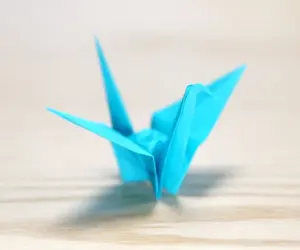

Action origami is paper folding designed to produce a deliberate movement, sound, or shape change when someone taps, pulls, pushes, presses, blows into, or releases the model. Unlike display-focused origami, action origami combines crease geometry with paper elasticity to create interactive mechanisms such as jumping frogs, flapping birds, poppers, balloons, and transforming stars.
Key Facts at a Glance
- Action origami uses folded paper as both the structure and the moving mechanism.
- Creases can function as hinges, springs, linkages, valves, or flexible joints.
- Common examples include jumping frogs, flapping birds, paper poppers, waterbomb balloons, and cootie catchers.
- Pure action origami normally uses one sheet of paper without cutting, glue, pins, or added hardware.
- Typical beginner models take 2-5 minutes and cost about $0.01-$0.15 per sheet using ordinary kami paper.
- Paper thickness, crease alignment, and controlled tension determine whether a model moves reliably.
What Does Action Origami Mean?
Action origami means origami with an intentional kinetic function. The finished fold must perform a repeatable action, such as jumping, flapping, snapping, opening, closing, expanding, collapsing, gliding, or changing configuration after a defined input.
The term covers a family of paper mechanisms rather than one specific folding style. A jumping frog stores energy in a compressed pleat, while a talking fox uses finger pockets as manual controls. A paper balloon expands when air enters its interior, and a flapping bird converts a tail pull into wing movement.
Action origami is therefore different from a static animal model that happens to flex when handled. The motion is part of the design objective. A useful test is simple: if the model cannot be activated in a predictable way, it is a movable paper sculpture, not a successful action model.
Is Action Origami the Same as Kinetic Origami?
Action origami and kinetic origami overlap, but action origami usually describes accessible, user-activated paper models. Kinetic origami can also include engineered structures, robotic mechanisms, deployable devices, and mathematically designed crease patterns that move without a person directly manipulating them.
The distinction is practical rather than absolute. Jeremy Shafer’s interactive paper creations belong comfortably to action origami, while Robert J. Lang’s foldable engineering structures may be better described as origami engineering or deployable origami.
How Does Action Origami Work?
Action origami works by converting an input into stored and released mechanical energy through a crease pattern. Pressing, bending, pulling, twisting, or blowing changes the paper’s shape; the paper’s elastic recovery, geometric constraints, and friction then produce the visible action.
A crease is not a perfect metal hinge. It is a narrow region where paper fibers have been permanently rearranged, partly weakened, and made easier to bend. A valley or mountain fold can guide rotation, while a pleated region distributes bending across several parallel creases.
The action cycle has four stages:
- Input: A finger presses, pulls, taps, slides, or releases a part.
- Loading: The model bends, compresses, twists, or inflates.
- Storage: Paper tension and geometric compression hold potential energy.
- Release: The structure returns toward its relaxed shape and moves another part.
Which Mechanical Elements Appear in Moving Folds?
| Paper element | Mechanical role | Typical example | Observable result |
|---|---|---|---|
| Single crease | Rotational hinge | Flapping bird body | Wing angle changes |
| Accordion pleat | Compression spring | Jumping frog rear legs | Model launches forward |
| Interlocked modules | Sliding linkage | Transforming magic star | Shape changes size |
| Internal pocket | Air chamber or control grip | Paper balloon or fox | Expansion or mouth motion |
| Curved fold pair | Snap-through structure | Paper popper | Sudden inversion and sound |
Paper’s springiness is useful but limited. Repeated sharp bending creates fiber fatigue, so an action model often becomes slower, weaker, or permanently distorted after extended play. Thin office paper may fold easily but lack recovery force, whereas very heavy cardstock can resist folding and crack at concentrated creases.
A useful practitioner rule is to make the action fold sharp enough to guide movement but not so compressed that the paper becomes brittle. The best crease for display is not always the best crease for motion.
What Are the Main Types of Action Origami?
The main types of action origami are flapping, jumping, snapping, inflating, transforming, and manually controlled mouth models. Each category has a different input, mechanical principle, and paper requirement.
| Model category | Input method | Main mechanism | Typical difficulty |
|---|---|---|---|
| Jumping frog | Press and release | Pleated spring | Beginner |
| Flapping bird | Pull the tail | Central hinge and linkage | Beginner-intermediate |
| Paper glider | Throw or release | Aerodynamic folded surfaces | Beginner |
| Paper popper | Swing or snap downward | Buckled air pocket | Beginner |
| Waterbomb balloon | Blow into aperture | Expandable three-dimensional base | Beginner |
| Magic star | Push or slide modules | Interlocked radial linkage | Intermediate |
| Talking fox | Insert and move fingers | Dual control pockets | Beginner |
| Kinetic gear model | Turn a handle or tab | Multiple linked folds | Advanced |
How Do Flapping and Flying Models Move?
A traditional flapping bird usually moves when the folder pulls or pushes the tail. The tail motion rotates a central body section, and that rotation transfers movement to the wings through connected folds.
A paper airplane or glider works differently. Its action comes from flight through air rather than an internal hinge. Wing loading, center of gravity, symmetry, and launch angle determine whether the model glides, stalls, dives, or spirals.
These models should not be judged by the same standard. A flapping bird is a hand-operated linkage. A glider is an aerodynamic object whose performance depends on the surrounding air.
How Do Jumping Frogs and Poppers Store Energy?
A jumping frog stores energy when its rear pleat is compressed. Releasing finger pressure allows the pleat to rebound, transferring force through the body and pushing the frog against the surface.
A paper popper stores energy in a folded pocket that suddenly reverses when the model is swung or pressed. The rapid change in volume and paper tension produces a sharp sound. Poppers need open space around the hands and should not be used near a person’s ear.
How Do Balloons and Transforming Stars Change Shape?
A waterbomb balloon expands when air is blown through its opening, causing pre-creased panels to move from a flat arrangement into a three-dimensional form. The expansion is manual and reversible, so the model qualifies as interactive action origami even though it does not launch or flap.
A magic star uses several folded units locked together in a ring. Sliding the units inward or outward changes the model’s diameter and often reveals a second color or geometric configuration.
Which Paper Is Best for Action Origami?
Standard kami paper around 60-80 grams per square meter is the most reliable starting material for small action models. The paper should fold cleanly, hold a crease, and retain enough flexibility to rebound without tearing.
Paper choice depends on the mechanism rather than the model’s appearance. A jumping frog needs resilience at its rear pleat, while a balloon needs flexible panels that can inflate without splitting. Foil-backed paper can hold complex shapes but may develop permanent kinks if a spring fold is over-compressed.
| Paper type | Typical weight or size | Approximate cost per sheet | Best application |
|---|---|---|---|
| Standard kami | 60-80 gsm, 15 cm square | $0.01-$0.15 | Frogs, balloons, foxes |
| Lightweight copy paper | 75-90 gsm, A4 or letter | $0.02-$0.08 | Poppers and prototypes |
| Foil-backed paper | 70-100 gsm, 15-20 cm square | $0.50-$2.00 | Detailed moving mechanisms |
| Tant or durable specialty paper | 70-100 gsm, 15-24 cm square | $0.30-$1.50 | Repeated demonstrations |
| Heavy cardstock | 160-250 gsm | $0.05-$0.40 | Usually unsuitable for small springs |
Pure action origami uses folding alone, which means zero cuts and zero glue. Classroom adaptations may add tape, rubber bands, or paper clips, but those versions are modified paper mechanisms rather than strict single-sheet origami.
Use larger paper for teaching. A 20 cm square makes crease direction, symmetry, and force distribution easier to inspect than a 15 cm square. For children, avoid sharp wire, staples, and rigid clips near the face or hands.
How Long Does Each Action Origami Project Take?
Beginner action models typically take 2-5 minutes, intermediate models take 10-20 minutes, and advanced kinetic designs can take 45 minutes to more than two hours. Folding accuracy usually affects completion time more than the number of steps.
| Project | Typical paper | Typical folding time | First-use difficulty |
|---|---|---|---|
| Paper popper | One A4 or letter sheet | 2-4 minutes | Low |
| Jumping frog | Half of a letter sheet or rectangle | 4-8 minutes | Low |
| Waterbomb balloon | One 15 cm square | 3-6 minutes | Low |
| Flapping bird | One 15 cm square | 8-15 minutes | Moderate |
| Transforming magic star | 8-16 modules | 20-45 minutes | Moderate |
| Complex kinetic flasher | Specialty paper, 20-30 cm | 45-120+ minutes | High |
Typical material cost remains low because most projects use one sheet. The main expense for advanced folders is specialty paper, replacement sheets, and time spent testing a mechanism rather than the paper object itself.
How Is Action Origami Different From Static Origami?
Action origami prioritizes controlled movement, while static origami prioritizes a stable finished form. The difference affects paper selection, crease treatment, design complexity, durability, and how the model is evaluated.
| Decision factor | Action origami | Static origami |
|---|---|---|
| Primary objective | Repeatable movement | Displayable form |
| Main design problem | Energy transfer and motion | Shape accuracy and detail |
| Preferred paper behavior | Flexible, resilient, moderate crease memory | Crisp, stable, strong crease retention |
| User interaction | Pressing, pulling, blowing, throwing | Usually none after completion |
| Expected wear | Often weakens after repeated cycles | Can remain stable for years indoors |
| Common failure | Dead spring or jammed linkage | Untidy or inaccurate silhouette |
Action origami is the better choice for play, demonstrations, and tactile learning. Static origami is better for display, collecting, exhibition, and highly detailed subjects whose value depends on a fixed silhouette.
The categories are not mutually exclusive. A static model can include a movable wing, and an action model can still have an elaborate appearance. The deciding factor is whether motion is an intended functional outcome.
What Is Action Origami Used For?
Action origami is used for play, classroom demonstrations, informal engineering experiments, puppetry, and accessible introductions to mechanics. Its value comes from making invisible forces visible through a low-cost object that can be built and tested quickly.
A teacher can use a jumping frog to discuss compression, friction, impulse, and surface contact. A flapping bird demonstrates linked rotation, while a waterbomb balloon introduces three-dimensional deployment from a flat sheet. A glider gives students a direct way to compare symmetry, center of mass, and launch angle.
Origami engineering extends these principles beyond toys. Researchers use foldable structures in deployable space systems, medical devices, robotics, and compact packaging. Those systems require precise materials and mathematical modeling, so a classroom frog is an analogy rather than a direct engineering prototype.
Origami designer Robert J. Lang has described origami as “a technology,” a useful framing for action models because the crease pattern determines how forces travel through the sheet. The artistic surface and mechanical behavior are linked, but they are not the same design problem.
When Is Action Origami a Good Learning Tool?
Action origami works well when learners need an immediate physical result from a small design change. Changing one pleat width, crease angle, or paper type can alter jump distance or wing movement without requiring a motor, software, or specialized equipment.
Action origami is less suitable when a lesson requires precise quantitative measurements. Paper varies by grain direction, coating, humidity, and previous handling, so results can differ between sheets even when folds appear identical.
How Do You Fold a Traditional Jumping Frog?
A traditional jumping frog can be folded in about 4-8 minutes from a rectangular sheet, with the rear accordion pleat determining most of the launch performance. A clean center axis and a moderately springy paper produce more consistent jumps than a heavily crushed or oversized model.
Before You Start
| Requirement | Recommended value |
|---|---|
| Paper | One rectangle with a 2:1 length-to-width ratio |
| Beginner size | 15 cm x 7.5 cm |
| Folding time | 4-8 minutes |
| Cost | $0.01-$0.15 |
| Tools | No scissors, glue, ruler, or bone folder |
| Surface | Flat table with enough room for testing |
Step 1: Prepare the Rectangle
Use an index card or create a rectangle from a square by folding the square in half and separating the halves only if cutting is permitted. For pure origami, begin with a correctly sized rectangle rather than cutting during the project.
Success checkpoint: The long edges are parallel and the short edges are square.
Common mistake: Starting with an uneven rectangle causes asymmetry in every later fold.
Step 2: Create the Top X Creases
Place the rectangle vertically. Fold the upper-left corner diagonally to the opposite right edge, crease the diagonal, and unfold. Repeat from the upper-right corner toward the left edge to create an X in the upper section.
Success checkpoint: The two diagonals intersect on the center axis.
Common mistake: Stopping the diagonal before it reaches the edge produces a weak waterbomb collapse.
Step 3: Collapse the Waterbomb Base
Push the left and right sides inward along the diagonal creases while allowing the top edge to move downward. Flatten the result into a triangular flap at the upper end of the rectangle.
Success checkpoint: The triangular flap is centered, with matching left and right edges.
Common mistake: Forcing the paper flat before the diagonal creases are fully established can reverse one fold and twist the body.
Step 4: Fold the Front Legs
Fold the two lower corners of the triangular flap upward toward the top point. These folds create the frog’s front legs and establish the front half’s symmetry.
Success checkpoint: Both leg flaps meet at matching heights.
Common mistake: Folding one leg farther than the other shifts the frog’s centerline and causes a curved launch.
Step 5: Narrow the Body
Fold the left and right raw edges of the lower body inward until they meet at the vertical centerline. Make the folds firm but avoid crushing the paper.
Success checkpoint: The lower body has equal-width sides around the center axis.
Common mistake: Leaving a gap between the edges weakens the body; overlapping them excessively makes the frog too rigid.
Step 6: Form the Rear Spring
Fold the entire bottom edge upward until it meets the base of the front legs. Then fold the same section back downward approximately halfway, creating an accordion pleat.
Success checkpoint: The rear pleat compresses and rebounds without tearing.
Common mistake: Flattening the pleat with excessive pressure removes the spring behavior needed for jumping.
Step 7: Activate the Frog
Turn the model over and place it on a smooth, level surface. Press the rear accordion fold, slide the finger backward toward the rear edge, and release the pressure as the finger leaves the paper.
Success checkpoint: The frog pushes against the surface and travels forward rather than rotating.
Common mistake: Pressing the front half or releasing vertically prevents the rear spring from transferring force efficiently.
Why Does an Action Origami Model Stop Moving?
An action origami model usually stops moving because its hinge is misaligned, its spring fold is overworked, its paper is unsuitable, or friction blocks the intended path. The correct fix depends on the failure symptom rather than on adding force.
| Failure symptom | Likely cause | Correction | Expected result |
|---|---|---|---|
| Frog lies flat | Weak paper or dead pleat | Use 60-80 gsm paper and recreate pleat | Rear section rebounds |
| Frog turns sideways | Off-center body | Re-align leg and body folds | Straighter launch |
| Bird flaps unevenly | Unequal wing angles | Match both hinge creases | Balanced wing cycle |
| Popper stays silent | Pocket not inverted | Sharpen outer folds and snap downward | Audible inversion |
| Balloon leaks shape | Incomplete base creases | Re-crease all diagonals and inflate slowly | More complete expansion |
| Star jams | Modules too tight | Loosen interlocks and reduce crease pressure | Smoother sliding |
How Should You Troubleshoot Paper Problems?
Paper that is too thin bends permanently or fails to rebound after compression. Paper that is too thick resists small hinges and may crack at the fold intersections. Start with ordinary kami or lightweight copy paper before changing the design itself.
Humidity also matters. Damp paper becomes softer and less crisp, while very dry paper can feel brittle. Store unfinished models flat and test replacement sheets in the same direction because paper grain can make one axis more flexible than another.
Overworking is a common hidden failure. A bone folder improves static precision, but aggressive polishing can flatten a spring hinge and reduce its travel. Action creases need definition, not maximum compression.
Which Action Origami Model Should You Choose?
Choose a jumping frog for a visible mechanical result, a paper balloon for the easiest three-dimensional transformation, a talking fox for direct hand control, and a flapping bird for learning linked motion. Advanced folders should move to modular stars or engineered kinetic designs after mastering symmetry and controlled tension.
| User or situation | Recommended model | Paper and size | Typical time | Reason |
|---|---|---|---|---|
| Child making a first model | Waterbomb balloon | 15 cm kami | 3-6 minutes | Few failure points |
| Beginner wanting movement | Jumping frog | 15 cm x 7.5 cm rectangle | 4-8 minutes | Clear input and result |
| Classroom mechanics lesson | Flapping bird | 20 cm kami | 10-20 minutes | Visible linkage |
| Group activity with sound | Paper popper | A4 lightweight paper | 2-4 minutes | Fast construction |
| Experienced folder | Magic star | 8-16 modules | 20-45 minutes | Repeated transformation |
| Engineering-oriented folder | Kinetic mechanism | 20-30 cm specialty paper | 45-120+ minutes | More complex force paths |
For educators, use 20 cm paper, demonstrate the activation before students fold, and test poppers away from ears. For children under close supervision, avoid designs that require forceful snapping or small modular units.
For advanced folders, Jeremy Shafer’s action-oriented designs provide a practical bridge from simple toys to complex kinetic mechanisms. Robert J. Lang’s work is more useful when the goal is mathematical crease design, deployable structures, or engineering principles rather than quick play.
What Is Action Origami Not Good For?
Action origami is not ideal for permanent outdoor display, heavy loads, repeated high-force cycles, or precision mechanisms that require identical performance from every unit. Paper absorbs moisture, accumulates fatigue, and varies enough that a hand-folded model cannot match a manufactured hinge for consistency.
Action origami also has a narrow design envelope. A model must leave room for motion, tolerate repeated bending, and transfer force without buckling in the wrong direction. A highly detailed static animal may have too many layers or cramped folds for a useful action mechanism.
The limitation is instructive. Successful kinetic folding requires sacrificing some surface detail, crease crispness, or long-term durability to preserve movement.
Frequently Asked Questions
Is action origami real origami if the model moves?
Yes. Action origami is generally considered origami when the model’s structure comes primarily from folding paper rather than cutting, gluing, or attaching mechanical parts. The moving function defines the category, while the exact boundary changes when designers add hinges, rubber bands, motors, or other materials.
Can beginners make action origami?
Beginners can make several action models in under 10 minutes. The jumping frog, waterbomb balloon, paper popper, and talking fox require basic valley folds, mountain folds, collapses, or pockets; beginners should use 15 cm kami and focus on symmetry rather than speed.
What is the easiest action origami model?
The paper popper and waterbomb balloon are usually the easiest action origami projects, with typical folding times of 2-6 minutes. The popper produces sound through snap-through motion, while the balloon changes from flat to three-dimensional when air enters its opening.
Does action origami require special paper?
Action origami does not require special paper, but standard 60-80 gsm kami is a reliable starting point. Lightweight copy paper works for larger poppers and prototypes, while heavy cardstock often fails in small spring mechanisms because it resists tight folds and cracks under repeated bending.
How can action origami be used in STEM education?
Action origami gives students a physical demonstration of hinges, compression, elasticity, symmetry, friction, aerodynamic balance, and deployable geometry. A teacher can compare two frogs with different pleat widths or two gliders with different wing angles, then measure travel distance and repeatability.
How long does an action origami model last?
A simple model may remain functional for dozens of gentle activation cycles, but durability varies with paper, crease sharpness, humidity, and force. Static storage can preserve the shape, while repeated compression fatigues spring folds and gradually reduces jumping, snapping, or flapping performance.
The Bottom Line
Action origami is interactive paper folding in which creases create a deliberate mechanical response. Jumping frogs use pleated springs, flapping birds use linked hinges, poppers use snap-through pockets, and balloons use expandable crease patterns. Start with 60-80 gsm paper, maintain a centered axis, and treat the action fold as a mechanical component rather than an ordinary display crease. Understanding what is action origami means understanding how a single sheet stores, redirects, and releases energy through geometry.
