

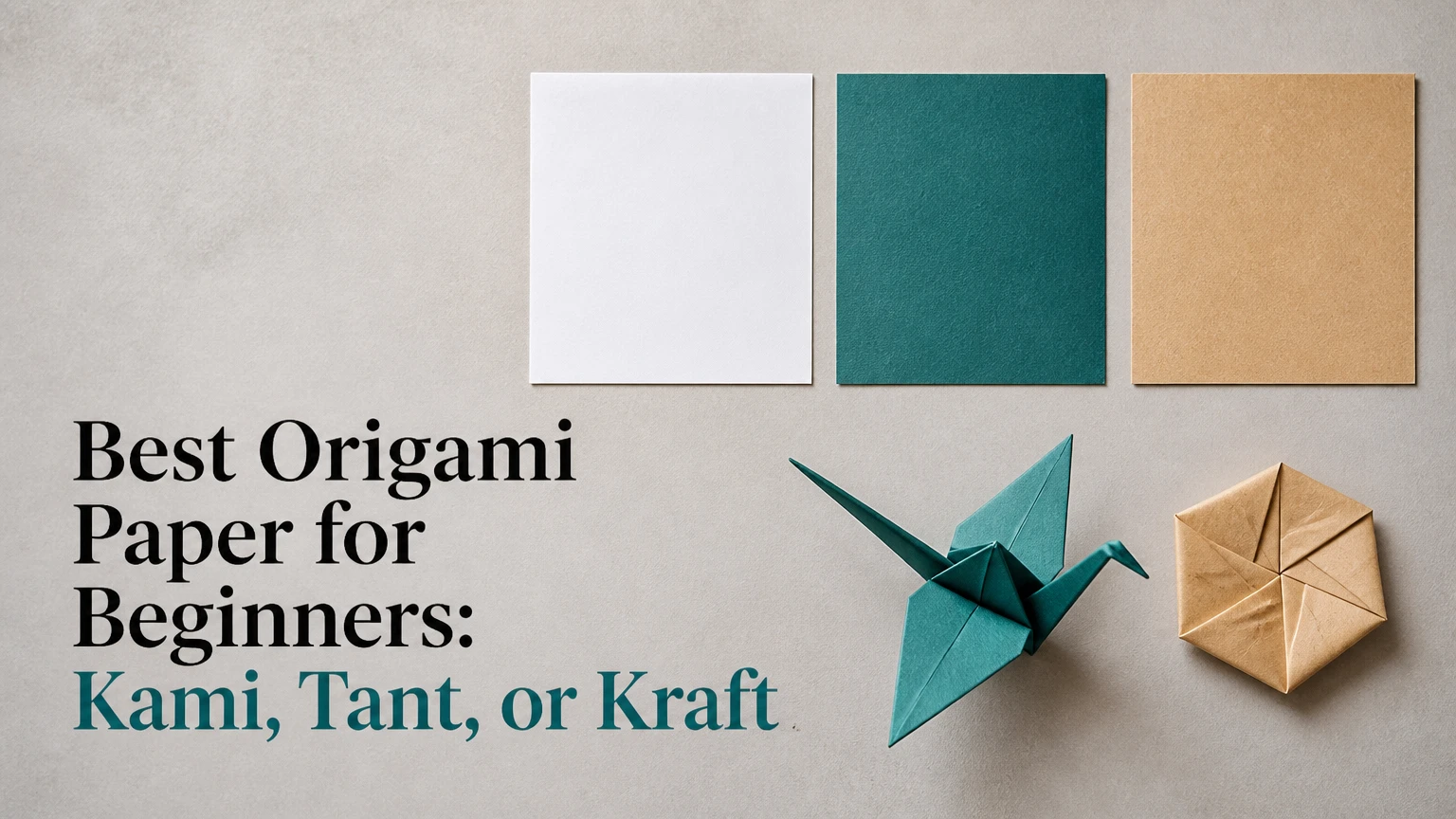
The best origami paper for beginners is standard 15 x 15 cm kami at roughly 50-60 GSM. Kami is inexpensive, easy to align, thin enough for multi-layer folds, and usually colored on one side with a white reverse that clarifies diagram instructions. Choose Tant, kraft, or foil only when a specific model or finish justifies their trade-offs.
Key Facts at a Glance
- Standard kami is the best first purchase for most beginners learning cranes, frogs, flowers, animals, and basic geometric models.
- A 15 x 15 cm square gives most adult and older-child beginners enough area for accurate folds without excessive paper sag.
- Paper weight alone does not determine folding quality; fiber length, coating, stiffness, grain direction, and surface texture also affect results.
- Thin copy paper can work for large practice models, but 80-90 GSM printer sheets become bulky in models with many layers.
- Tant paper gives both sides the same color and greater durability, but its 70-80 GSM body makes dense folds harder.
- Foil paper holds curved or sculpted forms well, yet its creases are difficult to reverse and its surface can wrinkle permanently.
What Is the Best Origami Paper for Beginners?
Standard kami is the strongest all-purpose choice because it minimizes the three problems that stop new folders: inaccurate alignment, excessive layer thickness, and poor crease visibility. A typical 15 cm kami sheet costs only a few cents when purchased in a 100-500-sheet pack, so beginners can repeat a model without treating every failed attempt as expensive.
Kami usually has a smooth, colored face and an unprinted white face. That contrast gives orientation information during diagrams, especially when instructions say to turn the paper over or form a colored flap. OrigamiUSA’s paper reviews commonly distinguish kami by how well it accepts repeated creasing, how much it stretches, and how cleanly it collapses into a base. Those practical properties matter more than a premium label.
Standard kami is not the best paper for every project. Dense insects, wet-folded animals, large display pieces, and models requiring matching color on both sides may benefit from Tant, kraft, tissue foil, or specialty Japanese papers. For a first pack, however, a 15 cm kami assortment offers the lowest-cost path to learning hand control.
Our Top Picks
| Category | Recommended paper | Typical size | Typical weight | Best first models |
|---|---|---|---|---|
| Best overall | Standard kami | 15 x 15 cm | 50-60 GSM | Crane, frog, heart, fox |
| Best for children | Large kami | 20 x 20 cm | 50-60 GSM | Boat, dog, tulip, jumping frog |
| Best for premium color | Toyo Tant | 15 x 15 cm | 70-80 GSM | Box, kusudama unit, geometric star |
| Best budget practice | Thin kraft | 15 x 15 cm cut squares | 50-70 GSM | Repeated bases, test folds |
| Best for sculpting | Tissue foil | 15-20 cm | Variable | Insects, curved animals, masks |
How Does Origami Paper Work?
Origami paper works because a thin, flexible sheet distributes stress along fibers while a sharp crease creates a controlled hinge. Each additional layer increases resistance, so paper that feels manageable at the first fold can become too thick at the final collapse. Kami balances flexibility and crease memory better than ordinary craft sheets for introductory models.
Paper fibers also have a grain direction. Folding parallel to the grain usually feels smoother, while folding across it can require more force and may produce a rougher crease. Grain matters most with larger sheets, long narrow folds, and heavier papers. A simple test is to gently curve two strips cut in different directions; the strip that bends more easily usually follows the grain.
The surface finish changes handling. A coated sheet slides during alignment but may resist sharp creases, while an uncoated sheet grips neighboring layers and can be easier to collapse. Texture improves visual depth on Tant paper but can make tiny crease intersections less precise.
What Should Beginners Look for in Paper?
Beginners should prioritize a true square, moderate thinness, a smooth or lightly textured surface, and enough contrast to read orientation. The following specifications are practical starting points rather than universal laws, because a 70 GSM sheet with soft fibers can fold more easily than a stiff 55 GSM sheet.
| Attribute | Beginner target | Why it matters | Warning sign |
|---|---|---|---|
| Sheet size | 15 x 15 cm | Fits common diagrams and adult hands | 7.5 cm sheets hide alignment errors |
| Paper weight | 50-60 GSM | Limits bulk in 8-20-step models | 80 GSM becomes dense in layered bases |
| Shape accuracy | Within 0.5 mm | Prevents diagonal drift | Unequal sides distort later folds |
| Surface | Smooth or mild texture | Supports clean crease intersections | Glossy coating causes slipping |
| Color layout | Single-sided or high-contrast | Makes orientation visible | Similar colors obscure front and back |
| Pack quantity | 100-200 sheets | Allows repetition and testing | 20-sheet packs discourage practice |
The 50-60 GSM range is a useful buying filter, not a pass-or-fail standard. Paper made for origami can outperform heavier office paper because it may be more pliable and less coated. Conversely, very light paper under approximately 40 GSM can collapse easily but tear at narrow points, particularly when beginners repeatedly reopen folds.
Which Origami Paper Types Suit Beginners?
Standard kami suits first projects, Tant suits durable colored models, kraft suits inexpensive repetition, and foil suits shaped display work. No paper type wins every category because ease of folding, appearance, crease permanence, and layer management pull in different directions.
Standard Kami: Best Overall
Standard kami is usually the right first pack for traditional origami. Its white reverse makes mountain and valley orientation easier to follow, while its thin body supports common bases such as the preliminary, bird, waterbomb, and frog bases.
Kami’s main weakness is overworking. Repeatedly unfolding and refolding the same line can weaken the sheet, and dark colors may reveal white edges at exposed layers. That limitation is acceptable during skill building because the low price supports multiple attempts.
Choose kami if you are learning diagrams, folding animals, or practicing 10-30 minute models. Skip it for large sculptural pieces that need substantial shape memory or for designs where exposed white edges would be distracting.
Tant Paper: Best for Double-Sided Color
Tant is a dyed-through Japanese paper with a lightly textured surface and a typical weight around 70-80 GSM. Both faces retain color, so a folded edge does not reveal a stark white strip. The material also feels more substantial in finished modular units and boxes.
The cost is higher, and the extra body accumulates quickly. A modular unit with several layers may remain manageable, but a complex animal with many narrow points can become resistant before the final steps. Tant also tends to preserve mistakes more visibly because reopening a firm crease can leave a permanent line.
Choose Tant when color continuity matters or when a simple model will be displayed. Skip it as the only paper for a child or adult learning basic alignment from scratch.
Kraft Paper: Best for Repetition
Thin kraft paper is a practical rehearsal material because it is inexpensive, widely available, and less visually precious than patterned sheets. A roll or large pack can provide hundreds of practice squares, although the user must cut them accurately.
Kraft varies significantly by manufacturer. Grocery-bag paper is often too coarse or stiff, while dedicated lightweight kraft around 50-70 GSM can fold cleanly. Brown paper also hides some surface dirt and handling marks, which helps in classrooms and workshops.
Choose kraft when you need 20 or more repetitions of one base or want to test a complex crease pattern before using decorative paper. Skip it when diagram orientation depends on a colored and white side or when the paper has a strong curl from roll storage.
Foil and Tissue Foil: Best for Shape Retention
Foil paper combines a thin metallic layer with paper, while tissue foil often uses foil laminated between very thin tissue sheets. The material holds curved legs, wings, and rounded bodies better than ordinary kami because it resists spring-back after shaping.
Foil paper is unforgiving. A misplaced crease remains visible, and stretching the sheet can create a wrinkle that cannot be removed. Beginners may find it useful after learning a model in kami, but it is a poor first medium for understanding corrections.
Choose foil for insects, sculptural animals, stars, and models with curved shaping. Skip it for first attempts, wet-folding practice, or diagrams that require frequent unfolding.
How Do Kami, Tant, Kraft, and Foil Compare?
Kami is the best overall beginner paper because it provides the lowest cost and the clearest learning feedback. Tant wins for double-sided color, kraft wins for high-volume rehearsal, and foil wins for sculpted forms that must retain a curve.
| Paper type | Typical weight | Typical price | Crease behavior | Best use |
|---|---|---|---|---|
| Kami | 50-60 GSM | $5-$10 per 100-500 sheets | Sharp, moderate memory | Cranes, frogs, flowers |
| Tant | 70-80 GSM | $8-$15 per 50-100 sheets | Firm, strong memory | Boxes, modular units |
| Kraft | 50-70 GSM | $5-$15 per roll or bulk pack | Moderate, variable by grain | Rehearsal and classrooms |
| Foil | 50-70 GSM equivalent | $6-$12 per 50 sheets | Permanent, low spring-back | Insects and curved models |
How Much Does Beginner Origami Paper Cost?
A beginner usually spends $5-$10 on a large kami pack, $8-$15 on Tant, or $6-$12 on a 50-sheet foil pack. The meaningful cost difference is not the initial package price; it is the number of usable practice attempts and the amount of waste caused by unsuitable paper.
| Buying option | Typical quantity | Typical total cost | Approximate cost per sheet | Suitable buyer |
|---|---|---|---|---|
| Kami assortment | 100 sheets | $5-$8 | $0.05-$0.08 | Individual beginner |
| Kami bulk pack | 300-500 sheets | $8-$15 | $0.02-$0.05 | Daily practice |
| Tant assortment | 50 sheets | $8-$12 | $0.16-$0.24 | Display-focused adult |
| Thin kraft roll | 100-300 cut squares | $5-$15 | $0.05-$0.15 | Classroom or rehearsal |
| Foil pack | 50 sheets | $6-$12 | $0.12-$0.24 | Intermediate sculptural work |
A 200-sheet kami pack can last two to four months for someone folding two or three models per day, although model size and failure rate change that estimate. A classroom using 25 sheets per session may consume the same pack in eight sessions.
What Size Origami Paper Should Beginners Buy?
Most beginners should buy 15 x 15 cm paper, while children, people with limited dexterity, and dense diagrams may benefit from 20 x 20 cm sheets. Small 7.5 cm squares are better for finished miniatures than for learning because small creases and alignment errors are difficult to see.
| Sheet size | Hand-control demand | Typical model scale | Recommended situation | Main limitation |
|---|---|---|---|---|
| 7.5 x 7.5 cm | High | Miniature crane | Experienced folders | Creases are hard to place |
| 10 x 10 cm | Moderate-high | Small animals | Compact decorations | Limited finger access |
| 15 x 15 cm | Moderate | Standard crane and frog | Most beginners | Less room for dense models |
| 20 x 20 cm | Low-moderate | Large animals and flowers | Children and accessibility | Extra paper can sag |
| 30 x 30 cm | Low at first, high later | Display models | Large complex folds | Cost and storage increase |
A larger sheet does not automatically make every model easier. On a simple boat, 20 cm paper gives children better finger access. On a loose waterbomb base, the same sheet may flex under its own weight and make alignment harder. Match size to both the folder and the model.
How Should Beginners Fold Kami Without Tearing It?
Beginners should align corners before pressing the crease, pre-crease lightly, then sharpen the line with a thumb or smooth plastic tool. The most important control is tension: forcing two misaligned edges together transfers stress to the center junction and causes tearing.
Use this five-stage workflow:
- Check the square. Fold one diagonal corner to corner without pressing hard. If the opposite edges do not meet, replace the sheet or trim it accurately.
- Pre-crease gently. Place the intended fold, align the edges, and make a light first pass. Do not drag the paper sideways.
- Sharpen the crease. Run a fingernail, thumbnail, or plastic bone folder along the fold from the center outward. A metal ruler can cut thin kami.
- Collapse the base. Bring several pre-creased lines together gradually rather than squeezing the center in one motion.
- Shape the model. Use small, controlled folds for eyes, legs, petals, or wings. Recheck symmetry before locking each final crease.
You will know the process is working when corners meet without puckering, the center junction stays flat, and the sheet moves along existing creases rather than resisting them. If the model requires excessive force, the paper is probably too thick, the square is inaccurate, or a previous fold is misaligned.
Which Paper Is Best for Common Beginner Models?
Kami is the best paper for cranes and jumping frogs, while larger kami helps children with boats, dogs, and tulips. Tant suits boxes and modular units, and foil becomes useful only when the model depends on curved or rigid shaping.
| Beginner model | Recommended paper | Recommended size | Typical folding time | Reason |
|---|---|---|---|---|
| Traditional crane | Kami | 15 x 15 cm | 10-20 minutes | Clear orientation and thin layers |
| Jumping frog | Kami | 15-20 cm | 10-15 minutes | Firm creases improve spring action |
| Simple boat | Kami | 15-20 cm | 5-10 minutes | Large surface tolerates alignment errors |
| Origami dog | Kami | 15-20 cm | 5-12 minutes | White reverse clarifies face folds |
| Masu box | Tant | 15 x 15 cm | 10-20 minutes | Double-sided color improves edges |
| Modular star | Tant or kami | 15-20 cm | 30-90 minutes | Consistent units need durable paper |
| Simple insect | Foil or kami | 15-20 cm | 20-45 minutes | Foil retains narrow curved parts |
For a crane, choose a single-color kami sheet rather than a busy pattern. Patterns can hide whether a corner is aligned, especially at the bird-base stage. For modular origami, test one unit before cutting or folding the entire pack because paper stiffness determines whether the completed units lock together.
Can You Use Printer Paper or Construction Paper?
Printer paper can work for large, simple practice folds, but ordinary 80-90 GSM sheets are usually too bulky for compact multi-layer models. Construction paper is generally a poor substitute because its coarse fibers and surface coating can crack or resist sharp folds.
| Alternative | Typical weight | Works for | Fails for | Practical adjustment |
|---|---|---|---|---|
| Copy paper | 80-90 GSM | Boat, hat, large heart | Crane, dense animal bases | Use 20-30 cm sheets |
| Newsprint | 40-50 GSM | Repeated practice folds | Durable display models | Fold gently and replace often |
| Construction paper | 100-180 GSM | Flat cut crafts | Multi-layer origami | Avoid narrow reverse folds |
| Scrapbooking paper | 120-220 GSM | Simple decorative boxes | Complex animals | Score lightly before folding |
| Gift wrap | 30-70 GSM | Large loose models | Precise small models | Mount only if the backing stays flexible |
The common mistake is judging paper by the first fold. Thick paper often feels strong at the start, then accumulates too many layers around the center and makes later folds impossible. A paper that survives folding is not necessarily a paper that permits the final model to close.
What Mistakes Make Beginner Origami Paper Fail?
Most beginner failures come from inaccurate squares, excessive force, poor orientation, or a mismatch between paper weight and model complexity. Changing paper can help, but correcting the preceding fold is often more effective than buying a premium sheet.
| Problem | Likely cause | Recovery action | Prevention |
|---|---|---|---|
| Center tears | Misaligned edges or forced collapse | Reopen to the last clean crease | Align corners before sharpening |
| Model springs open | Weak or incomplete creases | Re-crease from center outward | Sharpen each structural fold |
| White edges show | Single-sided kami on exposed layers | Use Tant or orient layers deliberately | Choose double-sided color |
| Paper wrinkles | Sliding during alignment | Flatten gently under a book for 10 minutes | Lift and reposition, do not drag |
| Final layers resist | Paper too heavy | Restart with 50-60 GSM kami | Test a model before bulk folding |
| Shape looks asymmetric | Unequal corners or rushed pivots | Compare both sides at each checkpoint | Rotate the model and inspect |
A 1 mm error can become visible several steps later because diagonal folds divide the original square repeatedly. The error is not mathematically guaranteed to “break” a model, but it can shift points enough to prevent a clean collapse. Accurate trimming matters more as the design becomes geometric.
Should You Use a Bone Folder?
A plastic bone folder can sharpen broad creases, but beginners rarely need one. A clean thumbnail or the rounded edge of a credit card applies enough pressure without cutting thin kami.
Do not use a knife, metal ruler edge, or sharp scoring tool on lightweight paper. Tools that work on cardstock can slice fibers in 50 GSM kami. For children, adult supervision matters more than specialized equipment, and a smooth tabletop is usually sufficient.
Which Paper Should Each Beginner Buy?
Different folders need different first purchases because hand size, model ambition, finish expectations, and practice volume change the value calculation. Standard kami remains the default, but the following choices prevent common mismatches.
For Children and Beginners With Limited Dexterity
Choose 20 x 20 cm kami in a 50-60 GSM weight, preferably with solid colors and a white reverse. The larger surface gives fingers more room to pinch corners and makes diagram checkpoints easier to inspect.
Avoid 7.5 cm mini sheets, foil, and heavily patterned packs. A child can move to 15 cm paper after completing several models without assistance.
For Adults Who Want Display-Ready Results
Choose a mixed pack containing 15 cm kami plus a smaller Tant assortment. Learn each design in kami first, then refold the successful model in Tant when double-sided color or surface texture improves the finished appearance.
Tant is not automatically more attractive. Its heavier body can leave bulky corners, so a simple box may look better than a complex animal.
For Classrooms and High-Volume Practice
Choose 200-500 sheets of kami or lightweight kraft cut to 15 cm. Count approximately 3-5 sheets per student for a first session because early attempts often fail at the base or final shaping stage.
Store the paper flat in a dry cabinet. Humidity softens uncoated sheets, while tightly rolled kraft develops a curl that complicates diagonal alignment.
What Is the Best Beginner Origami Paper Buying Checklist?
A reliable purchase should contain accurately cut squares, enough sheets for repetition, and a weight suitable for the models in the instruction book. Check the pack before committing to a large quantity, because product names such as “origami paper” do not guarantee comparable stiffness or fiber quality.
Use this checklist:
- Buy 15 x 15 cm sheets for standard adult beginner diagrams.
- Choose 50-60 GSM kami for cranes, frogs, flowers, and basic animals.
- Confirm whether the color is single-sided, double-sided, metallic, or printed.
- Prefer 100 sheets or more for skill development.
- Reject sheets with curled corners, visible size variation, or glossy plastic coating.
- Test one sheet with a diagonal fold and a four-layer corner.
- Buy Tant for color continuity, not because heavier paper is inherently better.
- Buy foil after learning the model in ordinary kami.
- Select 20 cm sheets for children or folders who need greater finger access.
- Keep a few plain white or light-colored sheets for diagrams where orientation is difficult.
Frequently Asked Questions
Is expensive Japanese origami paper easier to fold?
Expensive Japanese paper is not automatically easier for beginners. Specialty washi may have beautiful fibers, texture, or color, but some sheets are thicker, softer, or more absorbent than standard kami. Beginners usually gain more from accurate 15 cm kami and repeated practice than from a premium sheet that hides orientation cues.
Is double-sided origami paper better than single-sided paper?
Double-sided paper is better when exposed edges and reverse flaps should match the model’s color. Single-sided kami is better for learning diagrams because the white reverse reveals orientation and helps identify which layers are moving. Choose the layout according to the model and learning stage, not appearance alone.
How many sheets should a beginner buy?
A first-time folder should buy at least 100 sheets, while a classroom or daily practitioner should buy 200-500 sheets. A 20-sheet pack may cover a single project but provides too little room for failed attempts, repeated bases, and testing different folding sequences.
Can beginners fold origami with newspaper?
Newspaper works for large, forgiving models such as boats, hats, and oversized animals, but it is weak and transfers ink to hands and tables. Newsprint around 40-50 GSM can be useful for rehearsal, yet standard kami produces cleaner creases and more durable finished models.
Why does my origami paper keep unfolding?
Origami paper usually springs open because the crease is incomplete, the layers are misaligned, or the paper is too thick for the model. Return to the last successful step, align the edges without tension, and sharpen the fold from the center outward using a thumb or smooth plastic edge.
Should beginners buy patterned origami paper?
Beginners should start with solid colors or patterns with strong contrast. Dense prints make it harder to see corners, crease intersections, and the direction of flaps in diagram-based models. Patterned paper becomes more useful after the folder can complete the same model accurately with plain kami.
The Bottom Line
The best origami paper for beginners is standard 15 x 15 cm kami weighing approximately 50-60 GSM. It offers the clearest orientation, the lowest practice cost, and enough flexibility for the models most beginners learn first. Move to 20 cm kami for children, Tant for double-sided color, kraft for repeated rehearsal, and foil for shaped display models after the basic folds are reliable.
