


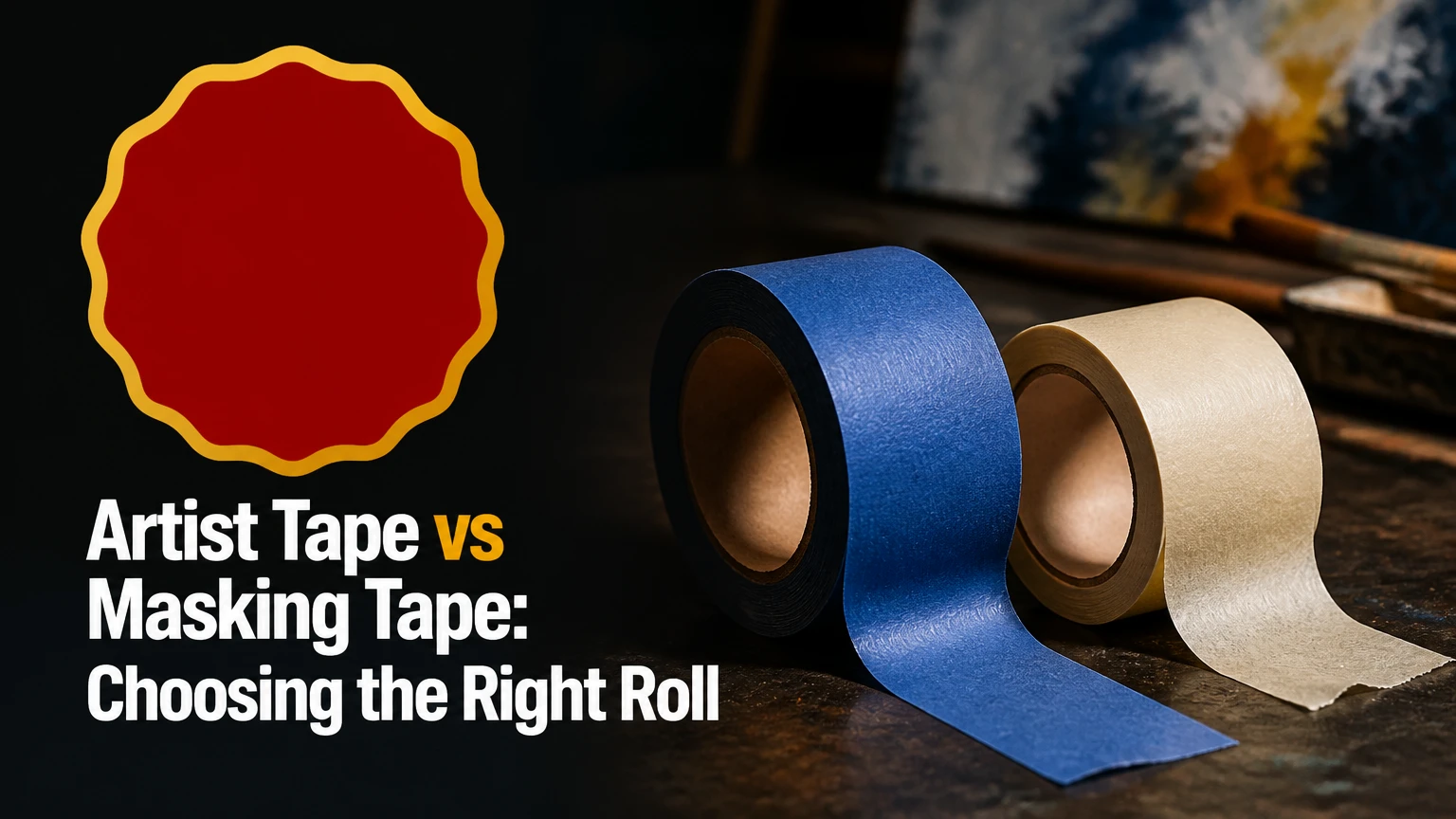
Artist tape is the safer choice for temporary borders, paper attachment, and delicate artwork because it usually has a smoother backing and a lower, more controlled peel force. Masking tape is the better utility product for durable surfaces, labeling, bundling, and short painting jobs. Neither category guarantees archival safety, so the adhesive specification and surface test matter more than color alone.
Key Facts at a Glance
- Artist tape is designed for controlled temporary adhesion on paper, canvas, boards, and drafting surfaces.
- Standard masking tape commonly has a crepe-paper backing and stronger initial grab than artist or drafting tape.
- Low tack does not automatically mean acid-free, pH-neutral, or archival.
- Blue painter’s tape is a masking-tape family product, but its adhesive and removal window vary by manufacturer.
- Thin origami paper can show adhesive staining or fiber lift even when a tape roll feels gentle.
- A small test strip, slow removal, and manufacturer instructions provide better protection than a universal day limit.
Artist Tape vs Masking Tape: What Is the Difference?
Artist tape is a precision masking product made for art, drafting, mounting, or studio work where controlled removal matters. Masking tape is a general-purpose pressure-sensitive tape made for holding, labeling, bundling, and masking common construction or household surfaces.
Both tapes use pressure-sensitive adhesive, or PSA. Pressure activates contact between adhesive and surface, while peel force determines how much stress reaches the paper fibers, paint film, varnish, or coating during removal.
The practical distinction is controlled risk. Artist tape typically prioritizes clean release, a flatter paper backing, and reduced residue. Standard masking tape typically prioritizes quick hand tearing, conformability, and reliable grip on wood, metal, glass, cardboard, or painted surfaces.
Product design varies widely. A professional artist tape can use synthetic rubber or acrylic adhesive, and a premium masking tape can also use acrylic adhesive. Color alone cannot identify chemistry, acidity, or removal performance.
| Attribute | Artist tape | Standard masking tape | Practical consequence |
|---|---|---|---|
| Typical backing | Smooth flatback paper, 18-25 mm wide | Crepe paper, 18-48 mm wide | Flatback tape leaves a cleaner border |
| Typical tack | Low to medium, product-specific | Medium to high, product-specific | Masking tape grips rough surfaces more aggressively |
| Common roll length | 25-55 m | 18-55 m | Retail value depends on length, not roll appearance |
| Primary design goal | Controlled masking or temporary paper attachment | Utility holding, labeling, and surface masking | Choose by surface sensitivity and required strength |
| Removal risk | Lower on tested surfaces | Higher on fragile or porous paper | Slow peel remains necessary for both products |
| Typical retail range | $6-$25 per roll | $2-$12 per roll | Archival claims and specialty backing raise price |
Is Artist Tape the Same as Masking Tape?
Artist tape is a specialized form of masking tape in the broad functional sense, but the categories are not interchangeable in practice. A product labeled artist tape may be optimized for paper and paint boundaries, while ordinary masking tape may leave residue, tear fibers, or allow paint seepage.
The word “artist” is a product description, not a universal conservation certification. Check for terms such as acid-free, pH-neutral, archival, non-staining, removable, and the recommended dwell time. A tape intended for watercolor paper is a different risk proposition from tape intended for canvas stretching or shipping labels.
Is Masking Tape Always Acidic?
Masking tape is not always acidic, and standard masking tape should not automatically be described as a permanent paper-damaging adhesive. Many products are temporary and perform acceptably on robust surfaces for short periods. The problem is that ordinary masking tape rarely provides the same paper-safety specification, adhesive control, or testing expected for artwork.
Paper damage depends on adhesive formulation, backing, heat, ultraviolet exposure, pressure, paper sizing, surface porosity, and time. A tape that removes cleanly from a coated sketchbook cover can bond strongly to unsized cotton watercolor paper.
How Do the Adhesives Behave?
Pressure-sensitive adhesives bond through contact, wetting, and mechanical interaction with the surface. Firm burnishing increases contact area, while heat and extended dwell time can increase flow into microscopic texture, especially on porous paper, unsealed wood, and matte paint.
Peel force is the useful studio concept. High tack describes initial grip, but a tape can have moderate initial tack and still become difficult to remove after heat, pressure, or prolonged contact. Shear resistance describes how well the tape resists sliding, whereas peel performance determines the stress imposed during removal.
| Adhesive factor | Low-tack artist or drafting tape | General masking tape | Why it matters |
|---|---|---|---|
| Initial grab | Light to moderate | Moderate to strong | Strong grab can disturb loose paper fibers |
| Surface wetting | Limited on rough paper | Greater on textured surfaces | Better wetting can increase residue risk |
| Shear holding | Usually modest | Moderate | Artist tape is poor for heavy suspended loads |
| Peel release | Controlled when used correctly | More variable after heat or dwell | Slow, low-angle removal reduces lifting |
| Water exposure | Backing may soften or wrinkle | Crepe backing may swell or split | Wet edges can permit capillary bleed |
| UV and heat tolerance | Product-specific | Product-specific | Outdoor painter’s tape differs from utility tape |
Acrylic adhesive does not automatically make a tape archival, and natural rubber adhesive does not guarantee immediate failure. The formulation, backing, additives, coating, and intended service window determine performance. Conservation professionals evaluate the complete product, not one ingredient in isolation.
Which Tape Works on Each Surface?
Artist tape is preferable for fragile paper, watercolor borders, drawing boards, and temporary alignment when the product carries suitable low-tack or archival specifications. Masking tape is appropriate for sealed wood, metal, glass, cardboard, and short-duration household masking when surface damage is acceptable or unlikely.
Origami requires extra caution because kami, washi, and tissue-weight papers have low mass and exposed fibers. Even a small adhesive footprint can create a shiny patch, curl a flap, or pull fibers from a crease.
| Surface or project | Preferred first choice | Typical width | Test requirement |
|---|---|---|---|
| Cold-press watercolor paper | Low-tack artist tape | 18-25 mm | Test on a paper edge for 5-10 minutes |
| Hot-press watercolor paper | Artist or premium painter’s tape | 18-25 mm | Test over both blank and painted areas |
| Gessoed canvas | Artist tape or painter’s tape | 24-38 mm | Confirm cured gesso and dry paint |
| Origami kami or tissue | Removable drafting tape, temporary tab | 6-12 mm | Test on scrap of identical paper |
| Sealed wood | Painter’s tape or masking tape | 24-48 mm | Test finish for lifting or staining |
| Glass or metal | Masking or painter’s tape | 24-48 mm | Clean grease and test residue |
| Uncoated cardboard | Masking tape for short use | 18-48 mm | Expect possible fiber lift |
| Painted wall | Painter’s tape matched to cure and finish | 24-48 mm | Test in an inconspicuous location |
Why Is Origami Different?
Origami uses folds rather than a continuous adhesive bond, so tape should usually function as a temporary positioning aid rather than a structural substitute. On thin kami, use a narrow strip on the reverse side, place it over a sacrificial tab when possible, and remove it before final presentation.
For modular origami, removable drafting tape can hold units during alignment, but tape should not bridge a stressed hinge unless the finished model hides the repair. Washi tape is useful for decorative reinforcement, although its visible color and paper thickness change the design.
A practitioner rule is simple: never test tape on a finished kusudama, tessellation, or wet-fold model first. Make one spare unit from the same paper, apply the intended pressure, leave the tape for the expected working period, and remove it under the same lighting and humidity conditions.
What Types Should You Consider?
Artist tape, drafting tape, washi tape, painter’s tape, and gummed paper tape overlap visually but serve different jobs. The correct choice depends on whether the tape must release, carry load, create a paint barrier, or become a permanent conservation component.
| Tape type | Backing and adhesive | Typical use | Main limitation |
|---|---|---|---|
| Flatback artist tape | Smooth paper, low or medium tack PSA | Painting borders and studio notes | May fail on dusty or highly textured surfaces |
| Drafting tape | Thin paper, very low tack PSA | Holding tracing paper and plans | Cannot carry substantial load |
| Japanese washi painter’s tape | Thin rice paper, precision adhesive | Fine paint lines and decorative masking | Some versions are decorative, not archival |
| Blue painter’s tape | Crepe or specialty paper, removable PSA | Walls, trim, household painting | Removal window varies by product and finish |
| Gummed archival tape | Kraft paper, water-activated starch adhesive | Paper hinging and watercolor stretching | Often permanent or difficult to reverse |
| Utility masking tape | Crepe paper, general-purpose PSA | Labels, bundling, rough masking | Higher risk on fragile paper and cured artwork |
Is Gummed Paper Tape Artist Tape?
Gummed paper tape is a separate class from self-adhesive artist tape. Water-activated gummed tape can be used for archival hinging or watercolor-paper stretching because the adhesive is activated with moisture, but that process requires conservation technique and is not a casual masking substitute.
Do not use gummed tape to create a removable painting border. Water activation can buckle paper, and removal may require controlled moisture that affects media, sizing, or mounting materials.
How Should You Apply and Remove Tape?
A clean border depends on surface preparation, moderate pressure, dry paint, and a low-angle peel. The full process usually takes 5-15 minutes to prepare and 2-10 minutes to remove, excluding drying time, while the most important factor is matching tape tack to the paper and coating.
Before You Start
| Requirement | Typical value |
|---|---|
| Materials | Tape, scissors, clean cloth, soft eraser, burnishing tool |
| Preparation time | 5-15 minutes |
| Removal time | 2-10 minutes |
| Tape cost | $0.10-$0.60 per project border |
| Difficulty | Low for dry media, moderate for wet media |
| Prerequisite | Fully dry, dust-free surface and a test strip |
Step 1: Test the Tape
Cut a 50-75 mm strip and apply it to a scrap or hidden edge made from the same material. Press with one finger, wait for the planned dwell time, and remove at a 180-degree fold.
You will know the tape is acceptable when the strip leaves no gloss change, adhesive residue, lifted fibers, or paint transfer. A common mistake is testing only on a smooth cover when the final artwork uses absorbent cotton paper.
Step 2: Clean the Boundary
Remove graphite dust, loose fibers, oil, and moisture with a soft brush or clean lint-free cloth. Do not aggressively rub watercolor paper because abrasion changes the sizing and creates a weaker edge.
The boundary should feel dry and smooth. Any remaining dust can create channels beneath the tape, while moisture can soften paper and increase paint seepage.
Step 3: Place and Lightly Burnish
Align the tape with the intended border and press from the outer side toward the edge. Burnish the inner edge with a fingertip, cotton swab, or soft bone folder, but avoid crushing a soft paper surface.
The tape should contact the edge continuously without stretching the backing. Stretching can cause the strip to contract, lift, or distort the border during painting.
Step 4: Seal the Paint Edge
For watercolor or acrylic, apply a thin line of the background color along the tape edge and let it dry before adding the contrasting color. This fills small gaps with a compatible coating and reduces capillary bleed.
Clear medium can work on suitable acrylic surfaces, but it may leave a sheen or alter absorbency. A common mistake is applying a thick seal coat, which creates a raised ridge that remains visible after tape removal.
Step 5: Paint Without Flooding
Apply controlled layers instead of leaving a large pool against the tape for hours. Water can travel under an edge through capillary action, especially when the tape backing wrinkles or the paper is heavily textured.
You will know the masking stage worked when the paint reaches the edge without a fuzzy halo. Do not judge the boundary while the surface is glossy with water; wait until the paint film has settled.
Step 6: Remove at the Right Time
Remove tape after the paint is dry to the touch but before a thick paint film forms a hard bridge across the tape edge. Fold the tape back against itself and pull slowly, keeping the strip close to the surface at roughly 180 degrees.
If the paper begins to lift, stop immediately, reduce the pull angle, and work from the opposite end. A common mistake is pulling upward at 90 degrees, which directs force into the paper surface.
How Long Can Tape Stay on Artwork?
A conservative working window is 15 minutes to several days for artist tape, depending on the exact product, paper, temperature, humidity, pressure, and media. Standard masking tape is safer when removed the same day, often within 4-24 hours, but manufacturer instructions override these typical ranges.
The frequently repeated claim that artist tape is always safe for 30-60 days is too broad. A low-tack tape may release after weeks in one studio and bond more firmly after heat, sunlight, or heavy burnishing in another.
| Condition | Conservative tape approach | Typical action |
|---|---|---|
| Thin origami paper | Very low tack, narrow strip | Remove within the same session |
| Dry graphite on smooth board | Drafting or artist tape | Remove within 1-3 days |
| Watercolor on cotton paper | Tested artist tape | Remove after drying, usually same day |
| Acrylic on gessoed canvas | Artist or painter’s tape | Remove when dry to touch, often 1-24 hours |
| Interior wall paint | Product-rated painter’s tape | Follow label, commonly 1-14 days |
| Outdoor metal or glass | UV-rated painter’s tape | Follow product rating, often hours to 14 days |
What Are the Main Failure Modes?
Tape failure usually comes from a mismatch between adhesive strength and surface sensitivity, not from the tape color. Heat, pressure, moisture, porous fibers, uncured paint, and excessive dwell time amplify the mismatch.
| Failure | Likely cause | Recovery |
|---|---|---|
| Paper fibers lift | Tack too high or peel angle too steep | Stop, lower the angle, and peel slowly |
| Paint bleeds | Textured edge, pooled water, or weak seal | Dry surface, seal edge, and use thinner layers |
| Sticky residue remains | Long dwell, heat, or adhesive transfer | Do not scrub; isolate and consult conservator |
| Tape tears into pieces | Wet backing or low tensile strength | Remove smaller sections with tweezers |
| Paint film pulls away | Paint or gesso was not cured | Stop and allow full cure before retesting |
| Border looks glossy | Burnishing or adhesive altered surface | Avoid further rubbing and compare with test area |
Can a Hair Dryer Remove Stuck Masking Tape?
Gentle warmth can soften some adhesive residues, but a hair dryer is risky on paper, wax, plastic, thermoplastic coatings, and heat-sensitive artwork. Use the lowest setting, keep the dryer moving, and test a hidden area before applying warmth.
Never heat an original artwork as a default repair. Conservators may use controlled thermal or solvent methods, but the correct treatment depends on the adhesive, support, media, and mounting history. Scraping, soaking, or adding solvent can cause more damage than the tape.
Which Should You Choose?
The correct choice depends on surface value, required holding strength, removal time, and whether the tape will touch the finished work. Artist tape wins for delicate artwork and origami preparation, while masking tape wins for robust utility tasks where aggressive temporary grip matters more than archival performance.
Watercolorists and Fine Artists
Choose pH-neutral or explicitly archival artist tape with a documented removal recommendation. Use a test strip on the actual paper, especially with cold-press or handmade sheets whose loose fibers can catch adhesive.
Avoid ordinary tan masking tape on a finished watercolor. The lower purchase price does not offset a torn deckle edge, residue, or a damaged painted boundary.
Origami Artists
Choose removable drafting tape or a very low-tack artist tape for temporary alignment, preferably on a sacrificial tab. For decorative work, use washi tape only when the visible color, thickness, and adhesive permanence fit the design.
Do not use utility masking tape across a crease or on tissue-weight paper. The tape can flatten the fold, stiffen the hinge, and tear the paper during removal.
Crafters and Sketchbook Users
Choose low-tack painter’s tape or washi tape for ordinary sketchbooks, collage layouts, and temporary stencils. Archival labeling matters when the page will be stored for years, sold, or incorporated into a portfolio.
Test glossy coatings because some low-tack adhesives release cleanly from paper but leave a visible change on varnished or laminated surfaces.
Painters and Home Improvers
Choose painter’s tape rated for the wall finish, paint type, and intended removal period. Standard masking tape may work on metal trim or disposable drop cloths, but it is less predictable on fresh latex paint, matte walls, and delicate wallpaper.
Remove tape according to the product label. A tape rated for 14 days outdoors is not automatically suitable for uncured interior paint.
Woodworkers, Packers, and General Utility Users
Choose masking tape when you need hand tearability, labeling, bundling, or temporary positioning on durable materials. Painter’s tape is preferable when a cleaner paint edge or lower residue risk matters.
Masking tape is not a structural clamp. For glued joints, use the tape only as a positioning aid and rely on clamps, cauls, or mechanical fasteners for holding pressure.
What Are the Costs and Alternatives?
Typical artist tape costs $6-$25 per roll, while general masking tape costs $2-$12, but roll length varies from approximately 18-55 meters. Premium precision tape often costs more per meter because the adhesive, backing, coating, and quality control target cleaner release rather than maximum initial grip.
| Option | Typical price | Typical length | Best use |
|---|---|---|---|
| Utility masking tape | $2-$6 | 18-55 m | Labels and rough household work |
| Blue painter’s tape | $4-$12 | 18-55 m | Walls, trim, and paint edges |
| Artist tape | $6-$25 | 25-55 m | Artwork and studio borders |
| Drafting tape | $7-$20 | 15-35 m | Tracing paper and plans |
| Washi precision tape | $5-$18 | 5-18 m | Fine masking and decorative work |
| Gummed archival tape | $8-$30 | 12-50 m | Hinging and paper stretching |
For very fragile paper, a removable polyester film barrier or temporary paper tab can reduce direct adhesive contact. For permanent conservation mounting, use a qualified framer or conservator rather than substituting masking tape for a hinge system.
Expert Rules That Prevent Expensive Mistakes
- The backing color is not a performance specification. Beige, blue, white, and green tapes can each contain several adhesive formulations. Read the label and test the surface.
- A clean removal test must match the real job. Test the same paper, coating, pressure, temperature, and dwell time. A five-minute test does not prove a tape will release after two days in sunlight.
- Low tack can still damage weak fibers. Delamination force depends on fiber cohesion and surface sizing, so a tape that releases from smooth hot-press paper may lift cold-press cotton fibers.
- The safest tape may be no tape. Use weights, a removable paper hinge, clips outside the artwork, or a cutting mat when the surface is irreplaceable and masking is unnecessary.
FAQ
Can I Use Masking Tape for Watercolor?
You can use masking tape for watercolor only after testing the exact product on the exact paper, but low-tack artist or painter’s tape is usually safer. Remove the tape after the wash dries, pull it back at a low angle, and avoid flooding the edge because porous paper allows water to travel beneath the adhesive.
Is Blue Painter’s Tape Better Than Artist Tape?
Blue painter’s tape is better for walls, trim, and many household paint jobs because its adhesive is designed for those surfaces. Artist tape is usually the better choice for paper, drawing boards, and artwork borders, provided the product specifies suitable tack or archival properties.
Can I Use Artist Tape to Hold Heavy Objects?
Artist tape is generally unsuitable for heavy objects because its low or moderate tack prioritizes controlled release over load capacity. Use masking tape, painter’s tape, clamps, or mechanical fasteners according to the object weight and surface, and never rely on tape alone for overhead or safety-critical loads.
Does Artist Tape Leave Residue?
Artist tape can leave residue when exposed to heat, sunlight, pressure, moisture, or excessive dwell time. Product quality also varies. A test strip is the only dependable way to confirm clean release on a particular paper, canvas coating, plastic film, or painted surface.
What Tape Is Best for Paper Origami?
Very low-tack drafting tape or a removable artist tape is the safest starting point for temporary origami alignment. Use the narrowest practical strip on a sacrificial tab, remove it during the same session, and avoid placing adhesive across a crease or on tissue-weight paper.
Should Tape Be Removed Before or After Paint Dries?
Remove tape after the paint is dry to the touch but before a thick paint film fully bridges the tape edge. Watercolor usually requires a dry surface before removal, while some acrylic borders benefit from removal once the film has set but remains easy to cut cleanly.
The Bottom Line
Artist tape vs masking tape is a choice between controlled release and general-purpose grip. Choose tested artist or drafting tape for watercolor, drawing, framing, and origami; choose painter’s tape for walls and trim; choose standard masking tape for labels, bundling, and durable utility surfaces. For valuable paper, test first and remove slowly.
