

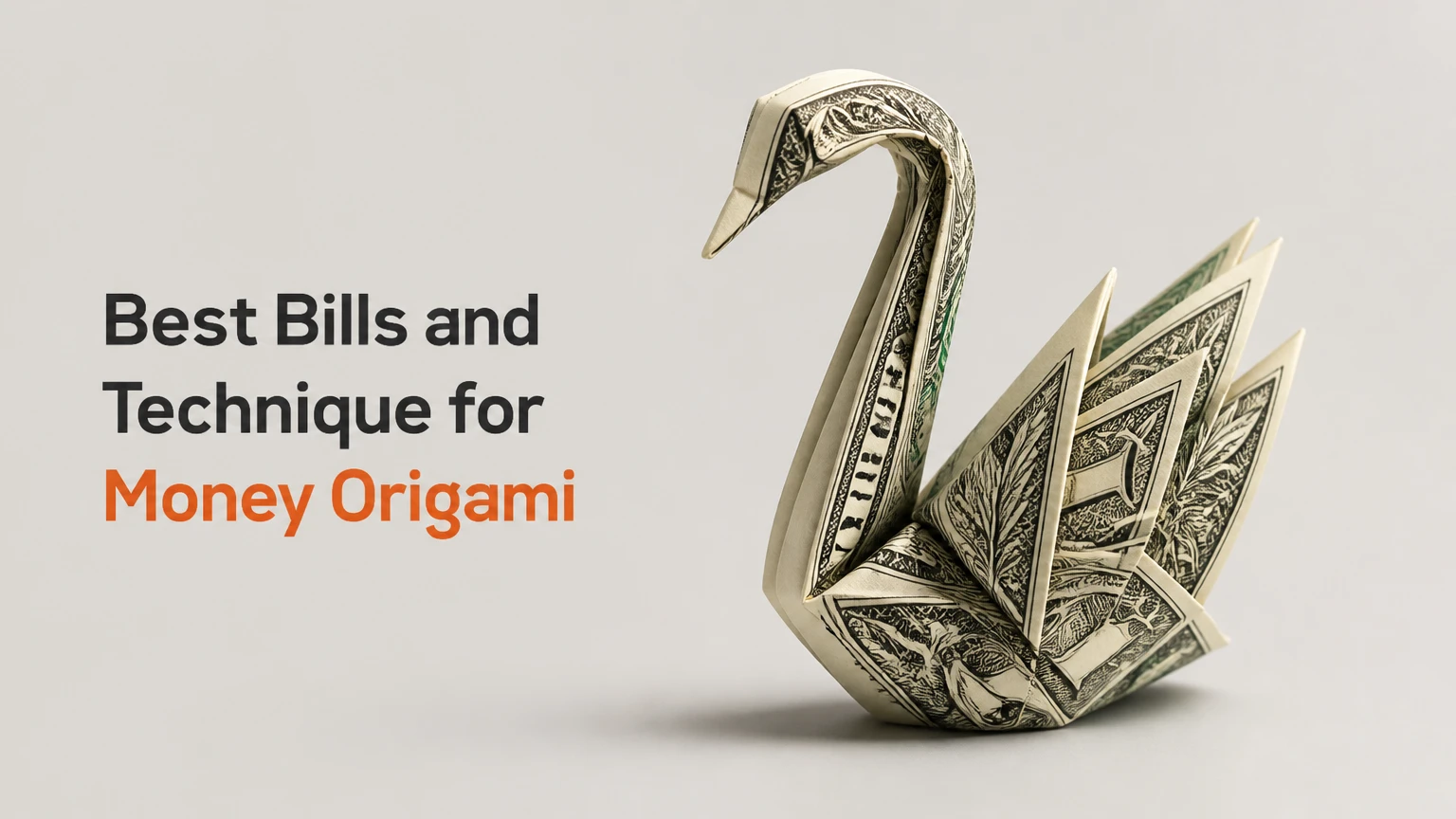
The best bill for money origami is a clean, moderately crisp US $1 note, and the best general technique is precise dry folding with reinforced creases, simple reverse folds, and no adhesive. US dollars offer uniform dimensions and reliable cotton-linen fibers, while euros suit colorful gifts and polymer notes work best for simple designs that tolerate spring-back.
Key Facts at a Glance
- A current US Federal Reserve note measures approximately 6.14 by 2.61 inches, producing a length-to-width ratio near 2.35:1.
- US currency contains approximately 75% cotton and 25% linen, according to the U.S. Currency Education Program.
- A circulated $1 bill is usually the best practice material because its softer fibers accept folds without the stiffness of a new note.
- Polymer banknotes resist sharp permanent creases, so rings, hearts, and basic geometric forms work better than detailed animals.
- A beginner money origami model typically takes 2-10 minutes; advanced single-note animals commonly require 45-120 minutes.
- Folded currency normally retains its face value, but glue, ink, cutting, heat damage, or deliberate defacement can make a note difficult to spend or redeem.
What Is Money Origami?
Money origami is the creation of three-dimensional forms from banknotes through folding alone. The note remains a single piece of currency, with the design produced by valley folds, mountain folds, pleats, reverse folds, sinks, and compression rather than cutting, gluing, taping, or writing.
Traditional origami usually begins with square kami paper. Money origami begins with a narrow rectangle, so the designer must use the banknote’s fixed proportions as part of the model. A shirt uses the long edges and central divisions efficiently, while a fish or dragon may convert surplus length into fins, limbs, or a tail.
Banknotes also behave differently from craft paper. US notes are fibrous and resilient, euro notes use cotton-based paper, and polymer notes use plastic film. The material determines whether a fold stays sharp, relaxes gradually, or springs open after pressure is removed.
How Does Bill Material Change the Result?
Banknote material controls crease permanence, friction, stretch, and edge stability. Cotton-based notes accept repeated dry creasing better than polymer notes, but excessive refolding can still weaken corners and produce visible wear.
The U.S. Bureau of Engraving and Printing describes US currency paper as a cotton and linen blend with embedded security features. That composition explains why a US note feels cloth-like rather than like ordinary wood-pulp copy paper. The European Central Bank likewise identifies euro banknotes as cotton-fibre paper, whereas the Bank of England and Bank of Canada issue polymer notes for many denominations.
A useful practitioner rule is simple: choose the note for the model, not the denomination. A crisp $1 and crisp $100 have the same US dimensions, but using a $100 note for a first attempt creates unnecessary financial risk.
Which Bills Are Best for Money Origami?
The best overall choice is a clean, circulated-to-moderately crisp US $1 bill. It combines low financial exposure, standardized dimensions, strong crease retention, and easy replacement when a beginner makes a mistake.
The best bill changes with the intended outcome. A used $1 is forgiving for practice, a new $1 or $2 is better for display, a euro note adds color but may require scaling, and polymer currency is durable but unsuitable for highly detailed crease patterns.
Ranked Bill and Technique Picks
1. Circulated US $1: Best Overall for Beginners
A moderately circulated US $1 is the strongest all-purpose choice for learning money origami. Its 6.14 by 2.61 inch format matches the majority of dollar-bill diagrams, and its face value limits the cost of alignment errors.
Softened fibers help a beginner reopen a fold and try again, although heavily worn notes can collapse at thin points. Use ordinary dry folding with a fingernail, plastic ruler, or smooth bone folder. Start with a heart, shirt, boat, simple ring, or butterfly.
Key specifications
| Attribute | Typical value | Practical effect |
|---|---|---|
| Face value | $1 | Low replacement cost |
| Note size | 6.14 x 2.61 in | Fits standard dollar patterns |
| Material | 75% cotton, 25% linen | Holds deliberate creases |
| Suitable level | Beginner | Supports basic folds |
| Typical project time | 2-15 minutes | Fast practice cycle |
The main drawback is cosmetic. A dirty or limp note makes the finished model appear uneven, particularly at wings, collars, and narrow legs. Select a note with intact corners, limited writing, and no deep diagonal wrinkles.
Choose this if: you are learning, teaching children, or testing a new diagram.
Skip it if: the gift must look pristine and professionally displayed.
2. Crisp US $1 or $2: Best for Display Gifts
A new or lightly circulated US $1 or $2 is best for wedding place settings, graduation cards, table decorations, and framed models. The uniform US note size means a pattern designed for a $1 can usually be repeated on a $2 without changing measurements.
A crisp note produces sharper wings, collars, petals, and geometric edges than a soft note. Use light preliminary creases first, then reinforce only after the landmarks align. Pressing every line immediately can create a dense grid that makes later correction difficult.
| Bill choice | Best model | Typical time | Main risk |
|---|---|---|---|
| New $1 | Shirt, heart, flower | 2-10 min | White stress lines after reopening |
| New $2 | Butterfly, bow, rosette | 10-25 min | Limited availability |
| New $5 | Koi, bird, complex flower | 20-60 min | Higher replacement cost |
| New $20 | Large presentation fold | 15-45 min | Expensive failed attempts |
A $2 note adds a distinctive red seal and is memorable in a gift, but availability depends on the country and cash register. The honest limitation is stiffness: a brand-new note resists small corrective movements, so beginners should practice the complete sequence on a used $1 first.
Choose this if: appearance matters more than low practice cost.
Skip it if: you are attempting a complex model for the first time.
3. Euro Notes: Best for Color and Regional Gifting
Euro notes are best when color, local currency, or a European recipient matters more than universal pattern compatibility. Euro denominations do not share one physical size: the €5 is smaller than the €20, and larger denominations increase in both length and height.
The European Central Bank lists euro banknotes in denomination-specific dimensions, so a dollar pattern cannot be transferred by eye. Measure the note or test the design with a rectangle cut to the same dimensions before using real currency.
| Euro note | Approximate dimensions | Useful feature | Pattern consequence |
|---|---|---|---|
| €5 | 120 x 62 mm | Smallest common note | Tight space for detail |
| €10 | 127 x 67 mm | Moderate width | Suitable for clothing forms |
| €20 | 133 x 72 mm | Larger working area | Needs scaled instructions |
| €50 | 140 x 77 mm | Broad visual field | Better for large flowers |
Euro paper generally creases well, but its printed windows, holograms, and architectural imagery can land in different positions than dollar artwork. That visual placement may improve a flower or shirt, yet it can disrupt a pattern that depends on a portrait, numeral, or border.
Choose this if: the recipient values euros or the design benefits from color.
Skip it if: the instructions were written specifically for a US dollar and offer no scale guidance.
4. Polymer Currency: Best for Simple, Durable Folds
Polymer notes are best for waterproof keepsakes and uncomplicated forms such as hearts, basic rings, crowns, and angular boats. They are poor candidates for intricate animals because plastic film stores tension and tends to reopen after a fold is released.
The Bank of England introduced polymer banknotes to improve durability and security, while the Bank of Canada reports that polymer notes resist soiling and moisture better than paper notes. Those same properties reduce crease permanence, creating a trade-off rather than a universal improvement.
| Polymer characteristic | Typical behavior | Suitable response |
|---|---|---|
| Water resistance | Handles brief moisture exposure | Use for outdoor or travel gifts |
| Shape memory | Reopens shallow folds | Reinforce landmark creases |
| Surface friction | Can slide during alignment | Fold on a clean, stable surface |
| Tear resistance | Resists ordinary pulling | Avoid assuming corners cannot split |
| Detail retention | Weak for micro-pleats | Choose geometric models |
Do not heat polymer notes with an iron or hair dryer. Heat can distort plastic, damage security features, and permanently alter the note. A heavy book or wide, smooth clip can hold a completed model for several hours, but clamping cannot replace accurate initial folds.
Choose this if: the model is simple and moisture resistance matters.
Skip it if: the pattern requires many tiny pleats, sinks, or layered animal anatomy.
5. High-Denomination US Notes: Best for Meaningful Presentation
A $20, $50, or $100 US note is best only when the monetary gift itself is substantial and the folder already understands the pattern. These notes share the standard US dimensions, but a failed fold has a much higher opportunity cost than a $1.
Use a high-denomination bill for a clean, reversible model with limited correction, such as a shirt, bow, heart, or flat flower. Avoid experimental wet-folding, adhesives, heat, and complex sink folds.
| Denomination | Face-value exposure | Recommended experience | Gift context |
|---|---|---|---|
| $20 | $20 | Intermediate | Graduation or birthday |
| $50 | $50 | Advanced | Formal presentation |
| $100 | $100 | Advanced | High-value gift or display |
| $1 plus envelope | $1 | Beginner | Classroom or casual gift |
The limitation is practical rather than structural. A $100 note does not fold better than a $1 note, and the larger denomination does not create extra working area.
Choose this if: the note’s value is part of the occasion.
Skip it if: you need repeated attempts or are teaching a group.
Which Folding Technique Should You Use?
Dry precision folding is the best general money origami technique because it preserves the banknote, requires no special equipment, and works across US paper and euro notes. Use box pleating for advanced animals, reverse folds for clothing and simple creatures, and modular folding when one note cannot provide enough volume.
Technique Comparison
| Technique | Skill level | Best models | Main strength | Main limitation |
|---|---|---|---|---|
| Dry precision folding | Beginner | Heart, shirt, ring | Reversible and inexpensive | Requires alignment |
| Reverse folds | Beginner to intermediate | Tie, bird, boot | Converts corners into details | Weak folds collapse |
| Pleating | Intermediate | Wings, skirts, scales | Creates repeated texture | Uses bill length quickly |
| Box pleating | Advanced | Fish, dragons, insects | Produces controlled anatomy | Pattern-dependent |
| Modular folding | Intermediate | Flowers, stars, polyhedra | Adds volume from several notes | Requires multiple bills |
The Practitioner Rules That Matter Most
Crease landmarks before decoration. A centerline, quarter mark, and major diagonal control the entire model. If those references are inaccurate by 1-2 millimeters, the error compounds at the final flap.
Use friction before force. A clean table and dry hands improve control more than aggressive pressing. A bone folder should compress a crease, not drag hard enough to stretch the note.
Treat the note as a finite-length grid. A US dollar’s 6.14-inch length cannot accommodate unlimited pleats. When a design requires 16 pleats, each section receives less than 0.4 inch before allowance for margins and layer thickness.
How Do You Prepare a Bill?
Prepare one note, a clean flat surface, and one smooth creasing tool before folding. Budget 3-5 minutes for inspection and landmark marking, and reject bills with deep random wrinkles, torn corners, heavy ink, tape residue, or moisture damage.
Preparation Checklist
| Material | Quantity | Specification | Purpose |
|---|---|---|---|
| Banknote | 1 | Clean, intact, suitable value | Main folding material |
| Smooth work surface | 1 | Flat, dry, nonporous | Prevents distortion |
| Bone folder or plastic ruler | 1 | Rounded or polished edge | Sharpens creases |
| Pencil and scrap paper | 1 each | Used away from currency | Practice scaling |
| Wide paper clip | 1-2 | Smooth, non-serrated | Temporary closure |
Avoid ironing currency. Heat and moisture can damage security elements, flatten texture, or create a permanent sheen. If a note is mildly curled, place it between clean sheets of plain paper under a heavy book for several hours; replace badly wrinkled currency instead.
How Do You Fold a Money Origami Heart?
A basic money heart takes approximately 3-8 minutes and uses half folds, corner folds, and small top tucks. The decisive factor is alignment at the centerline, because uneven lower points produce a lopsided heart even when the top curves appear correct.
Step 1: Establish the Long Centerline
Place the bill face down and fold the long edges together. Run a fingernail or bone folder from the center outward, then unfold the note.
Checkpoint: the crease should run lengthwise through the bill’s center without curving.
Common mistake: pressing from one corner to the other, which can shift the edges.
Step 2: Establish the Short Centerline
Fold the note in half across its width, align the short edges, crease lightly, and unfold.
Checkpoint: the two centerlines intersect at the geometric center.
Common mistake: using a diagonal fold as the reference for later corners.
Step 3: Build the Lower Point
Fold the lower left and lower right corners toward the vertical centerline so the bottom edges form two symmetrical sloping sides.
Checkpoint: both corner tips meet the same centerline at comparable heights.
Common mistake: forcing the tips past the centerline, which creates a twisted point.
Step 4: Shape the Upper Sections
Turn the model over. Fold the upper rectangular flaps downward along the existing horizontal reference, forming the heart’s upper lobes.
Checkpoint: the left and right lobes mirror each other.
Common mistake: folding one lobe deeper, which changes the heart’s center.
Step 5: Round the Corners
Fold the outer upper corners and side points inward by approximately 1/8-1/4 inch. Keep both tucks equal and avoid introducing extra layers into the center.
Checkpoint: the outline has two lobes and one lower point.
Common mistake: making large tucks that erase the heart shape.
Step 6: Lock and Flatten
Turn the heart face up and press the central layers gently. Hold the model under a book for 5-15 minutes if the note is new or polymer.
Checkpoint: the heart remains closed after being lifted from the table.
Common mistake: using tape, glue, or a tight metal clip that marks the currency.
Which Designs Suit Each Bill?
Simple geometric and clothing models suit almost any intact note, while detailed animals need fibrous paper, precise dimensions, and a pattern written for that exact format. Polymer notes suit hearts and rings; crisp US notes suit koi, butterflies, flowers, dragons, and multi-layered figures.
| Design family | Recommended bill | Typical time | Difficulty | Why it fits |
|---|---|---|---|---|
| Heart | Used US $1 or polymer | 3-8 min | Beginner | Few folds and broad surfaces |
| Shirt and tie | US $1, $2, or €10 | 5-12 min | Beginner | Flat final profile |
| Ring | Used US $1 or polymer | 10-20 min | Intermediate | Narrow band tolerates some softness |
| Butterfly | Crisp US $1 or $2 | 15-30 min | Intermediate | Wings benefit from sharp pleats |
| Flower or rosette | Several US $1 notes | 20-45 min | Intermediate | Modular layers add volume |
| Koi or dragon | Crisp US $1 or $5 | 45-120 min | Advanced | Requires pleats and reverse folds |
Flat designs work well inside cards because they tolerate compression. Three-dimensional flowers and animals need a display box or loose placement; forcing them into an envelope can permanently flatten the intended volume.
What Does Money Origami Cost and How Long Does It Take?
The material cost is the note’s face value, while the typical labor time ranges from 3 minutes for a heart to 2 hours for a complex animal. A practice project can cost $1, but an elaborate gift using five $1 notes carries a $5 face-value investment even though the currency remains spendable.
| Project | Bills required | Face-value cost | Typical time | Skill level |
|---|---|---|---|---|
| Heart | 1 | $1-$20 | 3-8 min | Beginner |
| Shirt | 1 | $1-$20 | 5-12 min | Beginner |
| Ring | 1 | $1-$5 | 10-20 min | Intermediate |
| Modular flower | 3-7 | $3-$35 | 20-60 min | Intermediate |
| Koi fish | 1 | $1-$20 | 45-90 min | Advanced |
| Dragon or peacock | 1-2 | $1-$40 | 90-180 min | Advanced |
These are typical practitioner ranges, not universal production times. A first attempt may take twice as long because the folder is reading the diagram, reversing folds, and checking orientation.
What Are the Main Failure Modes?
The most common money origami failures are poor starting material, inaccurate landmarks, excessive layer pressure, and choosing a pattern that exceeds the note’s physical capacity. Most failures can be corrected before the final lock if the folder stops at each checkpoint instead of forcing the next fold.
| Failure | Likely cause | Immediate fix | Prevention |
|---|---|---|---|
| Model springs open | Shallow crease or polymer film | Re-crease, then clamp briefly | Use a bone folder |
| Heart is asymmetric | Centerline drift | Unfold to the last reliable landmark | Align edges before pressing |
| Corner tears | Pulling layered paper apart | Stop and flatten gently | Avoid force on old notes |
| Animal collapses | Too many loose layers | Reverse-fold and compress layers | Follow layer order |
| Note looks dirty | Worn or marked bill | Replace with cleaner currency | Inspect before folding |
| Pattern does not fit | Wrong note dimensions | Scale on scrap paper | Verify measurements first |
A torn note should not be treated as automatically exchangeable under a simple percentage rule. The Federal Reserve explains that damaged currency redemption depends on whether enough note evidence remains and whether the damage can be verified; banks may refer questionable cases to the Bureau of Engraving and Printing.
Do not add glue, staples, tape, paint, or permanent ink. Adhesive residue prevents normal handling, and deliberate mutilation can create a legal or banking problem even when the note remains recognizable.
How Should You Choose for Your Situation?
Choose a circulated US $1 for learning, a crisp US $1 or $2 for a polished small gift, a euro note for regional relevance, and a polymer note for simple water-resistant forms. Advanced folders can use a crisp $5 for detailed models, but high denominations add financial risk without improving the folding physics.
For Beginners and Children
Use one clean, circulated US $1 and begin with a heart or shirt. The project should finish within 10 minutes, use no sharp tools, and allow several attempts without meaningful monetary loss.
For Weddings and Graduations
Use crisp $1 or $2 notes for modular flowers, butterflies, or a shirt inside a card. For a $20 or higher gift, practice the entire model on scrap paper or a $1 first, then make one final version.
For Advanced Folders
Use an unmarked US $1 or $5 for koi, insects, or other box-pleated models. A polished bone folder, strong lighting, and a diagram with mountain and valley symbols matter more than the denomination.
For International Travelers
Use the local currency only after confirming dimensions and note material. Euro paper supports many detailed folds, but a dollar-specific pattern may require proportional scaling; polymer pounds, Canadian dollars, and Australian dollars need simpler designs.
FAQ
Can You Use Any Dollar Bill for Origami?
Most current US Federal Reserve notes share the same 6.14 by 2.61 inch dimensions, so a pattern usually transfers across denominations. Condition matters more than value: a clean $1 is easier and safer to practice than a $100, while heavily worn notes may lack the stiffness needed for thin details.
Is New Money Better Than Used Money for Folding?
New money is better for sharp display models, but used money is better for learning. Crisp notes retain precise edges and stand more cleanly, whereas moderately circulated notes reopen more easily after an incorrect fold and reduce the cost of experimentation.
Can Folded Money Still Be Spent?
Folded money can generally be unfolded and spent when it remains intact, legible, and free from adhesive or other alterations. Deep creases may reduce convenience but do not normally erase face value. A bank, rather than the folder, decides whether severely damaged currency qualifies for replacement.
What Is the Easiest Money Origami Model?
The heart and shirt are among the easiest single-note models because they use broad folds and finish relatively flat. A heart usually takes 3-8 minutes, while a shirt commonly takes 5-12 minutes when the bill is aligned correctly.
Should You Iron a Wrinkled Bill?
Do not iron a banknote. Heat, steam, and pressure can damage printed features, security elements, and polymer film. Place a mildly curled note between clean paper sheets under a heavy book for several hours, or replace a deeply wrinkled note with a cleaner one.
What Tool Is Best for Sharp Creases?
A smooth bone folder is the best dedicated tool because its rounded edge applies pressure without cutting fibers. A clean plastic ruler or fingernail also works. Avoid serrated edges, metal blades, wet tools, and abrasive surfaces that can scratch or tear currency.
Can You Make Money Origami with Euro Notes?
Euro notes work well when the pattern matches the denomination’s dimensions. The €5, €10, €20, and larger notes vary in size, so a dollar-bill diagram may need proportional scaling. Test the layout on a rectangle cut to the note’s exact dimensions before folding cash.
The Bottom Line
The best bills and technique for money origami are a moderately crisp US $1 and controlled dry folding. Use a crisp US $1 or $2 when presentation matters, euro notes when color or regional currency matters, and polymer notes only for simple shapes. Begin with the heart or shirt, verify every centerline, reinforce creases gradually, and reserve high-value notes for patterns you have already practiced.
