

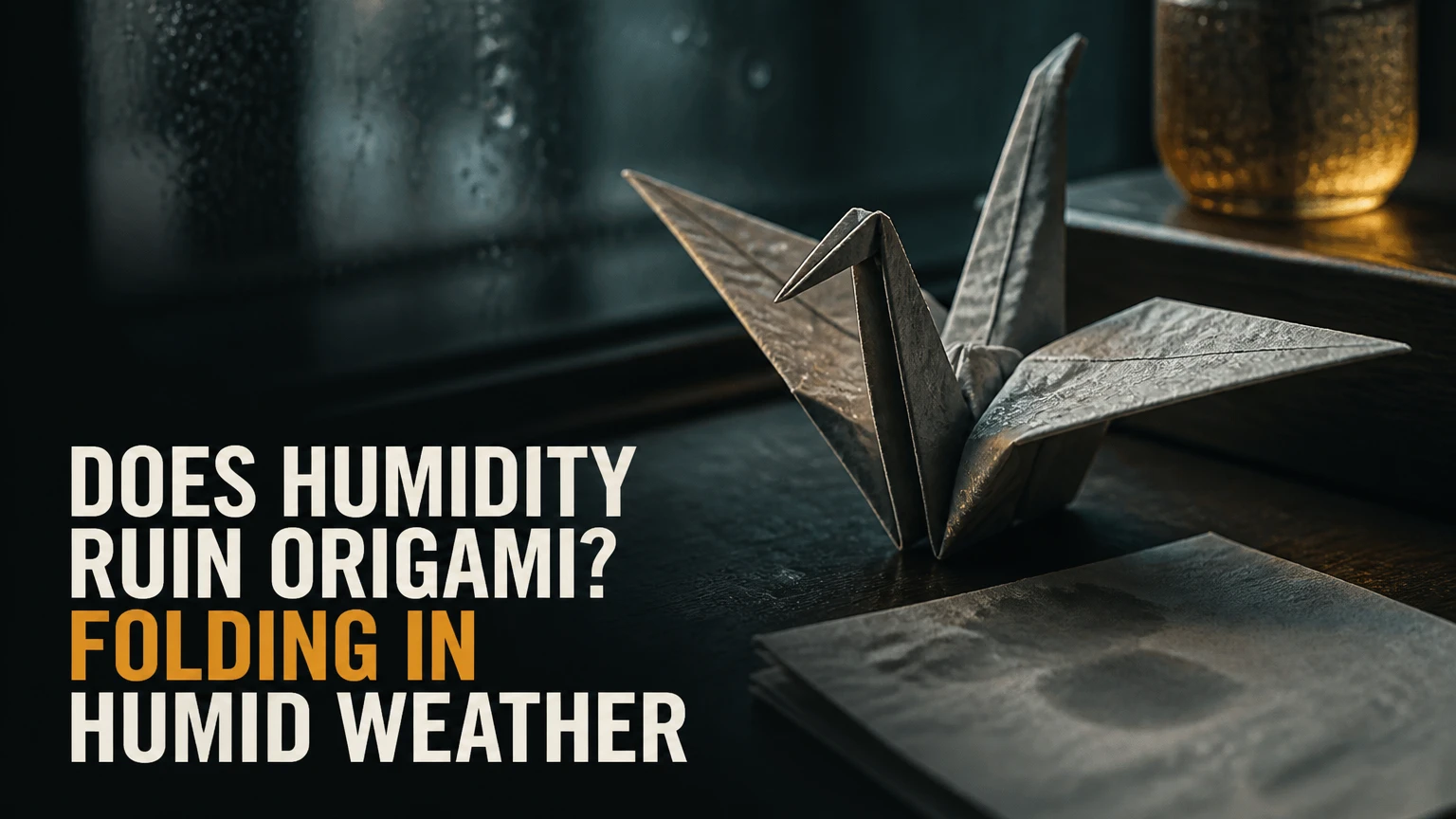
Yes, humidity can ruin origami temporarily and sometimes permanently. Paper absorbs water vapor from the air, which makes cellulose fibers swell, softens creases, increases warping, and reduces the model’s ability to support its own weight. Moderate humidity usually causes handling problems; prolonged high humidity, liquid moisture, adhesives, or repeated humidity cycling can cause lasting distortion.
Key Facts at a Glance
- Origami paper is hygroscopic, so its moisture content changes with surrounding relative humidity.
- A practical folding target is 40%-55% relative humidity, although paper weight, sizing, and model complexity change the result.
- Paper often becomes noticeably less crisp above approximately 65% RH, but there is no universal failure threshold.
- Thin kami can feel uncooperative within 10-30 minutes in a very humid room, while foil-backed paper changes much less.
- A dehumidifier improves the room; it does not instantly dry moisture already absorbed into a model.
- Wet-folded or sized origami may require 12-48 hours to dry, depending on thickness, shape, airflow, and adhesive content.
Why Does Humidity Change Origami Paper?
Humidity changes origami because cellulose fibers absorb water vapor and change dimensions. Paper is hygroscopic, a property recognized in conservation guidance from organizations such as the Canadian Conservation Institute, and the resulting moisture exchange affects stiffness, friction, crease sharpness, and dimensional stability.
Paper is not a solid plastic sheet. It is a porous network of cellulose fibers, fillers, coatings, and sometimes dyes or sizing agents. Water molecules enter that network as relative humidity rises, causing fibers to swell. When the paper contains different layers, coatings, or grain directions, those parts may expand at different rates.
A fold also creates a stress pattern. Sharp compression on one side and tension on the other help a crease guide the sheet into a repeatable position. Moisture lowers stiffness and allows stressed areas to relax. The crease may still exist, but it no longer provides enough resistance to hold a heavy flap or tightly packed structure.
Does a crease permanently break paper fibers?
A normal crease does not always permanently break cellulose fibers. Many folds mainly compress, bend, and rearrange the fiber network, while repeated sharp creasing can fracture fibers and weaken the sheet.
That distinction matters. Humid air does not erase every crease, and dry air does not guarantee permanent memory. A damp model can recover some crispness as it dries, but a repeatedly flexed, torn, or overworked crease may remain damaged. Conservation literature also treats paper as a material whose dimensions respond to moisture, not as a material that changes at one precise humidity switch.
What Relative Humidity Is Safe for Origami?
A 40%-55% RH workspace is a practical target for most origami, while 60%-65% RH is a warning range for thin or complex models. Above 70%-75% RH, ordinary uncoated paper commonly becomes softer, slower to crease, and more vulnerable to sagging, although foil laminates and heavily sized sheets may behave differently.
Relative humidity describes how much water vapor the air holds compared with the maximum it could hold at that temperature. Warm air can contain more vapor than cool air, so a stable hygrometer reading is more useful than judging the room by feel.
| Room condition | Typical RH | Likely effect on origami | Practical response |
|---|---|---|---|
| Dry, controlled room | 35%-45% | Crisp folds; possible brittle thin paper | Add a little handling care |
| Comfortable folding room | 45%-55% | Kami and Tant remain manageable | Best general target |
| Softening range | 60%-70% | Slower creases; weak layers; more warping | Reduce exposure and use heavier paper |
| Very humid room | 70%-85% | Limp sheets; sagging models; adhesive delays | Use foil, dehumidification, or postpone |
| Condensation or wet surface | Above local air RH effects | Staining, cockling, tears, adhesive failure | Stop folding and dry materials safely |
These ranges are practical workshop guidance, not a material standard. A dense insect made from 20-gram kami may fail at 60% RH, while a simple box made from 120-gram foil paper may remain stable at 75% RH.
How Long Can Origami Stay in Humid Air?
Thin untreated origami paper may become noticeably softer after 10-30 minutes in a room above 75% RH, but the exact timeframe varies too widely for a reliable universal number. A finished model can show changes over several hours, especially when gravity loads damp layers or when moisture enters from fingers and breath.
Exposure speed depends on surface area, paper thickness, air movement, temperature, and the difference between the paper’s stored moisture content and the room’s equilibrium condition. A sealed pack taken from an air-conditioned room may react faster than paper already acclimated to a tropical climate.
| Material or model | Typical noticeable change | Typical recovery after dry storage | Main risk |
|---|---|---|---|
| 50-gram kami sheet | 10-30 minutes at 75%-85% RH | 1-6 hours | Soft creases and tearing |
| 80-gram Tant sheet | 20-60 minutes at 70%-80% RH | 2-8 hours | Sliding layers and weak points |
| Sized Washi | 30-120 minutes at 70%-80% RH | 4-12 hours | Uneven curl and dimensional change |
| Tissue foil | 1-4 hours in ordinary humid air | Usually minimal change | Delamination or damaged foil |
| Dense finished model | 1-8 hours under load | 12-48 hours with support | Sagging and permanent set |
The recovery figures are typical workshop ranges, not guarantees. If a model has been wetted, glued, sprayed, or compressed while damp, drying may not restore its original geometry.
Which Paper Is Best for Origami in Humid Weather?
Foil-backed paper is usually the most reliable choice for complex origami in humid weather because its metal layer limits direct moisture exchange and adds shape memory. Tant offers a practical middle ground, while Washi provides fiber strength but still absorbs moisture and may need sizing.
| Paper type | Typical weight | Humid-weather behavior | Best use |
|---|---|---|---|
| Kami | 60-70 gsm | Softens quickly; inexpensive; easy to replace | Simple models below 30 steps |
| Tant | 70-100 gsm | More body than kami; still absorbs vapor | Geometric folds and modular units |
| Washi or kozo | 50-150 gsm | Strong long fibers; softens without tearing quickly | Wet-folding and large organic forms |
| Tissue foil | 30-70 gsm | Resists moisture; holds dense structures | Insects, dragons, and display models |
| Kraft paper | 70-120 gsm | Strong but may curl with uneven moisture | Boxes, masks, and structural prototypes |
| Coated paper | 80-150 gsm | Low surface absorption; slippery crease behavior | Simple display pieces and prototypes |
Foil paper is not immune to every humidity problem. The paper or tissue layer can still absorb moisture, foil can wrinkle, and a poorly bonded laminate can separate. Metallic foil also makes some reverse folds less forgiving because a mistake can leave a permanent ridge.
Washi is strong rather than humidity-proof. Long kozo, mitsumata, or gampi fibers can tolerate manipulation better than short-fiber machine paper, but the sheet still changes moisture content. Washi is often a better choice when tearing is the main concern, not when maximum dimensional stability is required.
How Should You Fold Origami in Humid Weather?
Fold origami in humid weather by controlling the paper’s exposure, minimizing skin moisture, using a firm work surface, and completing structural folds before the sheet softens. A typical preparation cycle takes 15-30 minutes, while a complex model may need several short sessions rather than one uninterrupted folding period.
Before You Start
| Requirement | Typical value | Why it matters |
|---|---|---|
| Workspace RH | 40%-55% | Preserves crease sharpness |
| Acclimation time | 20-60 minutes | Prevents sudden moisture shock |
| Paper reserve | 2-3 spare sheets | Covers tearing and failed tests |
| Hand-cleaning interval | Every 20-30 minutes | Reduces sweat transfer |
| Work surface | Glass, acrylic, or sealed board | Limits drag and moisture absorption |
| Cost | $10-$250 | Depends on paper and climate equipment |
- Measure the room. Place a digital hygrometer near the folding surface, away from the dehumidifier outlet and direct sunlight. Give the reading at least 15 minutes to stabilize.
- Acclimate the paper. Keep the paper in a sealed polypropylene box until the workspace is ready. Open one or two sheets for 20-30 minutes, then test a diagonal fold and a reverse fold.
- Prepare the surface. Use clean glass, acrylic, or a sealed cutting board. Avoid unfinished wood and fabric because both can transfer moisture and increase friction.
- Control your hands. Wash and dry your hands before folding, then take short breaks if your fingers become warm or damp. A bone folder can reduce repeated rubbing, but excessive pressure can cut thin paper.
- Fold high-load areas first. Complete major bases, sinks, and structural locks while the paper is firm. Leave shaping and small details until the main geometry has stabilized.
- Store between sessions. Put unfinished work in a rigid box with separated silica gel packets. Do not let desiccant touch paper, and do not assume a small packet can dry a large model.
You will know the environment is working when a test crease remains sharp for several minutes and layers stop sliding during a repeated fold. A common mistake is lowering room temperature without lowering moisture, because cold air can make the room feel comfortable while leaving RH high.
Can Methyl Cellulose Protect Origami Paper?
Methyl cellulose can stiffen and strengthen paper after drying, but it does not create a permanently humidity-proof barrier. Methyl cellulose, or MC, and carboxymethyl cellulose, or CMC, are water-based sizing materials that require controlled application, full drying, and a test sheet before use on valuable paper.
Commercial powders vary in viscosity and concentration, so a universal recipe such as one tablespoon per cup is unreliable. The product label should control the ratio. A typical small test batch uses 0.5-2% MC by weight, mixed gradually into water and allowed to hydrate for several hours.
A safer sizing workflow
- Mix the labeled concentration in clean water. Avoid clumps by sprinkling powder slowly while stirring.
- Let the solution hydrate for 2-12 hours, depending on the product.
- Brush a thin, even coat onto a test sheet on glass or polyester film.
- Dry the sheet flat for 4-8 hours with moderate airflow, away from dust and direct heat.
- Test foldability, color change, curl, and surface tack before treating the final sheet.
The treated paper should feel firmer without remaining wet, tacky, or visibly rippled. Excess MC can make paper brittle, sticky, glossy, or difficult to unfold. Sizing also reduces reversibility, so it is a poor choice for a historically significant sheet or a model that may need conservation treatment later.
How Do Humidity Defenses Compare?
For most folders, moderate dehumidification plus sealed storage offers the best balance of appearance, reversibility, and cost. Tissue foil gives the strongest immediate resistance, while MC sizing suits custom paper preparation and acrylic spray is mainly a display finish rather than a folding solution.
| Method | Typical cost | Preparation time | Main benefit | Main limitation |
|---|---|---|---|---|
| Room dehumidifier | $120-$300 | 30-120 minutes to change RH | Protects the entire workspace | Electricity, noise, heat output |
| Air conditioner | Existing equipment or $300+ | 30-90 minutes | Lowers temperature and often RH | May not control RH precisely |
| Tissue foil | $0.50-$3 per sheet | 0 minutes | Strong shape retention | Less forgiving; laminate can wrinkle |
| MC or CMC sizing | $10-$30 per container | 4-12 hours | Custom stiffness and strength | Adds water and reduces reversibility |
| Silica gel storage | $8-$25 per kit | 5 minutes | Protects stored paper and models | Does not dry an open room |
| Acrylic fixative | $8-$18 per can | 15-60 minutes plus cure | Adds surface resistance | Changes texture and introduces fumes |
Should you use acrylic spray on finished origami?
Use acrylic spray only when the model is a permanent display object and the paper’s appearance, reversibility, and archival status are not priorities. Apply several light coats outdoors or in a spray booth, following the product’s ventilation and safety instructions, rather than saturating the model.
Acrylic fixative can stiffen surface fibers and reduce light moisture exposure, but it cannot repair a badly warped structure. It may darken colors, increase gloss, clog narrow pockets, or make later conservation difficult. Test the spray on a folded scrap from the same paper first.
What Glue Works in Humid Weather?
Fast-setting, low-moisture adhesives are generally more reliable than dilute water-based glue in humid weather, but every adhesive changes the model’s reversibility. Neutral-pH PVA can work for modular assembly when applied in tiny amounts, while cyanoacrylate is fast but can stain, embrittle, and damage paper.
| Adhesive | Set time, typical | Moisture added | Suitable use | Important drawback |
|---|---|---|---|---|
| Neutral-pH PVA | 10-30 minutes | Moderate | Modular tabs and paper hinges | Paper can cockle |
| Methyl cellulose paste | 30-120 minutes | High | Conservation-minded paper work | Slow drying in high RH |
| Glue stick | 2-10 minutes | Low | Temporary positioning | Weak bond under load |
| Double-sided tape | Immediate | None | Prototypes and flat units | Adds thickness and lacks reversibility |
| Cyanoacrylate | 5-60 seconds | None | Tiny structural locks | Staining, fumes, brittle paper |
| Spray adhesive | 5-30 minutes | Solvent | Large flat laminations | Overspray and ventilation concerns |
Apply adhesive with a fine tool, not directly from a bottle. A useful practitioner rule is to use the smallest bond that prevents movement, because excess glue adds mass and moisture exactly where a humid model is already weakest.
How Do You Store Origami Paper in Humid Climates?
Store origami paper in a sealed, rigid container with a hygrometer and replaceable desiccant, keeping paper flat and separated from direct contact with the desiccant. Open bins allow every sheet to track daily humidity changes, which can create repeated swelling and shrinking even without visible wetness.
| Storage option | Typical capacity | Approximate cost | Protection level | Best application |
|---|---|---|---|---|
| Zip bag with closure | 20-50 sheets | $5-$12 | Short-term | Small active projects |
| Polypropylene box | 100-500 sheets | $12-$35 | Good | General paper storage |
| Airtight archival container | 200-1,000 sheets | $25-$80 | Very good | Premium or sized paper |
| Climate-controlled cabinet | 1,000+ sheets | $150-$600 | Highest | Studios and collections |
Do not seal visibly damp paper inside an airtight box. Trapped moisture can promote odor, staining, or mold. Dry the paper in a controlled room first, then store it with indicator desiccant that shows when regeneration is needed.
What Problems Does Humidity Cause?
Humidity causes four recurring origami failures: softened creases, dimensional warping, structural sagging, and adhesive delay. The visible symptom often appears at a different location from the cause, because a damp central layer can distort an otherwise dry outer surface.
Why does a finished model sag?
A finished model sags when softened paper loses bending stiffness or when moisture causes layers to expand unevenly. Heavy wings, long legs, broad petals, and unsupported tails show the problem first because gravity applies a continuous load to weakened creases.
Support the model in its intended position with acid-free tissue, clips that do not crush edges, or temporary foam forms. Dry it gradually in a 40%-55% RH room for 12-48 hours. A heater or hair dryer can create one-sided shrinkage and worsen warping.
Can humidity permanently damage origami?
Humidity can permanently damage origami when swelling, staining, mold, adhesive migration, torn fibers, or repeated deformation changes the paper beyond recovery. A single humid afternoon usually causes reversible softening, but prolonged exposure and drying under an incorrect shape can fix the distortion.
Paper that smells musty, shows spotting, or feels bonded between layers should be isolated from clean materials. Do not apply heat, spray, or extra glue before identifying the problem, because those interventions can conceal damage and complicate repair.
How Do You Rescue Damp or Warped Origami?
Rescue damp origami by removing surface moisture, supporting the intended geometry, and drying it slowly at stable room conditions. Never iron a three-dimensional model directly, and never use steam, because concentrated heat and water can set new creases or cause uneven shrinkage.
| Symptom | Likely cause | First response | Avoid |
|---|---|---|---|
| Limp sheet | High moisture content | Move to 40%-55% RH | Folding harder |
| Curling edges | Uneven grain swelling | Flatten between clean barriers | Wetting the opposite side |
| Sagging wing | Load on softened crease | Add temporary support | Heavy clips |
| Sliding layers | Damp adhesive or paper | Separate and dry if possible | More water-based glue |
| Brittle torn crease | Repeated manipulation | Stop and reinforce internally | Rubbing the fold |
| Musty odor or spots | Prolonged damp storage | Isolate and consult conservator | Sealing it with wet air |
For a flat sheet, place it between clean, smooth release sheets and apply gentle, even pressure. Low heat without steam may help only when the paper and ink tolerate it, so test an edge first and keep the iron moving. This is a recovery technique, not a routine preparation step.
Which Strategy Fits Your Situation?
A beginner folding simple models usually needs storage control rather than chemical treatment. An advanced folder making a dense insect or exhibition model benefits from a controlled room, foil-backed paper, and structural supports, while a wet-folding artist may deliberately introduce moisture and accept a longer drying cycle.
| Situation | Recommended paper | RH target | Best protection | Typical budget |
|---|---|---|---|---|
| Beginner, simple animal | Kami | 45%-60% | Sealed box | $5-$25 |
| Modular geometric model | Tant or kraft | 40%-55% | Dehumidifier and light adhesive | $25-$150 |
| Complex insect or dragon | Tissue foil | 40%-55% | Controlled room and supports | $20-$300 |
| Large wet-folded sculpture | Washi or kozo | 45%-60% during shaping | Slow supported drying | $20-$120 |
| Exhibition or archival piece | Tested custom paper | 40%-50% | Hygrometer and conservation-safe storage | $50-$600 |
Wet-folding is different from accidentally folding damp paper. Wet-folding deliberately uses a controlled amount of water to soften and shape thicker paper, then relies on drying to hold the form. High ambient humidity makes the process less predictable because the sheet may not dry evenly.
Common Mistakes to Avoid
- Leaving paper exposed overnight: A closed pack can acclimate safely, while an open stack absorbs the room’s moisture unevenly.
- Treating 65% RH as an exact failure line: Paper weight, coatings, grain, and model geometry matter more than one universal cutoff.
- Using a household iron with steam: Steam adds moisture and can emboss the barrier sheet into the paper.
- Overusing silica gel: Small packets protect containers but cannot dehumidify a room or rapidly dry a large sculpture.
- Spraying before testing: Fixative can alter color and sheen permanently, even when the model looks dry.
- Folding with damp fingers: Sweat transfers liquid salts and water directly to high-stress creases.
- Drying against a radiator: Fast uneven heating often causes cockling, curl, and detached layers.
Frequently Asked Questions
Does air conditioning protect origami from humidity?
Air conditioning often lowers both temperature and relative humidity, but the result depends on the unit and room conditions. A hygrometer should confirm the change. Portable units may collect water without maintaining a stable 40%-55% RH, while a dedicated dehumidifier can control moisture more directly.
Is origami paper waterproof?
Ordinary kami, Tant, Washi, and kraft paper are not waterproof. Tissue foil resists ambient vapor better because of its metallic layer, but its paper surface, edges, adhesive, and folds can still absorb liquid water. No common origami paper should be treated as safe for immersion.
Can I fold origami outside in summer?
You can fold simple models outside when RH is moderate, the table is dry, and wind is controlled. Avoid dew, direct sun, rain, and periods above approximately 70% RH for complex work. Outdoor air also carries dust and pollen, which can stick to MC sizing, glue, or fixative.
Should origami paper be refrigerated?
Refrigeration is usually a poor storage method because condensation can form when cold paper returns to a warm room. Keep paper flat in a sealed polypropylene container at stable room temperature, using dry indicator desiccant when the surrounding climate is humid.
How can I tell whether paper is too humid to fold?
Test a diagonal crease, a reverse fold, and one narrow flap before starting the model. Paper is probably too humid when the crease rounds over, the sheet feels limp, layers slide, or the flap springs open after several seconds. Move the paper to a controlled room or switch materials.
The Bottom Line
Does humidity ruin origami? High humidity can ruin crispness, stability, and sometimes the final geometry, but most damage is preventable. Keep the workspace near 40%-55% RH, store paper in sealed containers, use Tant or tissue foil for demanding models, limit hand moisture, and dry supported models slowly instead of adding heat or excess glue.
