

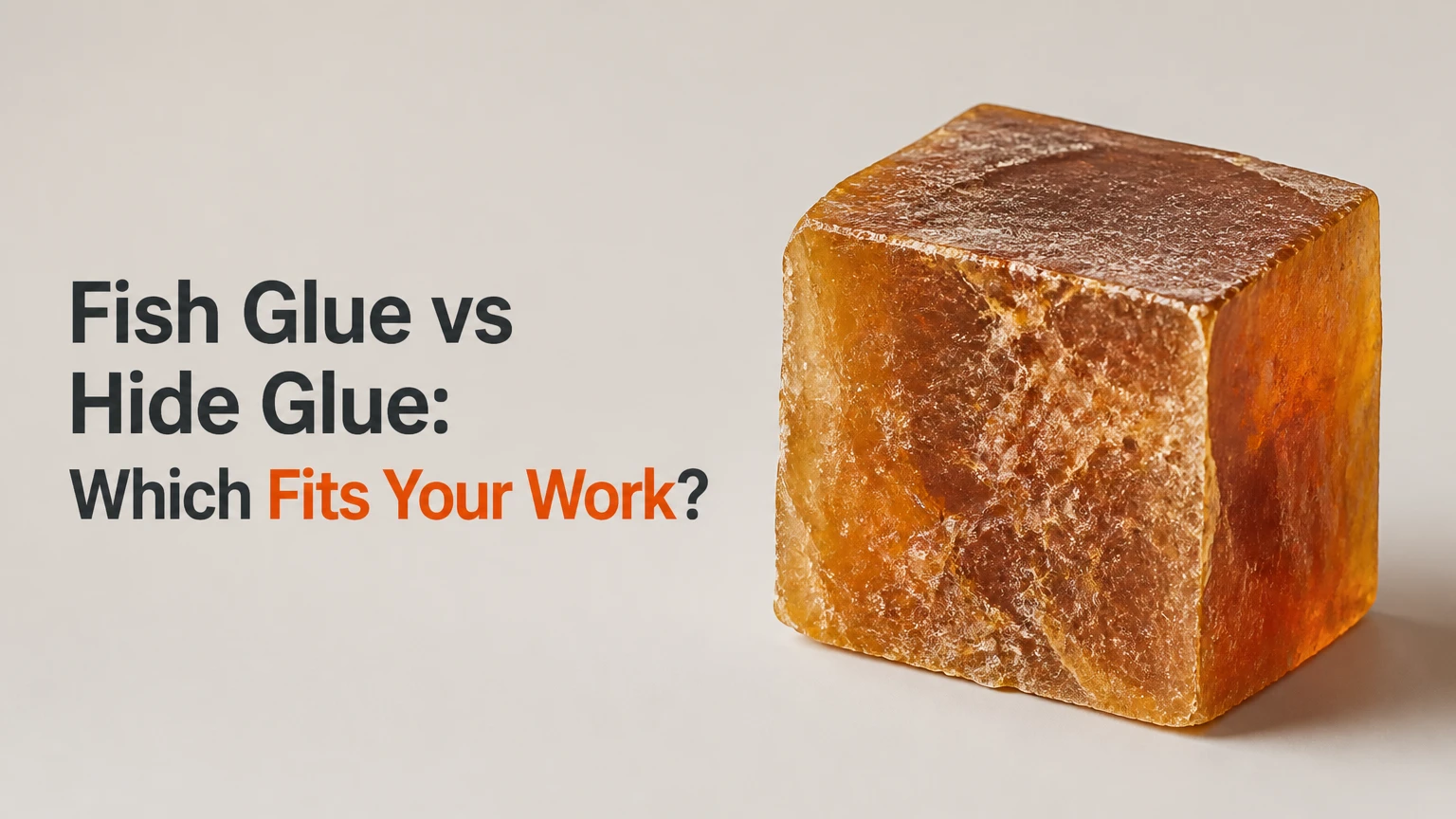
Fish glue is the better choice when you need room-temperature application, a long assembly window, or access to complicated paper and wood joints; hot hide glue is better when you need rapid tack, low creep, historical authenticity, and maximum control over a reversible structural joint. Both are collagen-based, water-sensitive adhesives, but their working temperatures, open times, and failure modes differ substantially.
Key Facts at a Glance
Fish glue is normally liquid at room temperature and cures mainly as water leaves the adhesive film.
Hot hide glue is heated to roughly 55-65°C, then sets rapidly as it cools and dries.
Fish glue typically offers 20-60 minutes of practical assembly time; hot hide glue often offers less than 2 minutes.
Dry hide glue granules can remain usable for years when kept dry; bottled products have finite shelf lives.
Neither adhesive should be treated as waterproof, and both perform best on clean, close-fitting porous surfaces.
Hot hide glue is usually the stronger practical choice for traditional instrument joints, while fish glue is easier for complex repairs and paper assemblies.
What Are Fish Glue and Hide Glue?
Fish glue and hide glue are traditional animal-protein adhesives made from collagen or collagen-rich tissue. Fish glue generally comes from fish skin, bones, or connective tissue, while hide glue comes from mammalian skins and related collagen sources, commonly cattle.
The source does not determine every performance value. Manufacturing temperature, molecular weight, solids content, preservatives, pH, and additives can change viscosity, tack, color, and shelf life. A bottle labeled fish glue is therefore not automatically equivalent to another brand, just as a 192-Bloom hide glue is not equivalent to every hide-glue granule.
| Attribute | Fish glue | Hot hide glue | Liquid hide glue |
|---|---|---|---|
| Main source | Fish skin or connective tissue | Mammalian hide collagen | Mammalian collagen with liquid-phase additives |
| Room-temperature state | Liquid | Solid gel or granules | Liquid |
| Normal application temperature | 18-25°C | 55-65°C | 18-25°C |
| Main setting trigger | Water evaporation | Cooling plus drying | Drying, with modified gel behavior |
| Typical color | Pale amber to brown | Amber to dark amber | Cream, amber, or brown |
| Common users | Woodworkers, paper makers, restorers | Luthiers, cabinetmakers, conservators | Repairers and general woodworkers |
Isinglass belongs to the same broad family but is a more refined fish-derived adhesive, traditionally associated with fish swim bladders such as sturgeon. Conservators use it when clarity, purity, and controlled reactivation matter; its higher price rarely makes sense for ordinary furniture construction.
How Do Their Curing Mechanisms Differ?
Fish glue stays liquid because its protein composition and formulation do not produce the same room-temperature gelation behavior as conventional mammalian hide glue. Fish glue forms a bond as water migrates into the wood and evaporates, leaving a concentrated protein film that grips the prepared surfaces.
Hot hide glue uses two setting mechanisms. Cooling causes thermal gelation, which gives the joint rapid initial grab, while later water loss increases the dried film’s cohesion. A hide-glue joint can therefore feel firm before it has reached its final dry strength.
The 60°C figure is a working target, not a universal chemical boundary. A glue’s gel point varies with concentration, bloom strength, dilution, ambient temperature, and the temperature of the wood. High-Bloom glue can gel sooner during an assembly than a more dilute, lower-Bloom batch.
Why Does Hide Glue Need Heat?
Hide-glue granules absorb water and become usable after controlled heating because the collagen molecules must disperse into a fluid solution. A water bath or thermostatically controlled glue pot limits hot spots, which are more damaging than the average temperature shown on a thermometer.
Traditional practice commonly keeps the adhesive near 60°C. Heating hide glue above approximately 65-70°C for extended periods can reduce molecular weight and weaken the resulting film, although the exact damage depends on time, concentration, and repeated heating cycles.
Does Fish Glue Cure Only by Drying?
Fish glue cures primarily through drying, but absorption into porous wood also affects the bond. A thick layer, damp workshop, cold surface, or poorly fitted joint can leave fish glue soft for many hours because the central portion cannot release moisture efficiently.
That difference explains the practical trade-off: fish glue gives more assembly time but generally requires longer pressure and drying time. Hot hide glue gives less time to position parts but establishes tack before the bond has fully dried.
Fish Glue vs Hide Glue: Which Performs Better?
The better adhesive depends on the decision criterion. Hot hide glue usually wins for fast tack, creep resistance, and traditional structural repairs; fish glue usually wins for room-temperature convenience, long open time, and assemblies that require repeated adjustment.
| Decision criterion | Fish glue, typical | Hot hide glue, typical | Practical winner |
|---|---|---|---|
| Application temperature | 18-25°C | 55-65°C | Fish glue |
| Open assembly time | 20-60 minutes | 20-90 seconds | Fish glue |
| Initial tack | 2-10 minutes | 10-60 seconds | Hot hide glue |
| Clamp or pressure time | 4-12 hours | 1-2 hours | Hot hide glue |
| Full useful drying time | 12-48 hours | 12-24 hours | Hot hide glue |
| Dry-film creep resistance | Low to moderate | Moderate to high | Hot hide glue |
| Reheating for removal | Limited and formulation-dependent | High | Hot hide glue |
| Typical cleanup method | Warm water | Warm water and steam | Tie, depending on task |
These values are typical workshop ranges, not product guarantees. Thin glue films on warm, dry, close-fitting joints can finish sooner, while thick glue lines on oily or poorly fitted surfaces can remain weak much longer.
Which Glue Is Stronger?
Hot hide glue often provides the more rigid and creep-resistant joint, but there is no defensible universal PSI winner across all fish-glue and hide-glue products. Joint design, wood species, adhesive solids, surface fit, moisture content, and cure time can outweigh the nominal adhesive category.
A well-fitted fish-glue joint can outperform a poorly fitted hide-glue joint. Protein adhesives transmit load effectively only when the mating surfaces make broad contact and the adhesive layer remains thin, generally around 0.05-0.15 mm after clamping.
Strength data should be compared only between products tested under the same standard and conditions. A manufacturer’s shear value for one fish glue cannot be directly compared with a different manufacturer’s hide glue value from another test method.
Which Glue Has More Open Time?
Fish glue has substantially more open time than hot hide glue. In a room at 20°C, a thin fish-glue application may allow 20-60 minutes for positioning, while hot hide glue can begin to gel within 30-90 seconds after contact with cool wood.
Long open time helps with curved bindings, multiple clamps, veneering details, marquetry, and paper structures. The cost is slower pressure development and a greater risk that the adhesive film will absorb moisture from a humid environment before drying.
Which Glue Resists Creep?
Hot hide glue generally resists creep better under sustained load, especially when used in a thin film on a well-fitted joint. Fish glue can soften more readily under prolonged warmth and high relative humidity because its dried protein film remains sensitive to absorbed water.
Neither adhesive is appropriate for an outdoor joint exposed to rain. For exterior service, a suitable waterproof structural adhesive should be selected instead, even if it sacrifices traditional reversibility.
What Types Should You Buy?
The main buying decision is not simply fish versus hide. You must also choose between dry granules, liquid formulations, bloom strength, viscosity, and conservation-grade purity.
| Product form | Typical price range | Shelf-life expectation | Best application |
|---|---|---|---|
| Dry hide granules, 192 Bloom | $12-$30 per 500 g | Several years when dry | Furniture and instrument joints |
| Dry hide granules, 315 Bloom | $15-$35 per 500 g | Several years when dry | Thin, fast-setting instrument work |
| Bottled liquid hide glue | $8-$15 per 16 oz | About 6-18 months after opening | Small indoor repairs |
| Bottled fish glue | $12-$30 per 16 oz | About 1-3 years, product-dependent | Complex woodworking and paper |
| Isinglass solution or flakes | $25-$80 per small package | Shorter after preparation | Conservation and high-clarity repairs |
Bloom is a measure of gel strength, not a complete ranking of adhesive quality. Higher-Bloom hide glue usually gels more firmly and can produce a harder, faster-setting film, but it also shortens working time and demands more accurate assembly.
Liquid hide glue commonly uses urea or another modifier to delay gelation. The modification makes room-temperature work possible, but the result does not behave exactly like freshly prepared hot hide glue during reactivation, creep testing, or conservation treatment.
Check the bottle date and perform a scrap test before using liquid animal glue. A useful test is to glue two pieces of clean scrap, leave them clamped overnight, then try to break the wood. A gummy film, sour odor, or rubbery residue indicates a questionable product.
How Do You Prepare and Apply Hot Hide Glue?
Prepare hot hide glue by soaking dry granules in cold water, heating the swollen mixture indirectly to approximately 55-65°C, and applying it quickly to warm, close-fitting surfaces. A common starting ratio is one part dry granules to two parts water by weight, followed by adjustments for the desired viscosity.
Step 1: Hydrate the Granules
Weigh 100 g of dry hide glue and add approximately 200 g of cold distilled water. Distilled water is not mandatory in every workshop, but it reduces mineral variation and is sensible for conservation or repeated batch preparation.
Allow the mixture to swell for 1-2 hours. Properly hydrated granules look soft and translucent rather than dry and chalky.
Success checkpoint: the granules have absorbed water throughout.
Common mistake: heating dry granules before hydration, which creates lumps and local overheating.
Step 2: Heat the Glue Indirectly
Place the hydrated mixture in a glue pot or container set in a water bath. Bring it gradually to 55-65°C and stir until the liquid is uniform.
Do not use a microwave or direct saucepan heat. Hot spots can degrade the protein even when the surrounding mixture appears to be at a safe temperature.
Success checkpoint: the glue flows in a continuous ribbon from the brush.
Common mistake: thinning the batch repeatedly with cold water, which changes concentration and slows gel formation.
Step 3: Warm the Joint
Warm the wood with a heat gun on low, a warming cabinet, or a controlled workshop environment. The surface should feel warm, not hot, and should not be scorched or dried excessively.
A cold joint can gel the adhesive before the parts seat. This is one reason experienced instrument makers organize clamps, cauls, and alignment tools before brushing glue.
Success checkpoint: the parts remain workable for the planned assembly sequence.
Common mistake: warming only one mating surface, leaving the other cold enough to cause premature gelation.
Step 4: Apply and Assemble
Brush a thin, even film onto both porous joint faces when the fit or wood species warrants double application. Bring the parts together within roughly 30-60 seconds, then rub or slide them slightly to distribute the adhesive.
Use enough pressure to close the joint, not enough to squeeze out nearly all the glue. A starved joint has too little adhesive to form a continuous film.
Success checkpoint: a small, consistent bead appears at the edge without a dry gap.
Common mistake: applying glue to a complicated assembly before rehearsing the clamp sequence.
Step 5: Hold and Cure
Maintain pressure for approximately 1-2 hours for ordinary interior joints, then allow the assembly to dry for at least 12-24 hours before heavy stress or finishing.
Large solid-wood panels, end grain, cold rooms, and high glue concentration can require longer. Drying is not the same as safe handling; a joint may feel firm while moisture remains inside the film.
How Should You Apply Fish Glue?
Apply fish glue directly from the bottle at 18-25°C, spread a thin coat over clean, fitted surfaces, assemble within the product’s open window, and maintain pressure for roughly 4-12 hours. The long working time makes fish glue easier for intricate assemblies, but the adhesive needs a dry environment and an adequately thin film.
| Application condition | Fish-glue adjustment | Expected consequence |
|---|---|---|
| 15°C workshop | Warm the bottle and wood gently | Higher viscosity and slower drying if ignored |
| 25°C, 40-55% RH | Apply a thin film | Usually the most predictable drying |
| Above 65% RH | Reduce glue quantity and extend clamping | Moisture leaves the joint slowly |
| End-grain joint | Size the end grain first | Less absorption and a stronger continuous film |
| Paper or thin veneer | Use a small brush and light pressure | Lower cockling and fewer glue ridges |
Fish glue is especially useful when clamps cannot all be installed within a minute. It also suits paper laminations and some origami structures because the operator can align folds progressively rather than racing a cooling adhesive.
Fish glue is not ideal for a load-bearing joint that must remain dimensionally stable in a warm, humid room. Paper artists should test buckling and cockling on the actual stock because water-based protein adhesive can distort lightweight sheets.
Is Fish Glue More Reversible Than Hide Glue?
Hot hide glue is usually more predictably reversible than fish glue because heat and moisture can soften a dried hide-glue film in a controlled repair process. Fish glue is water-sensitive too, but its exact response depends on formulation, aging, additives, and the thickness of the dried film.
Reversibility does not mean effortless removal. A restorer may use carefully controlled humidity, warm water, steam, or localized heat, while protecting veneers, finishes, pigments, and fragile substrates from the same treatment.
| Repair condition | Fish glue response | Hot hide glue response | Preferred choice |
|---|---|---|---|
| Reopen a clean wood joint | Warm water usually affects the film | Heat, moisture, or steam commonly works | Hot hide glue |
| Preserve historical method | Product may not match original adhesive | Historically appropriate for many furniture joints | Hot hide glue |
| Adjust a complex assembly before drying | Long open time helps | Short gel time limits correction | Fish glue |
| Remove adhesive from paper | Water can cockle or stain paper | Moisture and heat can also damage paper | Test both on scrap |
| Repair near a heat-sensitive finish | Localized moisture may be safer | Heat and steam may soften finish | Fish glue, conditionally |
A modern liquid hide glue can be less predictable during restoration than freshly prepared hot hide glue. Urea-modified products remain convenient, but their additives can change softening behavior and aging characteristics.
Which Glue Fits Each Workshop Situation?
Antique Furniture Restoration
Choose hot hide glue for historically appropriate repairs, loose chair joints, veneer work, and joints that may need future disassembly. The adhesive’s rapid grab and response to controlled moisture make it compatible with established conservation practice.
Do not assume every old piece originally used hide glue. Examine the residue, construction date, region, and previous repairs before deciding. A modern adhesive may be appropriate in a nonhistoric repair, while an original or valuable object should be assessed by a conservator.
Luthiery and Instrument Repair
Use hot hide glue for many structural instrument joints when the maker can control temperature, timing, and fit. Neck joints, bridge work, braces, and crack repairs may require different viscosities and working methods, so one adhesive choice does not cover every guitar or violin operation.
Fish glue can work well for bindings, purfling, and assemblies where a longer positioning period reduces alignment errors. It is less attractive where high humidity, heat, or sustained stress can soften the film.
General Furniture and Cabinetmaking
Fish glue suits small indoor repairs, complicated clamp layouts, and users without a glue pot. Hot hide glue suits repetitive work where the operator can prepare parts in advance and exploit fast setting.
Liquid hide glue occupies the middle ground. It avoids heating equipment but gives less traditional behavior than dry hide glue, so it is a convenience product rather than a perfect substitute.
Origami, Paper, and Book Arts
Fish glue is usually the more practical animal adhesive for complex origami and paper work because it remains brushable at room temperature and allows gradual positioning. Use the smallest workable quantity, test the paper for cockling, and press the assembly between release sheets until dry.
Hot hide glue can work for heavier paper, book structures, and rigid decorative forms, but its short gel time makes delicate folded alignment difficult. Neither adhesive is the first choice for lightweight origami exposed to high humidity; methylcellulose paste or a carefully selected archival adhesive may create less distortion.
What Are the Main Failure Modes?
Protein-glue failures usually come from poor fit, excessive moisture, incorrect temperature, contamination, or insufficient pressure rather than from the adhesive category alone.
| Failure symptom | Likely cause | Corrective action |
|---|---|---|
| Joint opens with a clean glossy film | Surfaces were too smooth or glue line was too thick | Refit, abrade appropriately, and apply less adhesive |
| Glue remains soft after 24 hours | High humidity, expired liquid glue, or thick film | Dry the assembly, test fresh adhesive, and reclamp |
| Hide glue gels on the brush | Cold parts, low pot temperature, or slow assembly | Warm parts and rehearse the clamp sequence |
| Fish glue joint slides during clamping | Excess adhesive or insufficient pressure | Remove squeeze-out and use controlled clamping |
| Veneer bubbles appear later | Uneven pressure or trapped moisture | Reflatten with suitable moisture and pressure |
| Bond fails at end grain | Excessive absorption | Apply a sizing coat, let it set, then glue normally |
A glossy, brittle adhesive line is not automatically stronger. Protein glue needs intimate contact with the wood, and a thick layer can shrink unevenly as it dries.
Oily tropical woods require special care. Wipe compatible surfaces with the manufacturer-approved solvent, allow the solvent to evaporate fully, and perform a destructive scrap test because some oils continue migrating into the bond.
Can You Mix Fish Glue and Hide Glue?
Do not mix fish glue and hide glue in the same batch unless the manufacturer or conservator has a documented formulation for that combination. Their solids, pH, gel behavior, preservatives, and molecular distributions may produce an unpredictable film.
Using one adhesive over an old layer of another is also risky. Remove loose residue, expose sound material, and test adhesion on an inconspicuous area before committing a valuable object.
What Are the Alternatives?
Animal protein glue is not the right answer for every substrate, stress level, or environment. PVA, epoxy, starch paste, methylcellulose, and cyanoacrylate each solve a different problem.
| Alternative | Typical working time | Moisture resistance | Reversibility | Suitable use |
|---|---|---|---|---|
| Interior PVA | 5-15 minutes | Low to moderate | Low | Routine indoor woodworking |
| Type I PVA | 5-15 minutes | Higher than interior PVA | Low | Damp interior locations |
| Two-part epoxy | 5-45 minutes | High after cure | Very low | Gaps, mixed materials, high strength |
| Methylcellulose paste | 10-30 minutes | Low | High with water | Archival paper and conservation |
| Cyanoacrylate | 5-60 seconds | Moderate | Low | Small rigid repairs and fills |
PVA is faster to buy and easier for ordinary joinery, but it generally does not offer the same heat-and-moisture repair path. Epoxy fills gaps better, yet its low reversibility makes it a poor choice for historically significant objects.
Methylcellulose is often more suitable than animal glue for lightweight origami and archival paper because it introduces less protein residue and can be reactivated with water. The paper’s sizing, weight, and surface coating still determine the result.
Which Should You Choose?
Choose Hot Hide Glue If You Restore Furniture
Hot hide glue is the strongest fit when historical compatibility, low creep, and future disassembly outweigh preparation time. Buy dry granules, select a bloom strength suited to the operation, and use a thermostatically controlled water bath.
Choose Hot Hide Glue If You Build Instruments
Use hot hide glue for structural luthiery when you can maintain a 55-65°C glue temperature and complete the assembly rapidly. Keep fish glue available for bindings, purfling, and other work that benefits from a longer positioning period.
Choose Fish Glue If You Need Simplicity
Fish glue is the better practical option when you lack a glue pot, need 20-60 minutes of working time, or are repairing a joint with an awkward clamp sequence. Expect longer pressure times and test the product before using it on a valuable object.
Choose Liquid Hide Glue for Occasional Repairs
Liquid hide glue is suitable for small indoor repairs where room-temperature convenience matters and the joint does not face sustained heat or humidity. Treat the bottle as perishable, unlike dry hide-glue granules.
Choose Methylcellulose for Lightweight Origami
Methylcellulose is often safer for delicate folded paper when low distortion and archival reversibility matter more than protein-glue tradition. Fish glue remains useful for heavier paper and rigid assemblies, but test every paper stock before production.
FAQ
Is fish glue stronger than wood glue?
Fish glue can create strong bonds on close-fitting porous wood, but ordinary interior PVA often provides more convenient performance for general joinery. Strength comparisons require the same wood, joint geometry, adhesive thickness, curing conditions, and test method, so a category-wide ranking is unreliable.
Is hide glue waterproof?
Hide glue is not waterproof. Dried hide glue can soften with sustained moisture, steam, or heat, which is valuable for repairability but unsuitable for exterior furniture, bathrooms, or joints exposed to repeated wetting.
Can fish glue replace hot hide glue?
Fish glue can replace hot hide glue for many indoor repairs, paper assemblies, bindings, and complex clamp-ups. It is not a direct substitute where rapid gelation, high creep resistance, or historically accurate hot-hide-glue behavior determines the repair.
Can you sand fish glue or hide glue?
Both dried adhesives can be scraped or sanded, but sanding is usually less efficient than removing squeeze-out while the adhesive is still warm or damp. Dried protein glue can clog abrasive paper and leave a hard ridge under veneer or finish.
How should animal glue be stored?
Store dry hide glue in a sealed container away from humidity, and store bottled fish or liquid hide glue according to the manufacturer’s temperature guidance. Mark the opening date, inspect the odor and viscosity, and test questionable adhesive on scrap before use.
What glue should beginners buy first?
Beginners doing occasional indoor repairs should usually start with fish glue or liquid hide glue because both work at room temperature. Beginners pursuing instrument making or historical restoration should learn hot hide glue early, since the preparation and assembly discipline affects the quality of the repair.
The Bottom Line
Fish glue vs hide glue is a choice between working time and setting behavior. Fish glue offers room-temperature application, long positioning time, and practical access to intricate wood and paper assemblies, while hot hide glue provides faster tack, lower creep, stronger traditional credentials, and more predictable heat-and-moisture reactivation.
Choose fish glue for convenience and complex alignment. Choose hot hide glue for structural luthiery, antique restoration, and controlled traditional joinery. Choose liquid hide glue when occasional indoor repairs justify convenience, and choose methylcellulose when lightweight origami or archival paper cannot tolerate a heavy water-based protein film.
