

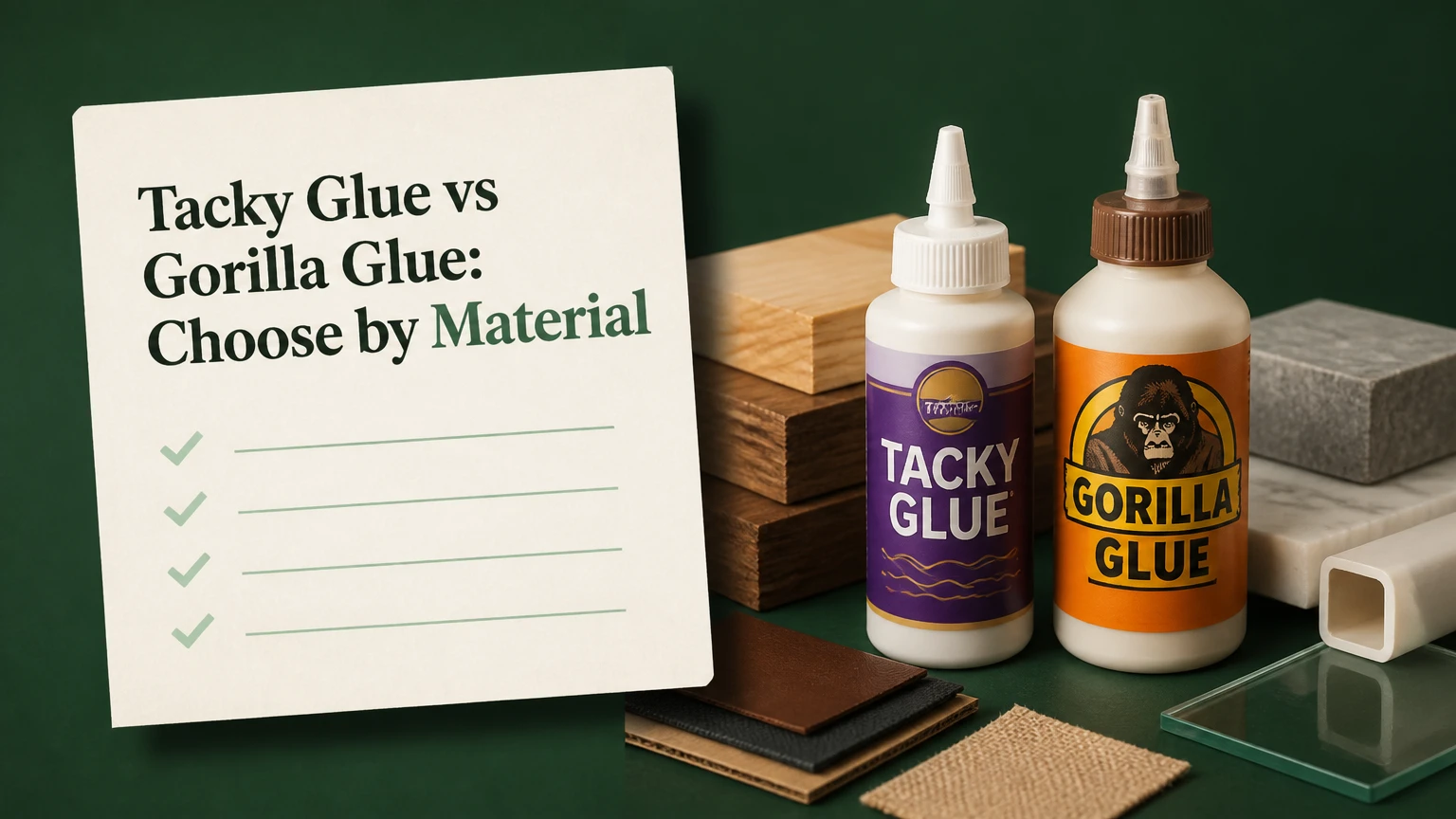
Tacky Glue is the better choice for paper, fabric, felt, lightweight wood, and origami because it dries flexible, grabs quickly, and cleans up with water while wet. Original Gorilla Glue is the better choice for waterproof structural bonds in wood, ceramic, stone, and some metals, provided you can control its expansion and clamp the joint.
Key facts at a glance
Aleene’s Original Tacky Glue is a thick, water-based polyvinyl acetate, or PVA, adhesive designed mainly for porous craft materials.
Original Gorilla Glue is a moisture-curing polyurethane adhesive that expands during curing and requires clamping.
Tacky Glue dries clear and flexible, while Original Gorilla Glue cures to a rigid amber or brown foam-like polymer.
Neither adhesive is a reliable permanent choice for polyethylene or polypropylene plastic.
Tacky Glue typically costs less per bottle and needs fewer tools, while Gorilla Glue provides better water resistance and gap tolerance.
For thin paper and origami, excess Tacky Glue can cause wrinkles, so application thickness matters more than maximum bond strength.
What Is the Difference Between Tacky Glue and Gorilla Glue?
Tacky Glue and Original Gorilla Glue use different curing systems and solve different bonding problems. Tacky Glue loses water and forms a flexible PVA film, whereas Original Gorilla Glue reacts with moisture and forms an expanding polyurethane polymer.
The product names can create confusion. “Tacky Glue” commonly means Aleene’s Original Tacky Glue, although other brands sell PVA craft adhesives under similar names. “Gorilla Glue” may mean the original brown polyurethane formula, Gorilla Super Glue, Gorilla Wood Glue, Clear Gorilla Glue, or Gorilla Epoxy. The comparison below uses Aleene’s Original Tacky Glue and Original Gorilla Glue unless a section identifies another formula.
Tacky Glue relies primarily on evaporation into the air or absorption into a porous surface. That mechanism explains its performance on cardboard, paper, unfinished wood, yarn, and fabric. It also explains why thick applications dry slowly and why prolonged water exposure can soften the bond.
Original Gorilla Glue needs moisture to cure. A lightly dampened surface starts the reaction, and the adhesive expands as it cures. The foam can help bridge small irregularities, but expansion also creates pressure that can separate parts unless the joint is restrained.
| Attribute | Aleene’s Original Tacky Glue | Original Gorilla Glue |
|---|---|---|
| Chemical family | Water-based PVA emulsion | Moisture-curing polyurethane |
| Wet appearance | Thick white paste | Amber-brown liquid |
| Cured appearance | Clear to translucent film | Rigid amber or brown polymer |
| Curing mechanism | Water evaporation and polymer film formation | Moisture-triggered chemical reaction |
| Expansion | No intentional expansion | Up to approximately 3 times the applied volume |
| Best surface type | Porous craft materials | Wood and irregular porous or semi-porous joints |
| Typical clamp requirement | Light pressure for 30-60 minutes | Firm clamping for about 1-2 hours |
| Water performance | Limited, product-dependent | Waterproof rating for the original formula |
| Typical full cure | About 24 hours | About 24 hours |
| Typical small-bottle retail cost | Roughly $3-$6 | Roughly $7-$12 |
Which Glue Is Stronger?
Original Gorilla Glue is stronger for structural, moisture-exposed joints, but strength alone does not make it the better adhesive. Tacky Glue is often the more reliable product when the bond must remain flexible, invisible, clean, and easy to apply.
Published adhesive strength figures are difficult to compare directly because manufacturers use different substrates, curing conditions, test geometries, and definitions of failure. A quoted tensile or shear value from one product cannot predict the performance of a thin paper joint or a poorly fitted furniture repair.
Original Gorilla Glue has a practical advantage when the materials are heavy, the joint is exposed to water, or the mating surfaces contain small voids. Its cured polyurethane is rigid and water resistant. Tacky Glue has a practical advantage when the attached material may bend, stretch, or tear before the adhesive should release.
The joint design matters as much as the adhesive. A wide wood lap joint distributes load efficiently. A tiny end-grain joint places stress on a much smaller area. A paper embellishment may require only positional holding, so structural strength would add inconvenience without improving the finished project.
Winner: Original Gorilla Glue for waterproof structural loads; Tacky Glue for lightweight, flexible, and decorative bonds.
Is Tacky Glue Waterproof?
Aleene’s Original Tacky Glue is not waterproof and should not be selected for items that will be washed, soaked, or left outdoors. High humidity may soften or weaken a PVA craft bond, although a dry indoor project can remain intact for years when the materials and joint are suitable.
Tacky Glue works well for indoor decorations, greeting cards, fabric embellishments that will not be laundered, scrapbook elements, cosplay details, and paper models. A sealed surface may reduce incidental moisture exposure, but varnish or paint over the project does not turn an unsuitable glue joint into a dependable outdoor structural bond.
Fabric requires special care. Tacky Glue can attach fabric to a rigid craft substrate, but repeated flexing and laundering call for a dedicated fabric adhesive such as Aleene’s Fabric Fusion or a sewn connection. The adhesive must match both the material and the expected maintenance routine.
Original Gorilla Glue is the more appropriate choice for outdoor wood, garden decorations, and waterproof repairs, but its label directions still control the application. Waterproof does not mean the joint can tolerate movement, poor surface preparation, standing water inside a crack, or a substrate that the polyurethane cannot wet effectively.
| Project condition | Better choice | Reason | Main limitation |
|---|---|---|---|
| Indoor paper card | Tacky Glue | Thin, clear, flexible bond | Excess moisture wrinkles paper |
| Washable fabric | Fabric-specific adhesive | Designed for laundering and flexing | Tacky Glue is not the intended product |
| Outdoor wooden planter repair | Original Gorilla Glue | Waterproof polyurethane bond | Requires clamping and cleanup |
| Ceramic ornament indoors | Tacky Glue for light decoration | Cleaner and less visible | Not suitable for impact loads |
| Stone garden ornament | Original Gorilla Glue | Better outdoor moisture resistance | Foam can look messy |
| Scrapbook page | Tacky Glue or glue stick | Controlled, low-load attachment | Liquid application can warp paper |
How Should You Apply Each Adhesive?
Application determines whether either glue succeeds. Tacky Glue needs a thin, even film and firm contact, while Original Gorilla Glue needs limited moisture, a very small adhesive quantity, and mechanical restraint during expansion.
How to Apply Aleene’s Tacky Glue
- Prepare the surfaces. Remove dust, loose fibers, oil, and debris. Surfaces should be dry unless the product label states otherwise.
- Spread a thin film. Use a brush, scraper, toothpick, or small nozzle bead. For paper, spread enough to cover without leaving wet ridges.
- Align immediately. Tacky Glue has high initial grab, so position the pieces before pressing them together.
- Press or weight the joint. Hold small pieces by hand for several minutes. Use books, clips, or light weights for larger flat areas.
- Remove squeeze-out. Wipe wet excess with a damp cloth. Dried PVA usually requires careful peeling, scraping, or rewetting.
- Allow the bond to dry. Light handling may be possible after roughly 30-60 minutes, but a thicker or enclosed joint may need 24 hours.
You will know the bond is ready when the adhesive is clear, the joint no longer shifts under light finger pressure, and the surrounding paper or fabric remains flat. A thick white center indicates retained water, not a completed cure.
How to Apply Original Gorilla Glue
- Dry-fit the parts. Confirm alignment and clamp access before opening the bottle.
- Dampen one surface lightly. Wipe or mist the surface with a damp cloth. Do not flood the joint.
- Apply a small amount to the opposite surface. A thin film is usually enough. Excess adhesive produces more foam, not a stronger joint.
- Join and clamp immediately. Use clamps, tape, straps, or evenly distributed weights. Prevent the expanding adhesive from lifting the pieces.
- Inspect after about 30 minutes. Remove uncured squeeze-out according to the product instructions, while avoiding contact with skin.
- Keep restrained for about 1-2 hours. Allow approximately 24 hours for full curing before stressing the repair.
You will know the application is controlled when only a narrow amount of foam appears at the edge and the pieces remain flush. A large, airy bead usually signals over-application, insufficient clamping, or excessive moisture.
| Application detail | Tacky Glue | Original Gorilla Glue |
|---|---|---|
| Surface moisture | Clean and dry | Lightly dampen one side |
| Typical adhesive amount | Thin continuous film | Very small bead or film |
| Initial restraint | Hand pressure, clips, or light weight | Firm clamp, tape, strap, or weight |
| Typical fixture period | 30-60 minutes | 1-2 hours |
| Full cure | About 24 hours | About 24 hours |
| Wet cleanup | Water and damp cloth | Follow label instructions; avoid skin contact |
| Cured cleanup | Peel or scrape PVA | Cut, scrape, sand, or chisel cured foam |
Which Glue Is Best for Paper, Fabric, and Origami?
Tacky Glue is the better option for most paper, fabric, and origami projects, but a glue stick or precision paper adhesive can outperform liquid Tacky Glue on very thin sheets. Original Gorilla Glue is unsuitable for ordinary origami because expansion, moisture, and rigid cured foam can distort the folds.
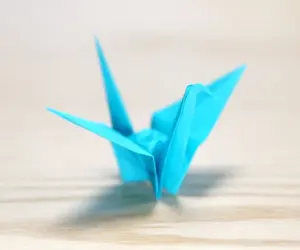
Origami depends on accurate creases and low added mass. Apply Tacky Glue with a toothpick or fine-tip nozzle, then spread it into an almost translucent film. A heavy wet layer can ripple lightweight kami paper, while a tiny amount at a flap or structural point preserves the model’s geometry.
For cardstock, Tacky Glue provides more initial grab than many school glues. For tissue paper, rice paper, or delicate foil-backed sheets, test on a scrap first. A glue stick often introduces less liquid and reduces cockling, although its bond may be less suitable for thick layered structures.
Fabric presents a different problem. Tacky Glue can hold trim, felt, ribbon, and costume details on an indoor project. It is not the right default for a garment seam or an item that will enter a washing machine.
Which Adhesive Fits Each Material?
| Material or joint | Recommended product | Typical use | Avoid or verify |
|---|---|---|---|
| Printer paper | Tacky Glue stick or thin Tacky Glue | Cards and paper models | Thick wet layers |
| Origami paper | Precision Tacky Glue application | Tabs, modular models, embellishments | Gorilla Glue expansion |
| Cardstock | Original Tacky Glue | Scrapbooks and props | Saturating large panels |
| Felt | Tacky Glue | Indoor ornaments and costumes | Laundered garments |
| Unfinished wood | Tacky Glue for light craft loads | Popsicle-stick models | Heavy or outdoor joints |
| Hardwood furniture joint | Gorilla Wood Glue or Original Gorilla Glue | Structural repairs | Poorly fitted gaps |
| Glass | Clear adhesive or epoxy selected for glass | Decorative attachment | Assuming PVA will hold permanently |
| Ceramic | Epoxy or Original Gorilla Glue | Repairs with controlled gaps | Visible foam on display faces |
| Metal | Epoxy or product-specific metal adhesive | Hardware and repairs | Smooth, oily surfaces |
| ABS or PVC | Plastic-rated adhesive | Plastic component repair | Treating all plastics alike |
| Polyethylene or polypropylene | Specialty low-energy-plastic adhesive | Containers and flexible parts | Standard Tacky or Gorilla Glue |
Does Gorilla Glue Work on Plastic, Metal, or Glass?
Original Gorilla Glue can bond some plastics, metals, and glass, but performance varies sharply with surface energy, cleanliness, fit, and movement. Polyethylene and polypropylene are particularly poor candidates for ordinary polyurethane adhesives because their low-energy surfaces resist wetting and mechanical adhesion.
Plastic identification matters more than the word “plastic.” A recycling code or manufacturer specification can distinguish polypropylene from ABS, PVC, or polystyrene, and each may require a different adhesive. Roughening a surface can improve mechanical keying, but sanding cannot fully solve poor chemical compatibility.
Metal and glass are nonporous, so the moisture-curing mechanism and gap behavior differ from a wood joint. Clean away oil, fingerprints, oxidation, and release agents. A two-part epoxy or a specialty adhesive may provide a cleaner and more predictable result when the surfaces are smooth and the joint is visible.
Tacky Glue is generally a poor permanent adhesive for smooth glass, metal, and dense plastic. It can temporarily hold a lightweight decorative item, but the flexible PVA film has limited resistance to peel, water, and low-porosity surfaces.
What Are the Main Product Alternatives?
Aleene’s Tacky Glue and Gorilla Glue are product families rather than single formulas. Choosing the correct variant can matter more than choosing the brand, because Gorilla Super Glue, Gorilla Wood Glue, and Gorilla Epoxy do not behave like Original Gorilla Glue.
| Product | Chemical type | Expansion or set behavior | Best application |
|---|---|---|---|
| Aleene’s Original Tacky Glue | PVA emulsion | No expansion; flexible dry film | General indoor crafts |
| Aleene’s Quick Dry Tacky Glue | Faster-drying PVA formulation | No expansion; shorter working time | Time-sensitive paper and craft work |
| Aleene’s Clear Gel Tacky Glue | Clear gel PVA formulation | No intentional expansion | Transparent or less-visible craft bonds |
| Aleene’s Fast Grab | High-viscosity craft adhesive | Minimal movement when wet | Bulky lightweight embellishments |
| Tacky Glue Sticks | Solid hot-melt-style craft format | Low liquid content; rapid set varies | Thin paper and portable projects |
| Gorilla Original Glue | Polyurethane | Expands during moisture cure | Waterproof structural joints |
| Clear Gorilla Glue | Clear polyurethane formulation | Product-specific expansion and cure | Less-visible household bonds |
| Gorilla Super Glue | Cyanoacrylate | Rapid set, little expansion | Small rigid repairs |
| Gorilla Wood Glue | Cross-linking PVA wood adhesive | No foaming expansion | Interior woodworking joints |
| Gorilla Epoxy | Two-part resin system | Rigid cure; gap filling | Metal, ceramic, and demanding repairs |
The brand label does not replace the technical data sheet. Check the exact bottle for dry time, water resistance, surface restrictions, and safety directions, especially because formulas and regional packaging can change.
Which Should You Choose?
The correct choice follows the project’s dominant failure risk. Choose Tacky Glue when visible residue, stiffness, moisture in the craft material, or paper distortion would ruin the project; choose Original Gorilla Glue when water, structural load, or an irregular wood joint creates the greater risk.
Crafters, Students, and Origami Makers
Choose Tacky Glue for paper, cardstock, felt, yarn, foam craft sheets, and lightweight embellishments. Its thick consistency reduces sliding, and its clear flexible film is less disruptive to a finished model.
Use a glue stick or a precision applicator for thin origami paper. Skip Original Gorilla Glue because it adds moisture, expands, requires clamping, and cures rigidly.
Woodworkers and Furniture Repairers
Choose Gorilla Wood Glue for a well-fitted interior wood joint when a non-foaming PVA formulation is appropriate. Choose Original Gorilla Glue when waterproof performance or modest gap tolerance matters and clamps are available.
Do not use expanding polyurethane as a substitute for accurate joinery. A foamed gap can look full while containing a weak, porous structure.
Household Repairers
Choose Tacky Glue for indoor decorative repairs that carry little load. Choose Original Gorilla Glue for a compatible outdoor or waterproof repair, such as a porous ceramic ornament or exterior wood component.
Choose Gorilla Super Glue for a small rigid part that must set quickly. Choose epoxy when the repair needs controlled gap filling across metal, ceramic, or mixed materials.
Which Glue Costs Less and Takes Less Time?
Tacky Glue usually costs less, requires fewer tools, and reaches light handling sooner, while Original Gorilla Glue costs more and adds clamping and cleanup time. Typical retail prices range from $3-$6 for a small Tacky Glue bottle and $7-$12 for a small Original Gorilla Glue bottle.
| Decision factor | Tacky Glue | Original Gorilla Glue | Practical consequence |
|---|---|---|---|
| Typical small-bottle price | $3-$6 | $7-$12 | Tacky Glue costs less initially |
| Tools required | Applicator, cloth, optional weight | Damp cloth, clamp, scraper, gloves | Gorilla Glue needs more preparation |
| Light handling | About 30-60 minutes | About 1-2 hours under restraint | Tacky Glue is faster for crafts |
| Full cure | About 24 hours | About 24 hours | Both need overnight planning |
| Cleanup difficulty | Low while wet | Moderate while wet, high when cured | Gorilla Glue rewards precise dosing |
| Replacement risk | Low for decorative work | Higher if foam lifts the joint | Clamping affects total project cost |
Drying time is not the same as usable strength. A PVA film may feel dry at the edge while remaining wet beneath a thick bead, and polyurethane may stop expanding before the chemical cure is complete.
What Common Mistakes Cause Bond Failure?
Most failures come from using the wrong formula, applying too much adhesive, or ignoring the joint’s movement and moisture conditions. Correcting the process rarely rescues a contaminated or incompatible substrate, so surface preparation and material identification come first.
| Failure mode | Likely cause | Immediate fix | Prevention |
|---|---|---|---|
| Paper wrinkles | Excess water-based glue | Flatten under clean weight after partial drying | Spread a nearly transparent film |
| Gorilla joint separates | No clamp or insufficient pressure | Reopen, remove cured foam, and rebond | Dry-fit and clamp before application |
| Brown foam remains visible | Excess polyurethane | Trim after full cure | Apply a very small amount |
| Fabric bond releases in washing | Non-washable adhesive | Replace with fabric adhesive or stitch | Match glue to care instructions |
| Plastic repair fails | PE or PP substrate | Use plastic-rated adhesive | Identify resin before bonding |
| Tacky Glue stays white | Thick or enclosed wet layer | Increase drying time and airflow | Use a thinner coat |
| Bond peels from metal | Oil or smooth surface | Remove adhesive and degrease | Abrade and clean as label permits |
A useful practitioner rule is to choose the adhesive according to the weakest interface, not the strongest advertised material. If glue bonds strongly to a coating that later peels from the substrate, the overall repair still fails.
Another rule concerns polyurethane foam: expansion is not equivalent to reinforcement. The cured foam can fill a void, but a properly fitted joint with a thin adhesive layer usually distributes load more reliably than a cavity packed with foam.
Removal also differs. Wet Tacky Glue usually responds to water and soap, although dyes and finishes may react first. Cured Original Gorilla Glue generally requires mechanical removal, such as careful scraping, sanding, or cutting, and solvents may damage the surrounding finish before dissolving the adhesive.
FAQ
Can You Mix Tacky Glue and Gorilla Glue?
Do not mix Tacky Glue and Original Gorilla Glue in the same container or rely on a layered application without testing. The adhesives cure through different mechanisms, and the water in Tacky Glue can alter the moisture conditions needed by polyurethane. Use one product selected for the joint.
Is Gorilla Glue Better Than Tacky Glue for Wood?
Original Gorilla Glue is better for outdoor or waterproof wood repairs with small irregularities, while Tacky Glue is adequate for lightweight indoor wood crafts. For accurately fitted interior furniture joints, Gorilla Wood Glue is often a more appropriate Gorilla product because it does not foam.
Can Tacky Glue Replace Mod Podge?
Tacky Glue can attach individual paper or fabric elements, but it is not a direct replacement for Mod Podge as a broad coating, decoupage medium, or sealer. Tacky Glue dries thicker and is intended primarily to form adhesive joints rather than uniform protective layers.
Can You Use Gorilla Glue Without Clamping?
You should not use Original Gorilla Glue without securing the joint during its expansion period. Tape, straps, spring clamps, C-clamps, or evenly distributed weights can work when they maintain contact and alignment. Gorilla Super Glue is a different formula and usually does not require prolonged clamping.
How Do You Keep Tacky Glue From Wrinkling Paper?
Prevent wrinkles by applying the thinnest even coat possible, avoiding saturated edges, and pressing the paper flat under clean weight. For very thin origami or tissue paper, use a glue stick or apply Tacky Glue only to tabs and small attachment points.
Which Glue Should You Keep at Home?
Keep Tacky Glue for indoor craft materials and a fast-setting adhesive for small rigid repairs; add Original Gorilla Glue only if you regularly repair compatible wood, ceramic, stone, or outdoor items. A small epoxy kit fills gaps that neither standard Tacky Glue nor polyurethane handles cleanly.
The Bottom Line
Tacky Glue vs Gorilla Glue is primarily a choice between clean flexibility and waterproof structural performance. Select Aleene’s Tacky Glue for paper, origami, fabric embellishments, felt, and lightweight indoor crafts; select Original Gorilla Glue for compatible outdoor or load-bearing joints when you can apply little adhesive, add moisture correctly, and clamp for 1-2 hours.
