


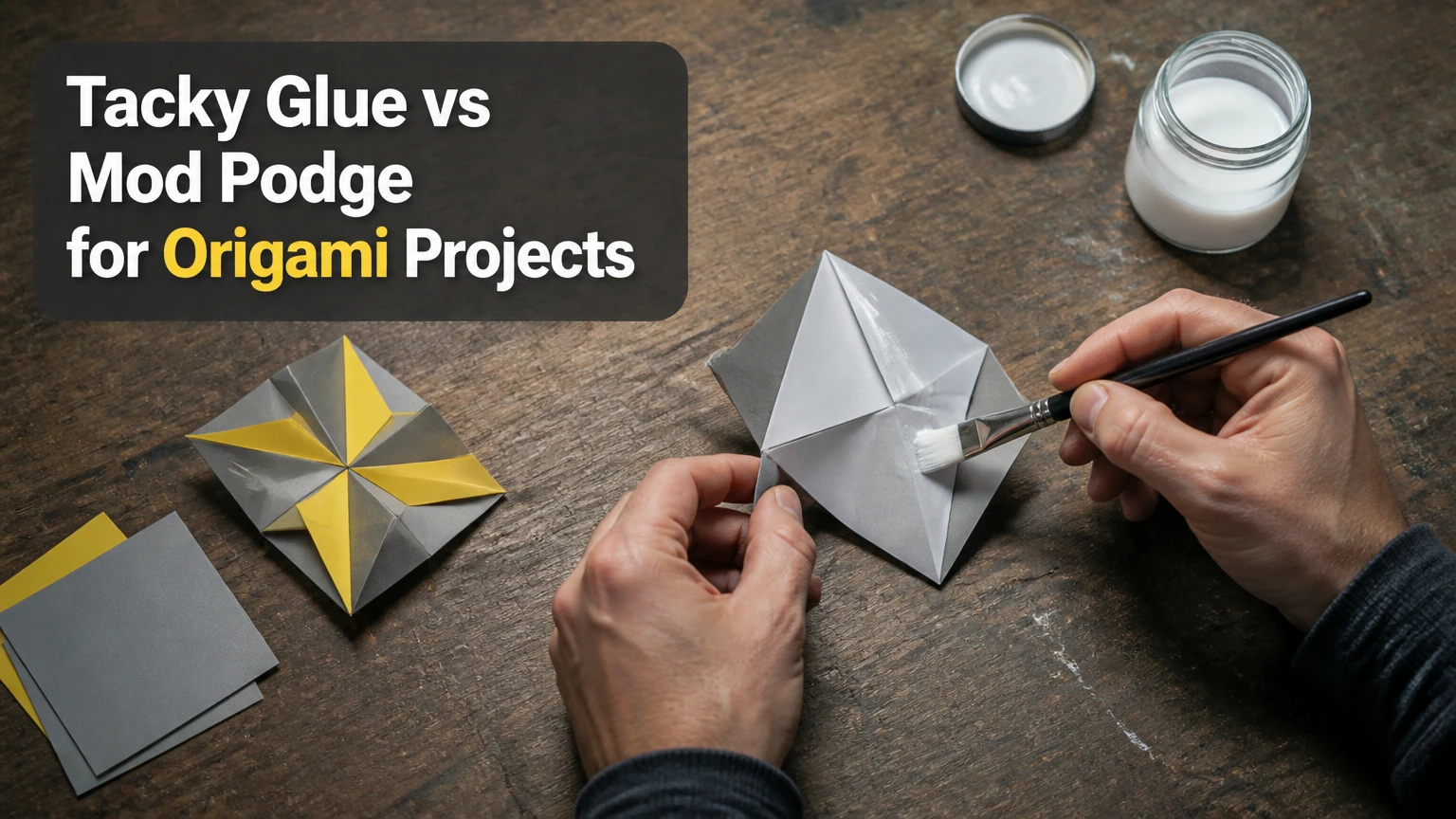
Tacky Glue is the better choice for making discrete structural joins in origami, while Mod Podge is better for attaching flat paper layers or adding a protective finish. For most folded models, use very small amounts of Tacky Glue and avoid coating the paper unless the finished sculpture needs sealing. Mod Podge’s added moisture can soften folds, create wrinkles, and reduce dimensional accuracy.
Key Facts at a Glance
- Tacky Glue is a thick, water-based craft adhesive designed to hold separate pieces together.
- Mod Podge is a decoupage medium that combines adhesive, sealer, and surface finish functions.
- Neither product is ideal for ordinary origami that must remain foldable and reversible.
- A 1-2 mm dot of Tacky Glue usually causes less distortion than a brushed-on coat of Mod Podge.
- Mod Podge Matte typically dries with a low-sheen film, while Mod Podge Gloss leaves a visibly shiny finish.
- Thin paper under approximately 80 gsm has a high risk of wrinkling under wet coatings.
Tacky Glue vs Mod Podge: Which Should You Choose?
Tacky Glue wins for origami joints, tabs, layered paper sculpture, and modular models that need parts to stay aligned. Mod Podge wins for decoupage, flat collage work, rigid display pieces, and selected protective coatings. The right product depends on whether the job is joining folded parts, laminating a surface, or finishing a completed model.
Quick Verdict by Origami Project
| Project situation | Recommended product | Typical application | Main reason |
|---|---|---|---|
| Traditional single-sheet origami | Neither | Fold dry paper only | Adhesive changes reversibility and crease behavior |
| Modular origami locks | Tacky Glue | 1 mm dots at hidden tabs | High viscosity limits sliding |
| Origami flowers with glued petals | Tacky Glue | 1-2 mm dots per overlap | Creates targeted structural joints |
| Paper collage on a rigid box | Mod Podge Paper or Matte | 0.5-1 mm brushed coat | Spreads evenly across flat paper |
| Finished paper sculpture needing a film | Mod Podge Matte | 2-3 thin coats | Adds a continuous surface layer |
| Glossy display ornament | Mod Podge Gloss | 2 thin coats | Produces a reflective finish |
| Archival, reversible museum model | Neither, usually | Methylcellulose or reversible paste | Easier future repair and removal |
A practitioner rule helps here: adhesive belongs at the joint, while finish belongs on the surface. Brushing a structural glue over an entire folded model wastes material and often leaves ridges, whereas coating a delicate model with a wet decoupage medium can flatten its geometry.
How Do Tacky Glue and Mod Podge Behave on Paper?
Tacky Glue concentrates adhesive where the paper pieces meet, while Mod Podge distributes moisture and polymer film across a broad surface. The difference matters because origami depends on dry fiber stiffness, sharp creases, and predictable tension between layers.
Aleene’s describes Original Tacky Glue as a thick, versatile craft glue that dries clear and remains flexible. Plaid positions Mod Podge as an all-in-one decoupage product, with formulas that differ in sheen, surface suitability, and intended durability. Product labels take priority because both brands sell multiple versions rather than one chemically identical universal formula.
Tacky Glue commonly contains a water-based PVA adhesive system. Its thick body creates immediate grab, but the glue still releases water into porous paper as it dries. Mod Podge formulas also vary, and users should not assume every version has the same resin system, water content, cure behavior, or suitability for flexible paper.
Practical Mechanics
| Property | Tacky Glue | Mod Podge | Origami consequence |
|---|---|---|---|
| Wet consistency | Thick cream or paste | Fluid medium | Tacky Glue stays in dots; Mod Podge spreads |
| Primary function | Joining parts | Gluing, sealing, finishing | Different placement strategies |
| Initial grab | High on many porous surfaces | Moderate while wet | Tacky Glue better for tabs |
| Moisture distribution | Localized | Broad and continuous | Mod Podge has greater warp risk |
| Dried film | Flexible adhesive line | Surface coating, finish varies | Coating can stiffen folds |
| Best scale | Small joints and attachments | Flat panels and broad surfaces | Match product scale to task |
| Removal after drying | Difficult on absorbent paper | Difficult after film formation | Neither is fully reversible |
The chemical label does not predict every craft outcome. Paper weight, humidity, coat thickness, absorbency, and drying airflow often matter more than the product category alone.
What Are the Practical Differences in Cost, Time, and Finish?
Typical US retail prices range from $3-$8 for a 4-8 fluid-ounce bottle of Tacky Glue and $6-$15 for an 8-16 fluid-ounce container of Mod Podge. A single origami model usually consumes less than 1 teaspoon of either product, so the larger cost difference comes from the project type and waste, not the price of one bottle.
Dry-to-touch timing is also application-dependent. A small Tacky Glue dot may become stable in 20-60 minutes, while a thin Mod Podge coat often feels dry in 15-30 minutes. Full strength or dependable hardness takes longer, especially in humid conditions. Test the actual formula on scrap paper before timing a valuable model.
| Decision factor | Tacky Glue | Mod Podge Matte | Mod Podge Gloss |
|---|---|---|---|
| Typical package price | $3-$8 | $6-$15 | $6-$15 |
| Common package size | 4-8 fl oz | 8-16 fl oz | 8-16 fl oz |
| Thin layer dry time | 20-60 minutes | 15-30 minutes | 15-30 minutes |
| Practical cure window | 24 hours for joints | Several days for handling | Several days for handling |
| Surface appearance | Clear, possible glue ridge | Low sheen | Noticeable shine |
| Typical origami use | Hidden joints | Matte display finish | Gloss display finish |
| Main waste risk | Excess squeezed from nozzle | Excess coating on folds | Visible streaks or glare |
Manufacturers may publish different dry times for different formulas and conditions. Treat the figures above as typical working ranges, not guarantees.
Which Is Better for Folding Origami?
Neither product should be applied before folding delicate origami paper. Wet adhesive changes fiber flexibility and can make a crease buckle, while a dried coating can crack or prevent the paper from folding cleanly along existing lines.
For glued origami, Tacky Glue is usually the safer option because the maker can place a controlled dot under a tab. Apply glue after the major folds are complete, then hold the joint with a clip, tweezers, or a silicone tool until the paper stops lifting. Keep adhesive away from exposed crease valleys.
Mod Podge works better after folding when the goal is surface protection rather than construction. Even then, seal only a model that no longer needs additional folds. Matte and Gloss formulas can make paper more rigid, darker, or slightly translucent.
Origami-Specific Application Matrix
| Origami material or construction | Glue placement | Suitable product | Avoid |
|---|---|---|---|
| 70-90 gsm kami paper | Hidden tab, 1 mm dot | Original Tacky Glue | Full-surface brushing |
| 120-180 gsm cardstock | Overlap, 1-2 mm bead | Tacky Glue | Large wet pools |
| Washi or highly absorbent paper | Small test joint | Tacky Glue, cautiously | Mod Podge on visible face |
| Foil-backed paper | Scuffed hidden tab | Tacky Glue | Expecting strong adhesion to foil |
| Printed scrapbook paper | Flat underside | Mod Podge Paper | Saturating the printed face |
| Finished paper animal | Exterior, thin coats | Mod Podge Matte | Coating articulated hinges |
| Modular kusudama | Inside petals and tabs | Tacky Glue | Glue at the visible point |
| Paper sculpture on wood | Broad paper panel | Mod Podge Matte or Paper | Using Tacky Glue as varnish |
Expert rule: build the model first, stabilize it second, and finish it last. Reversing that order traps moisture and makes later corrections much harder.
When Does Tacky Glue Make More Sense?
Tacky Glue makes more sense when the project needs a concentrated, flexible bond between paper, card, fabric, wood, or lightweight craft components. The product is especially useful for modular origami, paper flowers, pop-up mechanisms, layered masks, and folded sculptures with tabs.
Use the narrowest practical bead. For a small tab, a 1 mm dot is often enough; a 2-3 mm bead may add unnecessary moisture and squeeze onto the visible face. Place the adhesive on the less visible surface, press for 10-20 seconds, and support the joint for at least 30 minutes.
Tacky Glue is not a precision archival adhesive by default. Many craft glues are not marketed as acid-free or conservation-grade, and the label may not provide a pH or aging specification. For heirloom origami, consult an archival supplier and choose a product with documented reversibility or conservation use.
How to Apply Tacky Glue to an Origami Joint
- Dry-fit the parts. Confirm the tab alignment before opening the glue bottle.
- Cut a fine nozzle opening. A small opening reduces accidental over-application.
- Place a 1-2 mm dot. Use a toothpick for pieces smaller than a postage stamp.
- Join and align. Press the surfaces together without sliding them repeatedly.
- Hold for 10-20 seconds. Use reverse tweezers or a low-pressure clip when needed.
- Leave undisturbed for 30-60 minutes. Avoid testing the joint during the set period.
- Allow 24 hours before heavy handling. A thick bead or humid room may require longer.
You will know the joint is ready when the tab remains closed after the support is removed and the glue line feels firm rather than cool or wet. The common mistake is squeezing until glue appears around the tab. Excess adhesive adds weight and creates a glossy spot that is difficult to remove from absorbent paper.
When Should Mod Podge Finish an Origami Model?
Mod Podge should finish an origami model only after folding, gluing, and shaping are complete. A thin coating can protect a stationary display piece from light dust and handling, but Mod Podge is not a substitute for a structural adhesive at load-bearing tabs.
Choose the formula according to the desired surface. Mod Podge Matte reduces glare, Gloss increases sheen, Satin sits between the two, Paper is designed around paper projects, and Hard Coat is intended for tougher finished surfaces. Outdoor and Dishwasher Safe formulas target specialized exposure conditions, but neither makes a paper model waterproof.
Apply with a soft synthetic brush or foam applicator. Use approximately 0.5-1 teaspoon for a palm-sized flat panel, then spread it into a thin film rather than leaving a wet pool at the base of a fold.
| Mod Podge formula | Finish or purpose | Origami suitability | Limitation |
|---|---|---|---|
| Matte | Low-sheen protective film | Static display models | Can show brush marks if overworked |
| Gloss | Shiny protective film | Decorative ornaments | Highlights every ridge and streak |
| Satin | Moderate sheen | Display pieces needing less glare | Less visually flat than Matte |
| Paper | Paper-focused decoupage work | Flat folded-paper panels | Still introduces moisture |
| Fabric | Flexible textile adhesion | Paper attached to fabric or board | Not necessary for ordinary paper |
| Hard Coat | More durable hard-use finish | Rigid paper sculpture | Can stiffen or crack at folds |
| Outdoor | Exterior-oriented coating | Protected garden decor | Does not create waterproof paper |
| Dishwasher Safe | Specialized cured coating | Non-paper craft surfaces | Unsuitable rationale for delicate origami |
The label’s claimed finish does not eliminate application risk. Mod Podge can remain cloudy while wet, and a heavy coat can dry unevenly, especially over dark ink, porous paper, or enclosed folds.
What Works Better for Archival, Reversible, or Flexible Origami?
Methylcellulose paste, wheat starch paste, neutral pH bookbinding adhesive, and conservation-grade PVA can outperform both products when reversibility, aging behavior, or low visual impact matters. The best substitute depends on whether the model must be repaired, remain flexible, or resist handling.
For temporary mock-ups, use removable paper tabs, tiny pieces of artist’s tape on hidden areas, or a low-tack positioning aid. For book arts and archival paper construction, a conservation supplier can specify a neutral-pH adhesive and compatible paper stock.
| Alternative | Best use | Typical working property | Main limitation |
|---|---|---|---|
| Methylcellulose paste | Reversible paper joints | Slow drying, water reactivatable | Low strength on slick surfaces |
| Wheat starch paste | Conservation paper work | Smooth, controllable, reversible | Requires careful preparation |
| Neutral-pH bookbinding PVA | Durable paper construction | Strong, flexible, low creep | Usually less reversible |
| Spray adhesive | Large flat laminations | Even coverage, fast placement | Overspray and repositioning problems |
| Double-sided archival tape | Clean temporary tabs | Immediate bond, no wet time | Adds thickness to folds |
| Glue stick | Light flat paper attachment | Low moisture, easy application | Weak on stressed joints |
| Hot-melt glue | Large props and non-folding parts | Instant set after cooling | Bulky, rigid, poor for fine folds |
A counterintuitive point is that a stronger adhesive is not automatically better for origami. If the paper tears before the joint releases, the adhesive has exceeded the material’s useful strength.
Which Product Fits Each Surface and Stress Level?
Tacky Glue performs best on porous, lightly textured materials where the adhesive can key into fibers. Mod Podge performs best when a medium must cover a broad, relatively flat surface and leave a controlled finish after drying.
Neither product is a universal plastic, metal, or glass adhesive. Slick surfaces have low surface energy, so roughening, cleaning, or selecting a material-specific adhesive may matter more than choosing between these two craft products.
| Surface combination | Better starting choice | Preparation | Expected result |
|---|---|---|---|
| Paper to paper tab | Tacky Glue | Clean, dry surfaces | Flexible localized joint |
| Paper to chipboard | Tacky Glue or Mod Podge Paper | Seal very absorbent board | Strong tab or broad bond |
| Paper to wood panel | Mod Podge Matte or Paper | Sand and remove dust | Even flat adhesion |
| Paper to glass | Mod Podge cautiously | Degrease glass completely | Decorative, low-stress bond |
| Fabric to paper | Tacky Glue for edges | Test bleed and flexibility | Flexible edge attachment |
| Paper to plastic | Material-specific adhesive | Lightly scuff plastic | Variable, often weak |
| Paper to metal | Tacky Glue for light decor | Degrease and scuff hidden area | Suitable only for low stress |
| Paper to ceramic | Mod Podge for flat decor | Wash and degrease surface | Decorative, not load-bearing |
For a paper model attached to a wood base, use Tacky Glue on hidden feet or tabs, then use Mod Podge only on the exposed paper if a sealed finish is wanted. Combining products by function is safer than asking one bottle to do everything.
Why Did the Paper Warp, Bubble, or Stay Sticky?
Warping usually comes from too much water in one area, uneven drying, or paper fibers swelling more on one side than the other. Bubbling often results from placing thin paper onto a wet, uneven film without smoothing from the center outward.
Sticky Mod Podge usually indicates a thick coat, high humidity, insufficient airflow, incompatible paint underneath, or a formula that has not fully cured. Plaid’s product guidance distinguishes dry time from cure behavior, so a surface that feels dry after an hour is not necessarily ready for abrasion or repeated handling.
| Failure | Likely cause | Immediate response | Prevention |
|---|---|---|---|
| Ripples in thin paper | Heavy wet Mod Podge coat | Flatten under release paper after partial drying | Use a thin coat and lighter paper saturation |
| Raised bubbles | Air trapped under paper | Smooth from center outward while wet | Use a brayer or silicone tool |
| White haze | Moisture trapped in layers | Increase airflow and drying time | Apply fewer, thinner coats |
| Sticky surface after days | Excess thickness or humidity | Allow extended cure, then test sealer compatibility | Work in a dry, ventilated room |
| Visible glue dots | Oversized Tacky Glue bead | Remove only before full cure | Use a toothpick and smaller dots |
| Cracked coating at folds | Rigid finish stressed by movement | Stop flexing the area | Do not coat hinges or articulated joints |
| Detached tab | Dust, slick paper, or insufficient set | Reclean and reglue | Dry-fit and support the joint |
Do not use a hair dryer on high heat to rescue a delicate model. Forced heat can curl paper, soften some coatings, and create a faster moisture gradient between the outer film and inner paper.
How Can You Use Both Products in One Project?
Use Tacky Glue for hidden structural joints and Mod Podge for a final, selective surface coat. The sequence should be construction, drying, inspection, and finishing, with no Mod Podge applied over joints that still need to flex.
A reliable two-product workflow is:
- Fold and shape the entire origami model without adhesive.
- Add Tacky Glue to hidden tabs in dots of approximately 1-2 mm.
- Let the model rest for 24 hours, especially if several joints were glued.
- Inspect for squeeze-out, loose tabs, and blocked hinges.
- Brush one thin Mod Podge coat onto a scrap section first.
- Apply two thin coats only to stable exterior panels, waiting 30-60 minutes between coats.
- Leave the finished model in a dry, ventilated area for several days.
This approach preserves the division of labor between the products. It also limits the most common failure, which is saturating a completed folded model before its geometry has stabilized.
Which Product Should You Buy for Common Origami Situations?
Choose Tacky Glue when your decision turns on joint placement, immediate grab, or flexible attachment. Choose Mod Podge when your decision turns on broad coverage, decoupage, or a visible matte or glossy finish.
| User or project | Purchase choice | Suggested variant | Reason |
|---|---|---|---|
| Beginner making glued animals | Tacky Glue | Original or Quick Dry | Easier tab control |
| Modular origami maker | Tacky Glue | Original or Fast Grab | Holds repeated small joints |
| Teacher making classroom models | Tacky Glue | Original, small bottles | Less coating mess and lower waste |
| Scrapbooker using folded pages | Mod Podge | Paper or Matte | Broad, even paper coverage |
| Artist making a rigid paper sculpture | Both, used separately | Original plus Matte | Structural joins and controlled finish |
| Display maker wanting shine | Mod Podge | Gloss | Reflective surface |
| Conservation-minded folder | Neither by default | Methylcellulose or documented archival PVA | Better reversibility information |
| Outdoor paper decor maker | Neither for exposed paper | Outdoor-rated construction system | Paper remains vulnerable to moisture |
Tacky Glue is not good for producing a smooth varnish-like surface. Mod Podge is not good for supporting heavy three-dimensional parts, tensioned tabs, or joints that experience repeated movement.
FAQ
Can Mod Podge Be Used Instead of Tacky Glue on Origami?
Mod Podge can replace Tacky Glue for flat paper adhesion, decoupage, and low-stress overlaps, but it is a poor substitute for small structural tabs. The fluid medium spreads beyond the intended joint and adds more moisture, which can wrinkle thin paper or soften a precise crease. Use Tacky Glue for concentrated joins.
Does Tacky Glue Dry Clear on Colored Origami Paper?
Most clear-drying Tacky Glue formulas dry transparent, but a thick bead can remain visibly glossy or slightly raised on dark paper. Test the glue on the same paper stock before using it on the final model. Apply a smaller dot than expected, because excess adhesive is more noticeable than a small gap.
Is Mod Podge Acid-Free or Archival?
Mod Podge should not automatically be treated as archival simply because it dries clear. Formula composition, paper acidity, ink stability, and long-term aging requirements all affect conservation suitability. For heirloom or museum-oriented origami, select an adhesive with explicit conservation documentation rather than relying on the general Mod Podge name.
Can You Use Mod Podge on Origami Hinges?
Avoid Mod Podge on origami hinges, articulated limbs, opening boxes, and folds that must move repeatedly. The dried film can stiffen the hinge and crack when flexed. If a hinge needs reinforcement, use a narrow internal paper strip and a small amount of suitable adhesive instead of coating the moving fold.
How Long Should Glued Origami Dry Before Display?
Small Tacky Glue joints usually need at least 24 hours before normal display handling, while a Mod Podge finish may need several days to lose residual moisture and become more resistant to scuffing. High humidity, thick application, enclosed folds, and absorbent paper extend both periods.
What Is the Best Way to Store a Finished Paper Model?
Store the model in a dry room away from direct sunlight, condensation, and pressure from other objects. Use an acid-free box or display case with clearance around protruding folds. Do not seal an untested model in plastic immediately after applying Mod Podge, because trapped moisture can prolong tackiness and clouding.
The Bottom Line
For tacky glue vs mod podge, choose Tacky Glue when origami construction requires small, strong, flexible joints, and choose Mod Podge when a completed, mostly rigid paper project needs broad adhesion or a decorative protective finish. Traditional origami is best kept adhesive-free, while glued origami benefits from precise Tacky Glue dots and restrained finishing. Use each product for its actual job, not as a universal substitute for the other.
