


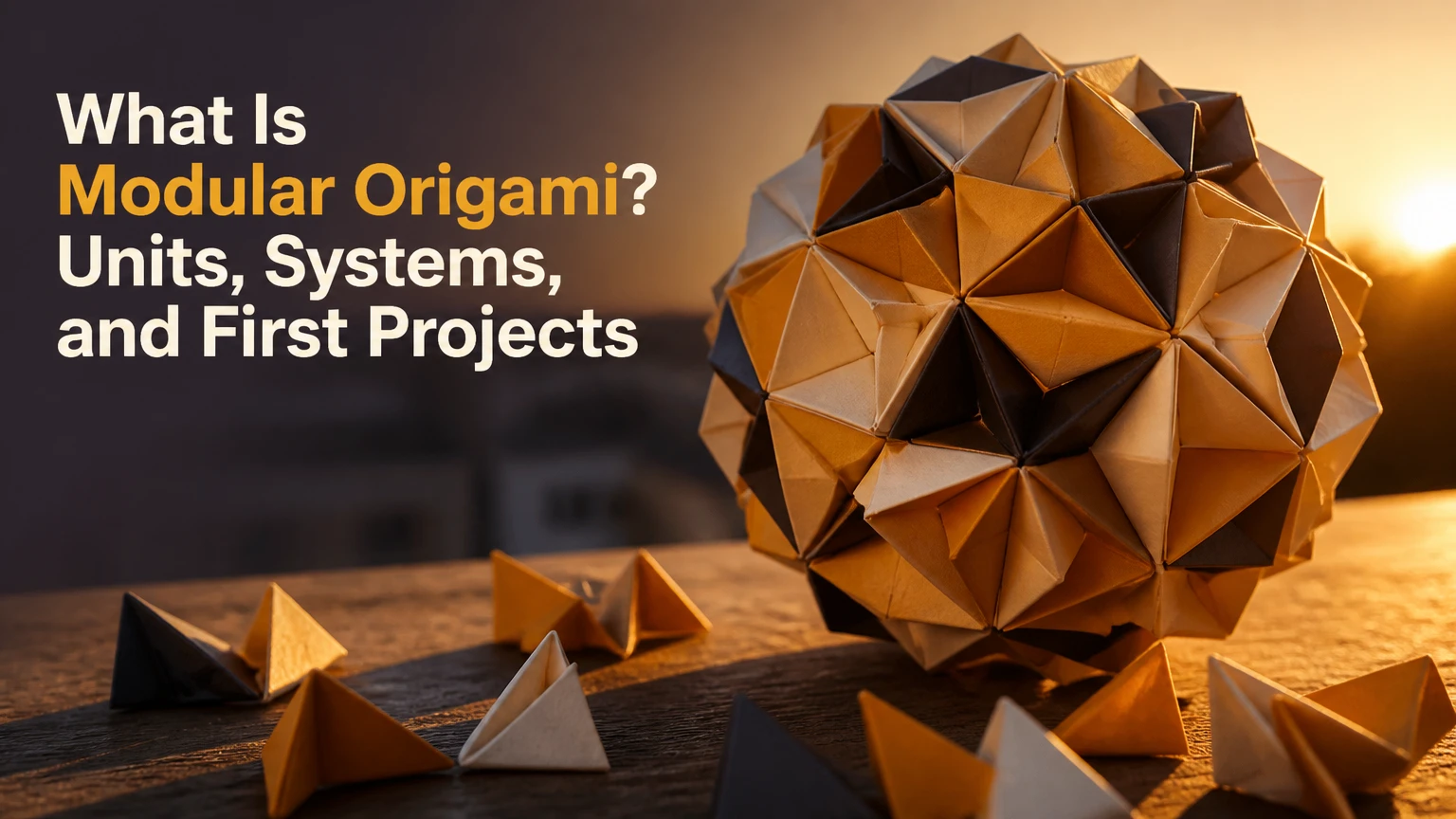
Modular origami is the practice of folding multiple separate sheets into repeated paper units and assembling those units into a larger three-dimensional form. The modules usually interlock through tabs, pockets, or folded edges without glue, tape, or scissors, producing models such as polyhedra, wreaths, stars, floral spheres, and large sculptures.
Key Facts at a Glance
- Modular origami uses two or more folded units assembled into one structure.
- Unit origami is a common synonym, although some folders distinguish specific systems by their assembly rules.
- A six-unit Sonobe cube is one of the most accessible first modular origami projects.
- A finished model can contain 6 units or more than 1,000 units, depending on the system and subject.
- Traditional interlocking modular origami does not require glue, but kusudama and 3D origami may use adhesive.
- Structural accuracy depends more on consistent folds and paper behavior than on a universal 0.5 mm tolerance.
What Is Modular Origami?
Modular origami is a branch of origami in which separate folded components, called modules or units, combine to form a single model. A designer may fold every unit from the same diagram, use several unit colors, or combine different modules according to a planned assembly pattern.
Traditional single-sheet origami creates a form from one uncut sheet. Modular origami distributes the design across many sheets, so the final object can have repeated symmetry, larger dimensions, and geometric structures that would be impractical from one square.
The phrase unit origami often means the same thing. Some practitioners use “modular origami” for systems with repeated identical units and reserve “unit origami” for a broader category that includes more loosely connected components. Terminology varies by author, diagram designer, and origami community.
Modular origami is not automatically synonymous with every paper model made from pieces. Models assembled with scissors, wet glue, staples, or permanent tape may be paper sculpture or modular paper craft rather than traditional glue-free modular origami.
Where Did Modular Origami Come From?
Modular origami developed through several traditions rather than from one inventor or one founding date. Japanese kusudama, Chinese paper-folding traditions, geometric origami design, and modern mathematical origami all contributed to the forms used today.
The Japanese word kusudama originally referred to a medicinal or aromatic ball, often made from assembled materials. Modern folded kusudama commonly uses repeated floral units, and many contemporary versions rely on glue even though other modular systems remain entirely interlocking.
Robert Harbin’s popularization of origami in English-speaking countries, the mathematical work of designers such as Tomoko Fuse, and the polyhedral designs associated with Mitsunobu Sonobe helped bring modular forms to a wide audience. The history is therefore layered: decorative spheres, geometric units, and contemporary paper engineering overlap without being identical categories.
How Does Modular Origami Work?
Modular origami stays together through the geometry and material behavior of folded paper. A unit creates receiving areas, insertion points, or overlapping layers, and the completed structure distributes small forces across many connected modules rather than depending on one joint.
A typical unit has three structural features:
- Tabs or flaps: Narrow folded sections that enter another module.
- Pockets or layers: Openings that receive and constrain tabs.
- Reference edges: Creases that control alignment and establish the model’s angle.
When a tab enters a pocket, the paper layers press against one another. Surface friction resists sliding, while the crease geometry limits rotation. Once several units form a closed ring or polyhedron, forces circulate through the structure and make individual joints harder to dislodge.
The phrase “friction lock” is useful, but it does not describe every system perfectly. Some designs depend on layer capture, edge overlap, compression, or a locking flap rather than friction alone. Paper stiffness, coating, crease depth, and insertion accuracy all influence the result.
Does Every Fold Need to Be Perfect?
Every fold needs to be consistent, but modular origami does not have one universal 0.5 mm failure threshold. A 0.5 mm error may matter in a tightly packed 90-unit model made from small paper, while a larger six-unit cube can tolerate a visibly larger discrepancy.
Errors compound because repeated units create repeated deviations. If ten modules are each angled slightly too far, the final opening may shift enough to prevent closure. The practical rule is to make one test unit, compare it with the next unit, and correct the folding sequence before producing the full batch.
What Are the Main Modular Origami Systems?
The main modular origami systems differ in unit shape, joint behavior, visual style, and tolerance for adhesive. Sonobe is a folded-tab system for polyhedra, kusudama commonly produces floral spheres, PHiZZ units create linked geometric frameworks, and Golden Venture units build dense stacked sculptures.
| System | Typical unit shape | Common forms | Adhesive practice |
|---|---|---|---|
| Sonobe | Rectangular folded unit with flaps | Cube, octahedron, icosahedron | Usually none |
| Kusudama | Floral or petal module | Spheres, wreaths, flowers | Often glue or thread |
| PHiZZ | Zigzag or Z-shaped linking unit | Rings, toroids, frameworks | Usually none |
| Golden Venture | Small triangular pocket unit | Animals, vases, figures | Often glue for permanence |
What Is a Sonobe Unit?
A Sonobe unit is a modular origami component with diagonal folds, flaps, and pockets that connect into polyhedral forms. Six units create a familiar cube, while larger assemblies can create octahedra, icosahedra, and stellated variations.
Sonobe is a strong beginner system because the unit diagram is short, the assembly logic is repeatable, and the six-unit cube provides immediate feedback. The system is not limited to cubes, although its flat faces and angular joints give many Sonobe models a distinctly geometric appearance.
Is Kusudama the Same as Modular Origami?
Kusudama is a modular origami category when repeated folded units form a larger object, but many kusudama designs differ from strict glue-free modular origami. Floral petals often join edge to edge, and adhesive can preserve the shape because the folded contact surfaces do not always create a reliable mechanical lock.
A kusudama is a good choice for decoration and color design. It is less suitable when the goal is a fully reversible model that can be disassembled without damaging the paper.
What Is 3D Origami?
3D origami, often called 3D Golden Venture origami, uses many small triangular units stacked in rows. The units are usually simple to fold, but a single sculpture can require hundreds or thousands of pieces.
The term can confuse beginners because “3D” describes the result rather than a single standardized unit system. Golden Venture sculptures often use glue for structural permanence, and their dense construction differs from the open polyhedral frameworks associated with Sonobe or PHiZZ.
How Many Units Do Projects Need?
Modular origami projects commonly require 6-120 units for geometric models and 500-2,000 or more for dense Golden Venture sculptures. Unit count predicts preparation time, but it does not predict difficulty by itself because a small model with complex closure can be harder than a large model with repetitive assembly.
| Project example | Typical unit count | Folding and assembly time | Typical paper cost |
|---|---|---|---|
| Sonobe cube | 6 | 15-30 minutes | $0.50-$2 |
| Sonobe icosahedron | 30 | 1.5-3 hours | $3-$10 |
| Floral kusudama | 30-60 | 3-6 hours | $5-$15 |
| PHiZZ toroid | 60-120 | 4-12 hours | $6-$25 |
| Golden Venture animal | 500-2,000+ | 10-30+ hours | $15-$40 |
These figures are typical hobbyist ranges, not fixed production standards. Folding speed, diagram complexity, paper size, and whether units are pre-creased can change the total substantially. A 30-unit model also requires enough room to sort, align, and temporarily support the growing structure.
What Mathematical Shapes Can Modular Origami Make?
Modular origami can form polyhedra by matching unit connections to faces, edges, or vertices of a target structure. A cube has 6 square faces, an octahedron has 8 triangular faces, and an icosahedron has 20 triangular faces, but the number of paper units depends on the chosen unit system rather than the solid alone.
| Target form | Geometric property | Example unit count | Assembly implication |
|---|---|---|---|
| Cube | 6 square faces, 12 edges | 6 Sonobe units | Three-dimensional corner alignment |
| Octahedron | 8 triangular faces, 12 edges | 12 Sonobe units | Repeated triangular openings |
| Icosahedron | 20 triangular faces, 30 edges | 30 Sonobe units | Long closure sequence |
| Toroid | Closed ring with a central opening | 60-120 PHiZZ units | Continuous loop tension |
A designer may assign one module to each edge, face, or vertex, depending on the system. That is why two models representing the same polyhedron can use different unit counts.
Which Materials Work Best?
Kami paper around 60-75 gsm is the easiest starting material for a six-unit Sonobe cube because it folds cleanly, opens into pockets without tearing, and remains light enough for a beginner to handle. For larger or more tightly packed models, 70-100 gsm text-weight paper often provides better crease retention.
Paper choice changes joint behavior. Thin paper creates flexible tabs that insert easily but may collapse under repeated handling. Heavy paper holds sharp geometry but can make pockets too tight, especially when many layers collect at one connection.
| Material | Typical weight | Best use | Main risk |
|---|---|---|---|
| Kami paper | 60-75 gsm | Beginner Sonobe cubes | Soft pockets in large models |
| Text-weight paper | 80-100 gsm | Polyhedra and medium units | Tight multi-layer joints |
| Tant paper | 70-80 gsm | Colorful geometric models | Higher cost per sheet |
| Kraft paper | 80-120 gsm | Large, rigid structures | Difficult small folds |
| Elephant Hide paper | 100-120 gsm | Advanced high-tension models | Excessive stiffness for beginners |
Square paper is essential for repeated units. Commercial origami squares reduce cutting errors, while trimmed printer paper can work for prototypes if every sheet is measured carefully. A paper trimmer or accurate ruler is more useful than expensive specialty paper during the testing stage.
Does Paper Grain Matter?
Paper grain matters more as a model becomes larger or more tightly locked. Folding repeatedly across the grain can produce a different crease quality from folding along the grain, and mixed grain directions may make identical units behave unevenly.
For a small cube, grain direction rarely prevents success. For a 90-unit structure, consistent orientation can reduce variation. Mark the grain direction on the back of a test sheet if the paper has a strong fiber pattern, then fold each unit in the same orientation.
How Do You Make a Beginner Modular Origami Model?
The most reliable first project is a six-unit Sonobe cube, which usually takes 15-30 minutes with six 15 cm squares and no adhesive. The main success factor is producing six matching units before assembly, because inconsistent flap length causes more failures than slow joining.
Before You Start
| Requirement | Beginner specification |
|---|---|
| Project | Six-unit Sonobe cube |
| Paper | Six identical 15 cm squares |
| Time | 15-30 minutes |
| Tools | Flat surface, ruler, fingernail or bone folder |
| Adhesive | None for a traditional interlocking cube |
| Difficulty | Beginner, with careful crease alignment |
Step 1: Fold Six Identical Units
Fold one Sonobe unit from a 15 cm square, then use it as a reference for the remaining five units. Press every crease firmly, especially the diagonal folds that define the tabs and pockets.
Checkpoint: Six units should have matching flap lengths and the same orientation of pockets.
Common mistake: Folding one unit from the reverse orientation and discovering that its tab points into the wrong assembly direction.
Step 2: Pre-Shape the Pockets
Open each pocket gently with a fingertip or blunt tool. Do not force a sharp object deep into the paper, because a punctured pocket loses the layer friction that holds the joint.
Checkpoint: A tab should slide into a pocket without crushing its tip.
Common mistake: Leaving pockets flat, then compensating by bending tabs during assembly.
Step 3: Build the First Corner
Insert one unit’s flap into another unit’s pocket, then add a third unit to create a corner. Keep the visible faces oriented consistently so the color pattern remains predictable.
Checkpoint: The three units should meet at one corner without a large triangular gap.
Common mistake: Tightening the first joint so aggressively that the next unit cannot enter.
Step 4: Add the Remaining Units
Continue joining units around the developing cube, supporting the structure with your fingers rather than squeezing opposite corners. A loose partial assembly is easier to correct than a crushed one.
Checkpoint: Five units should form a recognizable open cube with one planned area left for closure.
Common mistake: Rotating the model repeatedly and losing track of which pocket receives each flap.
Step 5: Close the Cube
Guide the final tabs into their pockets one at a time. If the final joint resists, loosen an earlier connection, realign the three surrounding units, and try again instead of forcing the paper.
Checkpoint: The cube keeps its shape when placed gently on a table.
Common mistake: Using glue before identifying the alignment error, which permanently fixes a distorted structure.
Why Does Modular Origami Fall Apart?
Modular origami usually falls apart because tabs are too short, pockets are misaligned, paper is too slippery, or the structure has not completed a stabilizing loop. A model that collapses at the last connection often has an earlier joint under the wrong angle, so adding force at the final joint rarely solves the cause.
| Failure symptom | Likely cause | Practical repair |
|---|---|---|
| Tab slips out immediately | Pocket too wide or shallow crease | Re-crease the pocket and replace damaged unit |
| Final units will not enter | Earlier angle is misaligned | Loosen two nearby joints and realign |
| Model twists | Mixed unit orientation | Sort units by pocket direction before assembly |
| Paper buckles | Material too soft or forced insertion | Use heavier paper or widen pocket gently |
| Joints slide during display | Smooth coated paper | Use less-coated paper or add an internal lock |
| Surface looks uneven | Inconsistent unit dimensions | Refold the outlier units before closure |
How Can You Prevent Cascading Collapse?
Prevent cascading collapse by supporting completed clusters and temporarily clamping only when the paper is not being crushed. Small paper clips, miniature clothespins, or removable low-tack clips can hold a ring while additional units are inserted.
Use temporary support as a positioning aid, not as a substitute for correct geometry. If a model needs continuous pressure to remain assembled, the joint design, paper choice, or unit orientation needs review.
A damaged tab should usually be replaced rather than reinforced with visible tape. Tape changes thickness at the joint and can prevent the neighboring pocket from closing.
When Should You Use Glue?
Use glue when the design explicitly calls for it, when a floral kusudama must survive handling, or when a Golden Venture sculpture is intended for permanent display. Avoid glue during early assembly because adhesive hides alignment errors and prevents disassembly.
For archival display, use a small amount of compatible paper adhesive at concealed contact points and test it on scrap paper first. Water-based glue can warp lightweight paper, while excessive adhesive adds mass to large sculptures.
Which Project Should a Beginner Choose?
A beginner should choose a six-unit Sonobe cube rather than a 30-unit sphere or a 500-unit sculpture. The cube teaches the essential skills, uses little paper, exposes orientation errors quickly, and can be disassembled for inspection.
| User situation | Recommended project | Unit count | Reason |
|---|---|---|---|
| First-ever modular model | Sonobe cube | 6 | Short assembly and easy diagnosis |
| One afternoon available | Sonobe icosahedron | 30 | Strong geometric result in 1.5-3 hours |
| Decorative gift | Floral kusudama | 30-60 | High visual impact and color flexibility |
| Mathematical framework | PHiZZ ring or toroid | 60-120 | Open structure and repeated connections |
| Long-term sculpture project | Golden Venture animal | 500-2,000+ | Dense forms and broad subject range |
Intermediate folders can move to a 30-unit Sonobe icosahedron after producing consistent cubes. Floral kusudama is appropriate when visual design matters more than glue-free reversibility. Advanced folders should attempt PHiZZ frameworks only after they can maintain orientation across a continuous ring.
How Does Modular Origami Compare With Alternatives?
Modular origami is the best choice for repeated geometric structures that should remain assembled without adhesive. Single-sheet origami is better for a self-contained animal or object, kirigami is better when cutting is central to the design, and glued paper craft is better when permanent rigidity matters more than reversibility.
| Method | Separate sheets | Cutting allowed | Typical structural behavior | Best application |
|---|---|---|---|---|
| Modular origami | 6-2,000+ | No in traditional forms | Interlocking, reversible | Polyhedra and repeated sculptures |
| Single-sheet origami | 1 | No | Continuous folded surface | Animals, flowers, representational forms |
| Kirigami | 1 or more | Yes | Cut-and-fold construction | Pop-ups and architectural models |
| Glued paper craft | 2 or more | Often | Permanent bonded joints | Display models and dense sculptures |
The main trade-off is labor. Modular origami simplifies each component but multiplies the number of components, while single-sheet origami concentrates difficulty into one sequence of folds.
Is Modular Origami Harder Than Regular Origami?
Modular origami is often easier at the unit-folding stage but harder during assembly and orientation control. A beginner may fold a Sonobe unit in minutes, yet still need careful spatial reasoning to connect six units correctly.
Single-sheet models usually demand a longer continuous crease sequence and offer fewer opportunities to restart. Modular models allow replacement of one bad unit, which makes them more forgiving when the assembly plan is understood.
What Can Modular Origami Make?
Modular origami can make geometric solids, decorative balls, wreaths, lampshades, mathematical frameworks, flowers, animals, vases, and large installations. The final subject depends on whether the chosen units create open edges, flat faces, curved petals, or dense stacked layers.
Common applications include:
- Classroom demonstrations of symmetry, polygons, angles, and graph connections.
- Holiday ornaments made from coordinated color sets.
- Tabletop sculptures and suspended mobiles.
- Collaborative workshops where each person folds part of a large model.
- Museum or gallery installations using hundreds of repeated units.
- Mathematical models that illustrate polyhedra and tessellated surfaces.
Modular origami is less suitable for load-bearing engineering, outdoor exposure, or objects that need reliable dimensional accuracy under humidity. Paper fibers absorb moisture, and an interlocking model can loosen or deform when its environment changes.
How Should You Store and Display It?
Store modular origami away from direct sunlight, high humidity, and compression. A lidded archival box with inert tissue support protects small models, while larger structures need a clean shelf with enough clearance that no edge bears constant pressure.
Keep dust from open frameworks with gentle air rather than a cloth, which can catch tabs. Display dense Golden Venture pieces on a stable base because their weight can deform a narrow or unsupported section.
Humidity is an overlooked risk. A model that fits tightly in dry indoor air may loosen in a humid room, while a brittle model may crease or split after repeated movement between environments.
FAQ
Can modular origami be made from rectangles?
Yes, some modular origami systems use rectangles, including several Sonobe variants and strip-based units. Square paper remains the safest starting material because most beginner diagrams assume equal dimensions, and a rectangular substitute changes flap length, pocket depth, and final proportions.
How long does modular origami last?
A carefully stored indoor model can last for years or decades, but longevity depends on paper acidity, light exposure, humidity, handling, and adhesive choice. Acid-free paper and low-light display generally preserve color and crease strength better than ordinary printer paper in direct sunlight.
Is modular origami good for children?
Modular origami suits children who can follow repeated folds and manage small paper parts, generally from about age eight with supervision. A six-unit cube is safer than a tiny 3D Golden Venture project because it reduces repetitive strain, frustration, and the risk of losing components.
Can you mix different modular origami units?
You can mix different units when a published design specifies compatible dimensions and connection geometry. Arbitrarily combining Sonobe, PHiZZ, and floral units usually fails because their pocket depth, tab width, and connection angles are not interchangeable.
What is the largest modular origami model?
There is no single meaningful maximum size because large modular origami installations can contain thousands of units and may require internal supports. Unit count, paper weight, assembly space, and the model’s weight distribution matter more than a universal record number.
The Bottom Line
Modular origami is a paper-folding discipline built from repeated units that interlock into larger two-dimensional and three-dimensional structures. Start with a six-unit Sonobe cube, use identical 15 cm paper squares, batch-fold carefully, and treat consistent geometry as the main determinant of success. Choose kusudama for floral decoration, PHiZZ for open mathematical frameworks, and Golden Venture for dense large-scale sculpture.
