
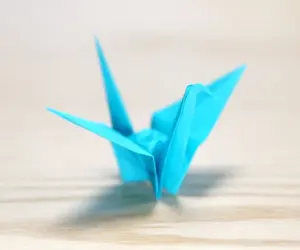

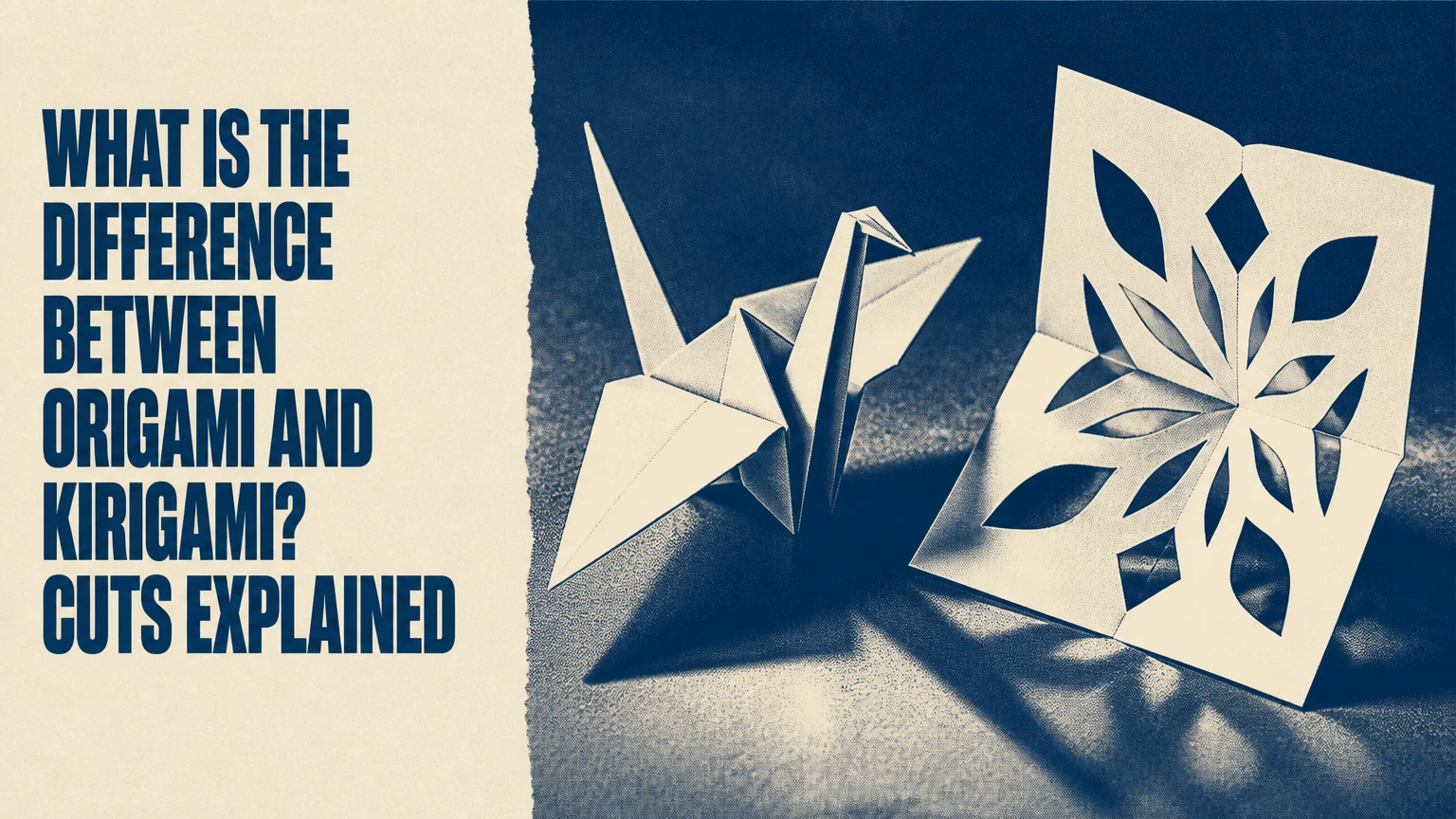
The difference between origami and kirigami is that origami traditionally transforms paper through folding alone, while kirigami combines folding with deliberate cutting. Origami preserves the sheet as one connected piece, whereas kirigami removes paper to create openings, silhouettes, pop-up mechanisms, radial patterns, or flexible structures.
Key Facts at a Glance
- Origami traditionally uses folding without cutting, tearing, or glue.
- Kirigami deliberately cuts paper before, during, or after folding.
- Origami depends on crease geometry, while kirigami also depends on negative space and cut placement.
- Origami commonly begins with a square sheet, while kirigami can use squares, rectangles, cards, or cardstock.
- Origami usually needs paper and a flat work surface; kirigami adds scissors or a craft knife and often a cutting mat.
- A project that combines folding and cutting is kirigami or a related hybrid, even when its visual style resembles origami.
What Do Origami and Kirigami Mean?
Origami means “folding paper,” from the Japanese words oru, meaning “to fold,” and kami, meaning “paper.” Traditional origami creates a model from a sheet through folds, without cutting or adhesive. A paper crane, frog, boat, or complex animal model fits this definition when the sheet remains intact.
Kirigami means “cutting paper,” from kiru, meaning “to cut,” and kami. Kirigami uses cuts as part of the design rather than treating them as an error or shortcut. A snowflake made by folding and cutting paper, a pop-up building, and a cut-and-fold architectural card are common examples.
The boundary is practical rather than purely visual. Modern paper artists sometimes use glue, multiple sheets, scoring, painting, or trimming in work described as origami-inspired. Strict origami organizations generally reserve “origami” for folding-based construction, while broader commercial descriptions may use the word for almost any folded paper object.
Robert J. Lang gives the compact definition, “Origami is the art of paper folding.” That definition explains why cutting changes the classification: cutting adds a second structural operation.
How Does Each Craft Transform Paper?
Origami transforms a continuous sheet by placing creases that act like hinges. Mountain folds push upward, valley folds push downward, and combinations such as reverse folds, squash folds, and sink folds redistribute the sheet into a three-dimensional form.
Kirigami transforms paper through two operations: folding and removal. A cut can create a hinge, release tension, open a window, divide a surface into movable cells, or let a flat pattern expand into a standing form. The removed area becomes negative space, which is part of the design rather than wasted material.
Origami models must manage the paper’s existing area and thickness. Kirigami gains more freedom because a designer can remove material, but every cut also weakens the remaining sheet. That trade-off explains why a kirigami pop-up may look more architectural while requiring thicker paper and more careful scoring.
Why Do Origami Crease Patterns Matter?
Origami crease patterns determine whether a flat sheet can fold into the intended shape. Maekawa’s theorem states that, at a flat-foldable vertex, the number of mountain folds and valley folds differs by two. Kawasaki’s theorem states that alternating sector angles around a flat-foldable vertex add to 180 degrees.
Beginners do not need to calculate either theorem, but the rules explain common outcomes. If a crease pattern is geometrically inconsistent, the model may buckle, twist, or refuse to lie flat. The mathematical study of origami also informs deployable structures, folded airbags, medical devices, and compact aerospace components.
Why Do Kirigami Cuts Change the Structure?
Kirigami cuts change the structure by removing constraints from the sheet. A slot can allow an area to stretch, a hinge can permit rotation, and a repeated cut pattern can create an expandable mesh. A kirigami designer therefore controls both crease lines and cut lines.
Kirigami engineering uses this behavior in flexible materials and deployable structures. Research discussed by the Wyss Institute at Harvard has examined kirigami-inspired designs that expand, bend, and conform through patterned cuts. The same principle appears in paper pop-ups, although engineering versions may use polymers, metal films, or composite materials rather than paper.
What Is the Direct Difference Between Origami and Kirigami?
Origami is fold-only paper construction, while kirigami is cut-and-fold paper construction. Origami preserves the original sheet, so its shape comes from crease arrangement and compression. Kirigami removes selected areas, allowing openings, tabs, hinges, radial symmetry, and pop-up movement that folding alone may not produce.
| Decision factor | Origami | Kirigami |
|---|---|---|
| Primary action | Folding a continuous sheet | Cutting and folding a sheet |
| Traditional material rule | No cuts, tears, or glue | Cuts are intentional; glue varies by project |
| Typical starting shape | 15 x 15 cm square | A4 rectangle, square, or card |
| Main equipment | Paper and flat surface | Scissors or craft knife, mat, scoring tool |
| Structural principle | Crease geometry and paper compression | Creases, cut geometry, hinges, and negative space |
| Typical output | Crane, animal, tessellation, modular form | Pop-up card, snowflake, silhouette, expandable mesh |
| Common paper range | 50-80 gsm for simple folding | 120-220 gsm for durable pop-ups |
| Main failure | Misaligned or weak creases | Torn hinges, over-cut vertices, collapsed tabs |
The terms overlap in everyday conversation because both crafts manipulate flat paper into designed forms. The defining distinction remains whether cutting is part of the construction method.
Which Types of Origami and Kirigami Should You Know?
Origami and kirigami each contain several specialized approaches. The categories differ by construction method, not only by appearance.
| Craft and type | Construction method | Typical result | Beginner project time |
|---|---|---|---|
| Traditional origami | One uncut square, folded by hand | Crane or simple animal | 5-15 minutes |
| Modular origami | Multiple folded units assembled together | Polyhedron or decorative sphere | 30-90 minutes |
| Wet-folding origami | Damp paper folded and dried | Curved animal sculpture | 1-4 hours |
| Origami tessellation | Repeating crease pattern across one sheet | Geometric surface texture | 1-6 hours |
| Symmetrical kirigami | Folded paper cut through several layers | Snowflake or paper doll | 10-30 minutes |
| Architectural kirigami | Cut and scored card opened at 90 or 180 degrees | Building or staircase | 30-120 minutes |
| Silhouette kirigami | Fine cuts remove negative space | Portrait or landscape | 1-8 hours |
| Mechanical kirigami | Repeated slots or cells allow expansion | Mesh, spring, or flexible panel | 1-20 hours |
Is Origami Tessellation the Same as Kirigami?
Origami tessellation is not kirigami when the repeating pattern comes entirely from creases. A tessellation covers a sheet with geometric folds, while a kirigami pattern also removes material through cuts or slots.
Some artists combine both methods. Once a cut becomes structurally necessary, the project is better described as kirigami, cut-and-fold paper art, or a hybrid rather than pure origami.
Is Origamic Architecture Origami or Kirigami?
Origamic architecture is usually closer to kirigami because it relies on cuts, slots, and folds to produce a standing building or pop-up scene. The name refers to the visual relationship with origami, not necessarily compliance with fold-only rules.
A card that folds from flat to a 90-degree or 180-degree display often uses cardstock, a template, a craft knife, and scored hinges. Those requirements distinguish it from traditional origami.
What Paper and Tools Does Each Craft Need?
Origami needs a sheet that folds cleanly without cracking or springing open. Thin kami paper around 50-80 gsm works well for beginner models, while tissue foil, double-sided paper, and 100-120 gsm sheets support more demanding designs.
Kirigami needs paper strong enough to retain narrow hinges and upright tabs. Cardstock between 120 and 220 gsm is typical for pop-up cards, although very intricate cutting may require thinner stock to prevent bulky folds.
| Supply | Origami specification | Kirigami specification | Typical cost |
|---|---|---|---|
| Standard paper | 50-80 gsm, 15 x 15 cm | 120-180 gsm, A4 or card size | $0.05-$0.50 per sheet |
| Specialty paper | Tissue foil, washi, 60-120 gsm | Smooth cardstock, 160-220 gsm | $5-$25 per pack |
| Cutting tool | Not required | Scissors or 30-degree craft blade | $3-$20 |
| Cutting surface | Desk or foam board | Self-healing mat, A4 or larger | $8-$30 |
| Scoring tool | Bone folder, optional | Bone folder or blunt needle | $3-$15 |
| Adhesive | Not used in strict origami | Optional, depending on template | $2-$8 |
The paper weight ranges are typical craft recommendations, not universal standards. A wet-folded model may need heavier paper, while a delicate kirigami silhouette may work better with 80-120 gsm paper because fine cuts become easier.
How Much Time and Money Does Each Craft Take?
A beginner project in either craft usually takes 5-15 minutes and costs less than $5 when basic supplies are available. Intermediate work commonly takes 30-90 minutes, while complex modular origami, tessellations, and detailed kirigami can require several hours or more.
Kirigami has a higher initial equipment cost because a safe cutting setup matters. Origami has lower setup costs, but specialty paper and complex diagrams can raise the price of advanced projects.
| Project level | Origami time | Kirigami time | Typical material cost |
|---|---|---|---|
| Beginner animal or snowflake | 5-15 minutes | 10-30 minutes | $0.05-$3 |
| Intermediate model or pop-up | 30-90 minutes | 30-120 minutes | $1-$10 |
| Detailed tessellation or silhouette | 2-8 hours | 1-8 hours | $3-$25 |
| Expert sculpture or engineered model | 10-40+ hours | 5-40+ hours | $10-$100+ |
Project duration depends more on the number of operations than the craft label. A simple kirigami snowflake may finish faster than a complex origami crane, while an intricate silhouette can take longer than many folded models.
Which Craft Is Easier for Beginners?
Origami is usually easier for beginners who want a low-cost, tool-free activity, while simple symmetrical kirigami is easier for people who prefer templates and immediate visual results. Origami rewards accurate folding; kirigami rewards controlled cutting and careful scoring.
| Beginner goal | Better starting choice | First project | Reason |
|---|---|---|---|
| No sharp tools | Origami | Boat or crane base | Requires paper only |
| Fast decorative result | Kirigami | Folded snowflake | Symmetry multiplies one cut |
| Spatial reasoning | Origami | Frog or bird base | Folds build a 3D form |
| Impressive handmade gift | Kirigami | Pop-up card | Card opens into a scene |
| Fine motor practice for ages 5-8 | Origami | Simple animal | Lower injury risk |
| Engineering curiosity | Either | Tessellation or slot mesh | Shows structural behavior |
Kirigami can feel easier because a template identifies the cuts and folds. That convenience hides a higher error cost: one blade slip can sever a hinge, whereas an inaccurate origami fold can often be unfolded and corrected.
How Do You Make a Basic Origami Model?
A basic origami model follows four stages: choose suitable paper, establish the base, execute the fold sequence, and refine the final shape. A simple model normally takes 5-15 minutes, and alignment accuracy determines the result more than paper price.
- Choose a 15 x 15 cm square. Use 60-80 gsm paper for a first model.
- Make the reference creases. Align edges and corners before pressing the fold.
- Build the base. Use a kite, bird, fish, or frog base according to the instructions.
- Apply shaping folds. Reverse folds and squash folds create the recognizable features.
- Sharpen the finished creases. A bone folder or fingernail improves definition.
You will know the fold sequence is working when edges meet consistently and the model lies flat at intermediate checkpoints. The most common mistake is folding a reference line slightly off-center early in the process, because that error propagates through later layers.
How Do You Make a Basic Kirigami Project?
A basic kirigami project uses a marked template, controlled cuts, scored folds, and gradual activation. A simple card takes 30-60 minutes, with clean hinge cuts and accurate scoring determining whether the structure opens smoothly.
- Select 160-220 gsm cardstock. Use lighter paper for fine silhouettes and heavier stock for upright pop-ups.
- Transfer the template. Mark solid lines for cuts and dashed lines for mountain or valley folds.
- Score before bending. Use a blunt needle or bone folder along every fold line.
- Cut on a protected surface. A sharp blade and several light passes are safer than one forced pass.
- Activate the structure slowly. Push tabs and panels from the back while opening the card.
- Trim only after testing. Remove loose fibers after the mechanism moves correctly.
You will know the project works when the card opens without tearing and the main tabs reach their intended angle. The most damaging mistake is cutting beyond a hinge intersection, because the remaining connection may no longer support the pop-up.
What Are the Main Advantages and Limitations?
Origami offers portability, low equipment cost, and strong training in spatial reasoning, but complex models demand patience and precise crease control. Kirigami produces recognizable architecture and intricate negative space faster, but cutting introduces safety concerns and irreversible mistakes.
Origami is not ideal when the desired form requires a large opening, a separate movable tab, or a rigid architectural wall that folding alone cannot support. Kirigami is not ideal when the project must preserve one continuous sheet, remain reversible, or follow strict traditional origami rules.
What Are the Common Failure Modes?
| Failure mode | Craft | Likely cause | Practical correction |
|---|---|---|---|
| Layers drift out of alignment | Origami | Early fold off by 0.5-1 mm | Reopen and realign before sharpening |
| Creases look soft | Origami | Pressure applied with fingertips only | Use a bone folder or firm fingernail |
| Paper cracks at folds | Both | Stock too heavy or fold too sharply | Score first or switch to 80-160 gsm stock |
| Hinge tears | Kirigami | Cut reached the vertex | Stop cutting 1-2 mm before the joint |
| Pop-up collapses | Kirigami | Tab too narrow or cardstock too soft | Widen the hinge or use 180-220 gsm stock |
| Pattern lacks symmetry | Kirigami | Folded layers shifted during cutting | Clamp or crease the stack before cutting |
A counterintuitive practitioner rule is that sharper tools reduce damage when used lightly. A dull craft blade requires pressure, and pressure makes it more likely to crush cardstock, wander past a vertex, or tear a narrow hinge.
Another rule is to test a design with inexpensive copy paper before using specialty stock. Copy paper exposes proportion and mechanism errors at low cost, even though it may not support the final structure.
Can Origami Include Glue, Scissors, or Multiple Sheets?
Strict origami does not use scissors, cuts, or glue, but modern origami practice includes recognized variations that use multiple sheets, wet paper, foil, or complex assembly. Glue may appear in display work or modular construction, yet adhesive changes the classification of a strict traditional model.
| Technique | Cutting allowed | Glue allowed | Common classification |
|---|---|---|---|
| Traditional single-sheet origami | No | No | Pure origami |
| Modular origami | No | Usually no | Origami |
| Origami collage | Sometimes | Yes | Origami-inspired hybrid |
| Kirigami pop-up | Yes | Sometimes | Kirigami |
| Paper quilling | Yes | Yes | Separate paper craft |
| Paper model kit | Yes | Yes | Paper modeling |
The important question is what operation creates the structure. If folds alone create the form, “origami” is accurate. If cuts create essential hinges, openings, or silhouettes, “kirigami” is more precise.
Which Craft Should You Choose?
Choose origami for fold-only sculpture, meditation, classrooms with limited equipment, or projects that must remain one connected sheet. Choose kirigami for pop-up cards, cut silhouettes, radial decorations, and structures that need openings or expansion.
For Children and Classrooms
Origami is the safer default for children ages 5-8 because it requires no blade and supports repeated practice with inexpensive paper. For older children, symmetrical kirigami with rounded safety scissors can introduce symmetry and negative space, provided an adult controls templates and tool handling.
For Gifts and Cards
Kirigami is the stronger choice for a handmade card because scored tabs can create buildings, flowers, animals, or lettering when the recipient opens the card. Use 160-220 gsm cardstock for standing elements and test the mechanism on copy paper first.
For Mindfulness and Repetition
Origami suits repetitive practice because the hands follow a controlled sequence without switching between folding and cutting. Modular origami adds assembly, with each 5-15 minute unit becoming part of a larger geometric form.
For Engineering and Design
Both crafts have engineering value, but they model different behaviors. Origami studies compact folding and deployment, while kirigami studies expansion, flexibility, and material removal. Research in deployable structures and mechanical metamaterials uses both crease patterns and cut patterns to control movement.
What Is the Bottom-Line Difference Between Origami and Kirigami?
The difference between origami and kirigami is one deliberate structural operation: origami folds paper without cutting, while kirigami cuts and folds paper to create negative space, hinges, and pop-up movement. Choose origami for continuous-sheet sculpture and low-tool practice; choose kirigami for architectural cards, silhouettes, snowflakes, or expandable designs.
Frequently Asked Questions
Is kirigami harder than origami?
Kirigami is not automatically harder, but the mistakes are less recoverable. A beginner kirigami template may be easier than a complex origami diagram, yet a cut that severs a hinge cannot be unfolded and corrected. Origami usually demands greater spatial reasoning at advanced levels, while kirigami demands stronger cutting and scoring control.
Can you make a snowflake with origami?
A traditional folded paper snowflake that uses scissors is kirigami, not strict origami. Folding alone can create a snowflake-like origami design, but the familiar radial snowflake depends on cutting through folded layers to remove repeating sections.
Does kirigami always need glue?
Kirigami does not always need glue. Many snowflakes, silhouettes, and pop-up mechanisms work from one cut-and-fold sheet. Glue becomes useful when a design joins separate panels, reinforces a hinge, or combines multiple layers, but adhesive is not the defining feature of kirigami.
What is the best paper for a first project?
Use 60-80 gsm square paper for a first origami model and 160-180 gsm cardstock for a first kirigami pop-up. Thin paper folds easily, while medium cardstock holds tabs and walls upright. Very heavy paper can crack unless the fold lines are scored first.
Is paper cutting the same as kirigami?
Paper cutting alone is not necessarily kirigami. Kirigami specifically combines deliberate cutting with folding in its classic form, although modern usage sometimes includes flat cut-out work. A detailed silhouette made without folding is more precisely called paper cutting or papercutting.
Which craft creates more realistic buildings?
Kirigami usually creates more immediately recognizable buildings because cuts and scored tabs can form walls, windows, stairs, and rooflines at fixed angles. Origami can represent architecture through folded surfaces, but it must preserve the sheet and therefore uses a different visual language.
