

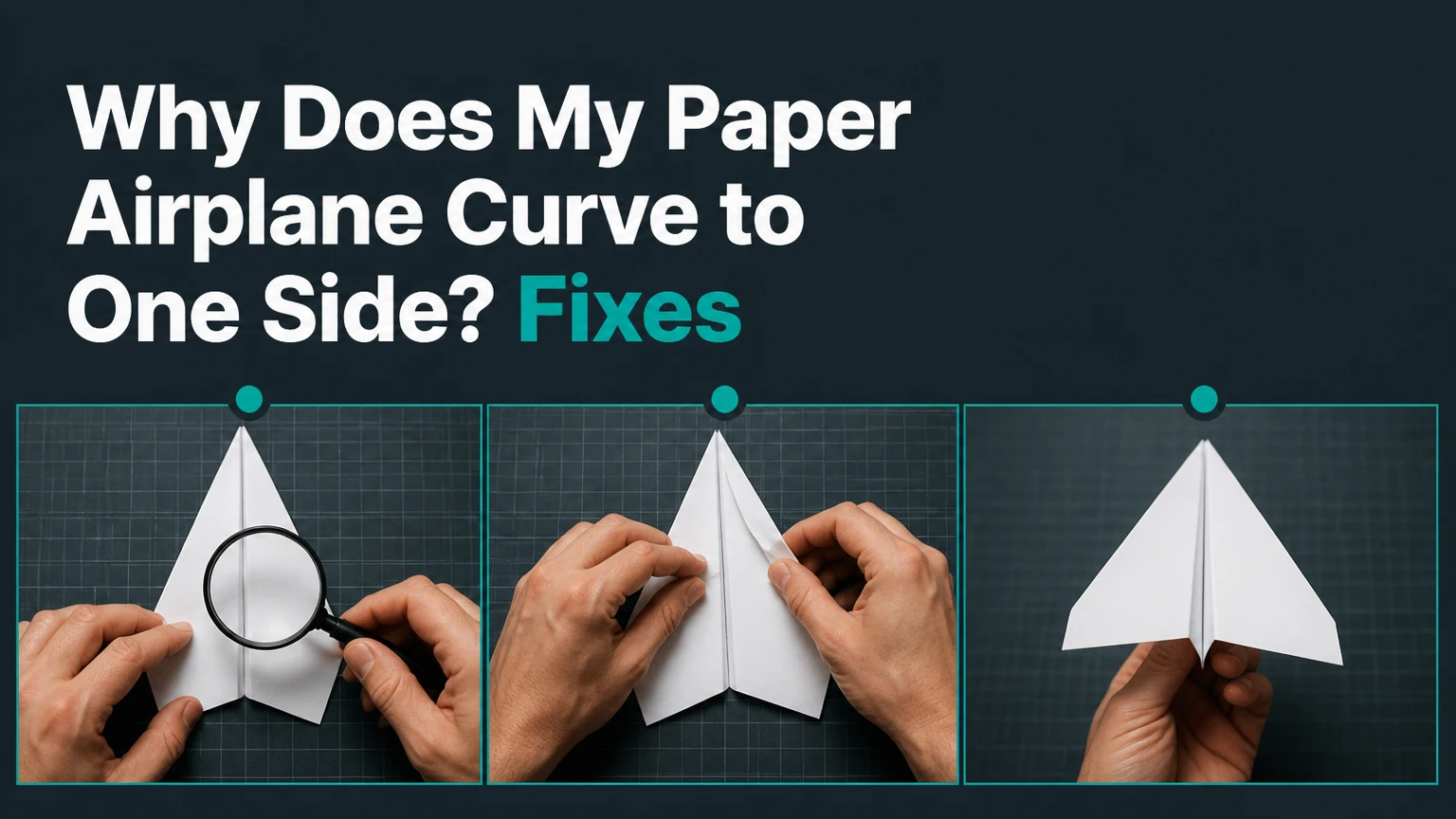
A paper airplane curves to one side because the left and right sides produce unequal aerodynamic forces or begin with unequal motion. A warped wing, uneven crease, bent tail, off-center nose, wrist rotation, or crosswind can create roll and yaw, which combine into a curved flight path. Most consistent turns come from the airplane, not the air.
Key Facts at a Glance
- A paper airplane turns when its left and right sides do not generate matching lift, drag, or side force.
- A wing that drops usually creates roll first; the resulting change in airflow can add yaw and tighten the turn.
- A consistent curve usually indicates a repeatable trim or folding error, while a changing curve often indicates launch variation or air movement.
- The 0.5 millimeter asymmetry figure is a useful precision target for careful folding, not a universal failure threshold.
- A slightly upward wing angle, called dihedral, can improve roll stability; excessive dihedral can also reduce speed and lift efficiency.
- The most reliable repair is to test indoors, inspect from the rear, make one tiny adjustment, and repeat.
Why Does My Paper Airplane Curve to One Side?
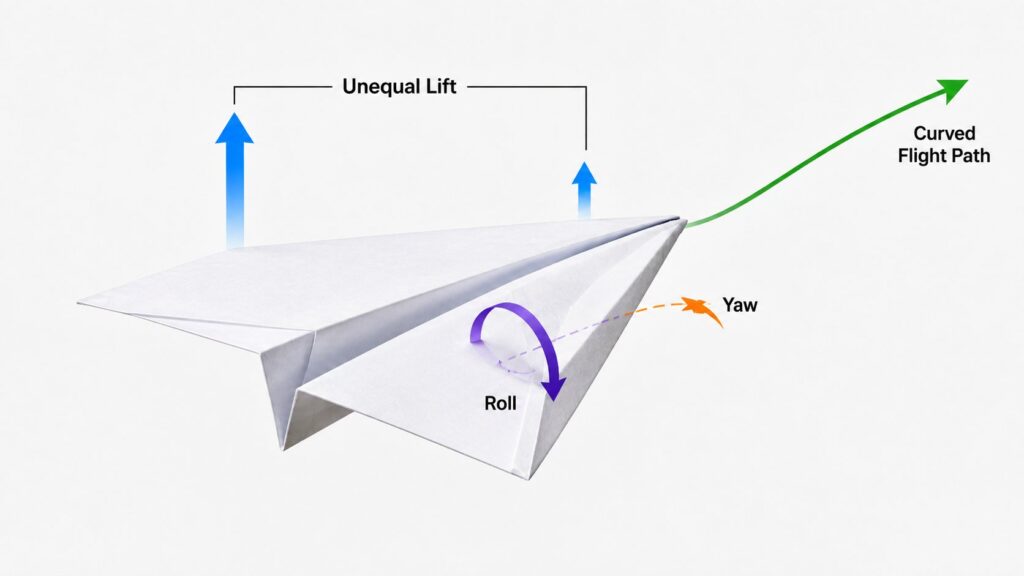
A paper airplane curves because a difference between its two sides creates a turning moment. The difference may involve wing area, wing angle, surface smoothness, fuselage alignment, nose mass, tail trim, or the way the throw leaves the hand.
A perfectly symmetrical model can still curve if the launch adds roll or yaw. A right-handed throw commonly introduces wrist rotation, although the direction depends on grip, release angle, airplane design, and throwing motion. A draft from an open window can produce the same visible result without any folding defect.
The four familiar forces explain the flight condition. Lift acts mainly upward, weight acts downward, drag resists forward motion, and thrust moves an aircraft forward. A gliding paper airplane has no continuing engine thrust after release; its initial forward speed comes from the throw, and gravity helps maintain its descent. NASA Glenn describes lift as “the force that directly opposes the weight of an airplane,” a useful definition for understanding why unequal wing lift changes attitude.
The important practical point is force balance, not a single magic crease. A narrow dart may tolerate a small wing-area difference because its long fuselage and concentrated nose mass resist disturbances. A broad glider exposes more paper to airflow, so a small warp can produce a visible turn.
How Does a Small Fold Become a Curve?
A small fold changes the local angle of attack or the amount of paper meeting the airflow. That change alters lift and drag on one side, creates torque around the airplane’s center of gravity, and rotates the model until its nose no longer points along the original path.
Air does not need to move faster over one wing in a simple, isolated Bernoulli sequence for a paper airplane to turn. The wing’s angle, camber, edge shape, and wake all affect its force. Newton’s third-law description, in which a wing redirects air downward and receives an opposing force, and pressure-based descriptions both apply to the flow.
Roll, Yaw, and Pitch
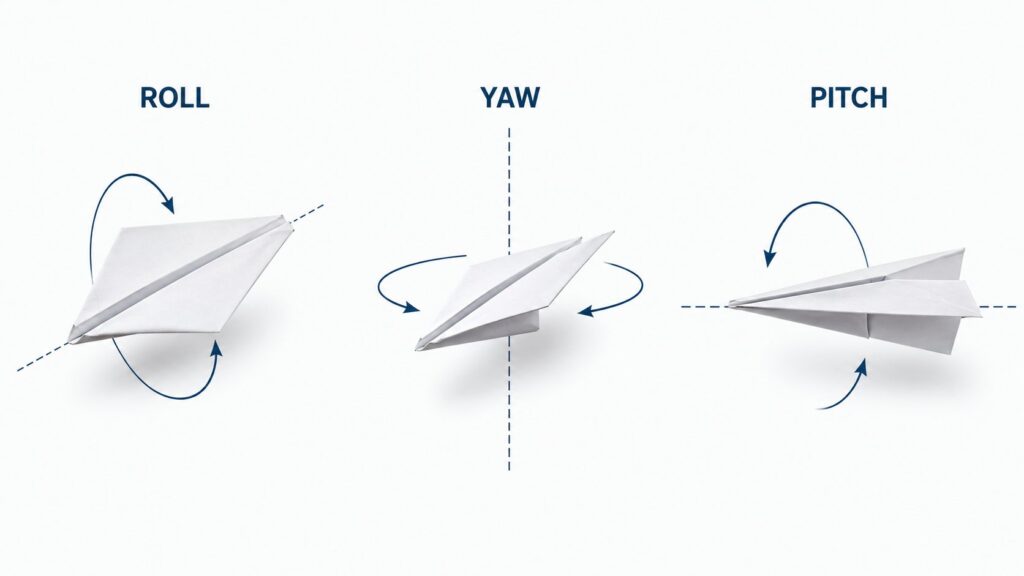
Roll is rotation around the nose-to-tail axis. Roll occurs when one wing generates more upward force, has a different angle, or carries a different effective area, causing one side to rise while the other drops.
Yaw is rotation around the vertical axis. A crooked spine, uneven vertical fin, or different drag near the nose and tail can point the airplane left or right without immediately dropping one wing.
Pitch is rotation around the side-to-side axis. A nose that rises too far can stall, while a nose that points down can create a fast dive. Pitch and roll interact because a dropped wing changes the direction of lift, often turning a mild bank into a descending spiral.
| Visible motion | Primary rotation | Likely physical cause | Typical result |
|---|---|---|---|
| Nose points left while wings stay nearly level | Yaw | Crooked fuselage or uneven fin | Gradual left drift |
| Right wing drops immediately | Roll | Lower right-wing lift or higher left-wing lift | Right bank and turn |
| Nose rises, stalls, then falls | Pitch | Upward elevator trim or weak launch | Stall followed by a side fall |
| One wing drops while nose swings | Roll plus yaw | Wing warp combined with drag difference | Tightening spiral |
| Airplane oscillates left and right | Coupled roll and yaw | Loose folds or excessive tail movement | Wobbling, inconsistent path |
Why Does the Turn Often Tighten?
A banked airplane redirects part of its lift sideways, so less lift remains available to oppose weight. The model descends, loses speed, and becomes less resistant to the original imbalance. A low-speed glider can therefore enter a tightening spiral even when its first turn looked mild.
A paper airplane also loses stability after repeated impacts. Nose compression shifts the center of gravity rearward or changes the fuselage angle, while crushed wing edges create extra drag. The same trim that worked on the first flight may fail after ten hard landings.
Which Parts Should You Inspect First?
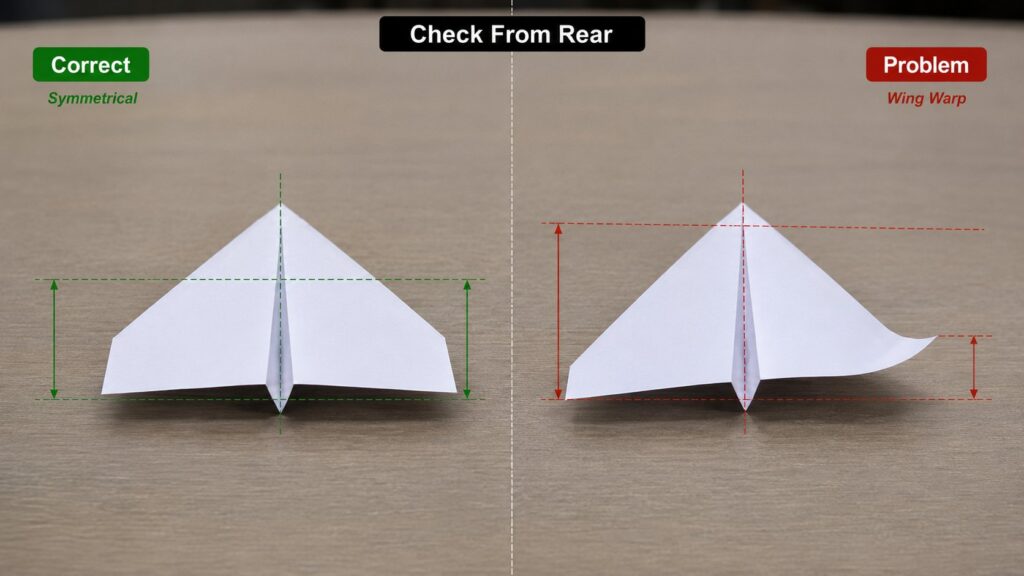
Inspect the fuselage centerline, wing symmetry, trailing edges, vertical surfaces, and nose before changing any trim. The most important comparison is not whether each fold looks attractive from above, but whether both sides match when viewed from the rear and from the nose.
Place the airplane on a flat table. Press the fuselage gently so it rests without rocking. Compare the wing roots, outer tips, leading edges, trailing edges, and folds that form the tail. A small ruler helps reveal whether one wing sits higher or extends farther.
Paper grain can also matter. Machine-made printer paper has preferred bending directions, and a fold made across the grain may spring open more strongly. Grain rarely explains a large immediate turn by itself, but it can make one wing relax after release and create a repeatable bias.
| Inspection point | What to compare | Typical warning sign | First response |
|---|---|---|---|
| Wing span | Left and right tip distance from centerline | Difference of 1-2 mm | Refold or flatten the larger side |
| Leading edge | Nose-to-tip alignment | One edge angles outward | Re-crease against a ruler |
| Trailing edge | Height and straightness | One side curls upward | Flatten before trimming |
| Fuselage spine | Straightness from nose to tail | Visible sideways bow | Reverse-bend gently and flatten |
| Vertical fin | Height and angle | Fin leans 2-3 degrees | Align it with the centerline |
| Nose | Centering and compression | Crushed or offset tip | Rebuild if the nose is visibly damaged |
A practitioner rule of thumb is to inspect from the tail first. Looking from above hides a wing’s vertical warp, while a tail view immediately shows whether one wing forms a different angle.
Does Paper Type or Design Affect the Curve?
Paper type and airplane design affect sensitivity, but neither guarantees a straight flight. A heavier, narrow dart usually resists small disturbances better, while a wide glider produces more lift and exposes more surface to folding errors.
Standard 70-80 GSM office paper is a practical starting point because it folds sharply without becoming too heavy. Thin paper can flutter and deform during a forceful launch. Heavy cardstock may hold a crease but often needs more launch energy and can become nose-heavy.
| Design type | Typical paper | Normal launch speed | Curve sensitivity | Best use |
|---|---|---|---|---|
| Narrow dart | 70-80 GSM printer paper | 6-10 m/s | Low to medium | Straight-distance tests |
| Wide glider | 70-80 GSM or 60-75 GSM paper | 3-6 m/s | Medium to high | Long descent and stability |
| Loop or stunt model | 70-100 GSM paper | 4-8 m/s | High by design | Curves, loops, and rolls |
| Heavy-nose model | 80-100 GSM paper | 5-9 m/s | Low at launch, high after damage | Beginner practice |
The table gives typical hobby ranges, not engineering specifications. Actual speed depends on throw strength, mass, wing loading, and model geometry. An intentionally curved stunt plane should not be judged by the same standard as a distance dart.
A wide glider is also a poor choice for diagnosing a launch problem because its slower flight magnifies room drafts. A narrow dart is a better first test when the goal is to separate folding defects from environmental effects.
How Can You Tell Whether the Launch or Plane Is at Fault?
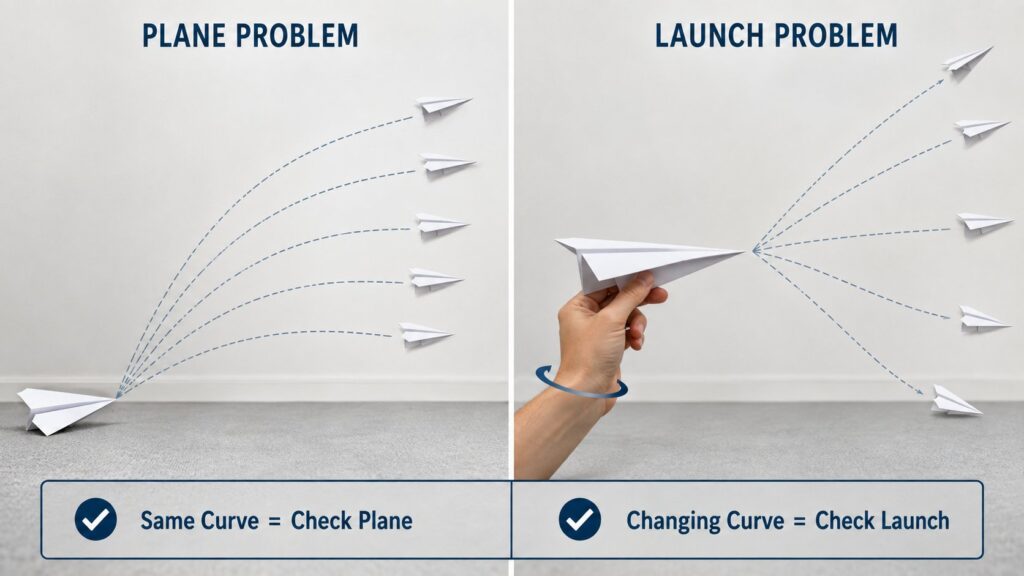
Repeatability separates aircraft trim from launch error. If the airplane turns in the same direction after five gentle throws from the same height, inspect the model; if the direction changes with grip or release, correct the launch before altering the folds.
Use a consistent test: stand in a room with still air, keep the nose level or slightly downward, release without a wrist snap, and record the first two seconds of flight. A phone recording from behind the thrower can reveal whether the airplane leaves the hand already banked.
Test at moderate force. An overpowered throw can bend a glider temporarily, while a weak throw can exaggerate a stall caused by poor pitch trim. The objective is repeatable input, not maximum distance.
| Test condition | Throw setting | What it isolates | Interpretation |
|---|---|---|---|
| Gentle indoor throw | 3-4 m/s, level release | Basic trim | Consistent curve indicates model asymmetry |
| Moderate indoor throw | 5-7 m/s, 0-5° downward | Normal flight | Stable direction confirms repeatability |
| Same model, two grips | Thumb-index grip, then palm grip | Hand influence | Changed direction indicates launch torque |
| Outdoor throw | Calm conditions below 1 m/s wind | Environmental effect | New curve outdoors may be crosswind |
| Five-flight series | 5 throws, same line | Statistical consistency | Four or more matching turns suggest a persistent bias |
Do not adjust the airplane after one flight. One flight is evidence of a result, not evidence of a cause.
How Do You Fix a Paper Airplane That Curves?
Fix a curving paper airplane by correcting the largest visible asymmetry first, then making a tiny trim adjustment to the rear edge of the wing or tail. Use a tail view, change only one side, and retest five times before making another change.
Step 1: Establish the Turn Direction
Write down left or right, gradual or sharp, level or descending. A gradual drift differs from a banked spiral, and each points to a different correction.
Step 2: Flatten Before Trimming
Undo accidental curls with gentle finger pressure. Do not force a sharp crease into a soft wing, because a crease can create a new angle-of-attack difference.
Step 3: Check Symmetry
Match the wing tips, leading edges, trailing edges, vertical fin, and fuselage spine. If a visible difference exceeds roughly 1 mm, rebuild or refold before using aerodynamic trim.
Step 4: Make a Micro-Adjustment
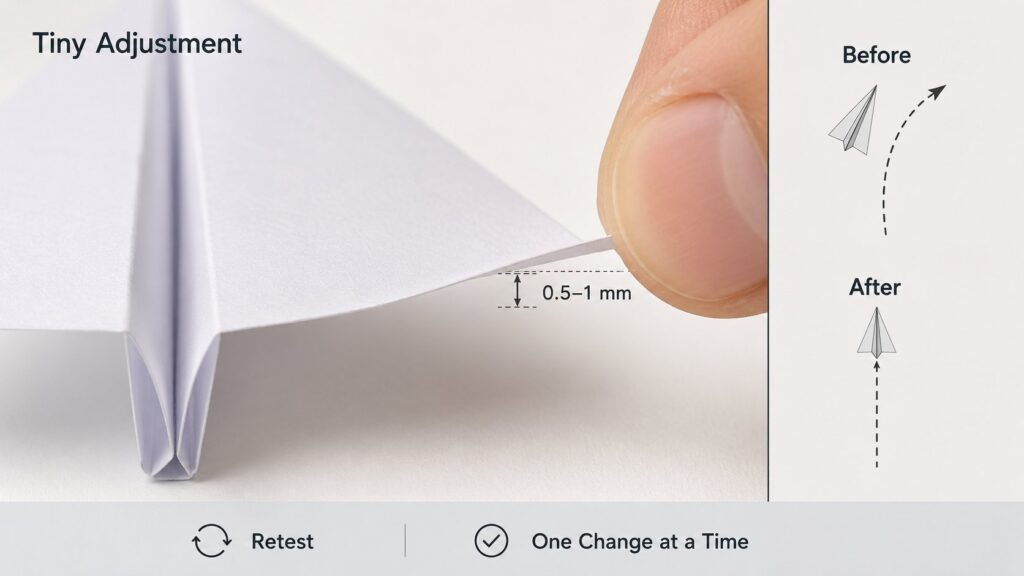
For a persistent roll, adjust the rear edge of the wing that is dropping or the opposite side, but use a change of about 0.5-1 mm at the edge. For pitch, adjust both rear edges equally by a fraction of a millimeter.
Step 5: Retest at Moderate Speed
Throw five times from the same position. Keep the adjustment if at least four flights improve in the same direction; restore the original trim if the path becomes unstable or the correction reverses unpredictably.
The direction of a trailing-edge correction depends on which surface is being adjusted and how the airplane is held. Generic instructions such as “bend the left flap down” can be wrong when the airplane is viewed from the nose instead of the tail. Tail-view diagnosis prevents that common reversal.
| Symptom after release | Most likely cause | Adjustment to try | Stop condition |
|---|---|---|---|
| Gentle left drift with level wings | Left-right yaw asymmetry | Straighten spine or fin first | Stop when nose tracks straight |
| Right wing drops immediately | Unequal roll lift | Match wing angles, then alter dropped-side rear edge by 0.5 mm | Stop if wing rocks |
| Sharp left bank and dive | Roll plus excessive pitch | Flatten warped wing and raise the nose trim slightly | Stop if the nose stalls |
| Nose rises, stalls, then falls right | Excessive elevator plus side bias | Reduce both elevator bends, then inspect right wing | Stop when descent is smooth |
| Alternating turns | Launch inconsistency or loose folds | Reduce throw force and reinforce center crease | Stop changing trim until launches repeat |
| Flip or barrel roll | Excessive anhedral or uneven tail | Set both wings slightly upward and align fin | Stop if one tip remains lower |
The table gives adjustment directions by symptom, but the airplane’s physical attitude takes priority over the label. If the right wing visibly drops, correct that geometry before assuming the turn direction identifies a particular flap.
What Wing Angle Makes a Paper Airplane Stable?
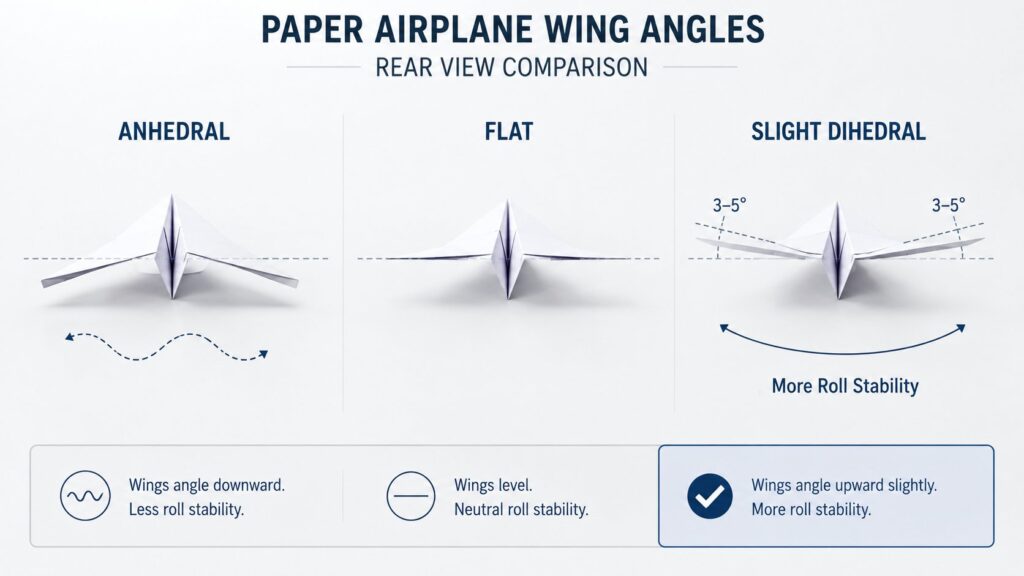
A small positive dihedral, meaning both wings rise slightly from the center, can improve roll stability. A practical starting range is about 3-5 degrees for many simple gliders, although the correct angle depends on wing span, fuselage depth, paper stiffness, and center of gravity.
Dihedral creates a self-righting tendency during a mild bank because the lowered wing presents a different effective angle to the airflow. The effect is not automatic perfection. Too much dihedral reduces the horizontal lift component available for efficient forward flight and can make the airplane wobble.
Anhedral, where the wings slope downward from the center, can make a lightly built model less stable. Some aircraft use anhedral intentionally for maneuverability, so the geometry is not universally bad. For a beginner’s straight-flight test, a slight upward V is usually easier to manage than a downward V.
How Does Pitch Trim Interact With a Side Curve?
Pitch trim controls whether the nose rises or falls, but pitch can amplify a side turn. A nose-high airplane slows and stalls, allowing a low wing to fall; a nose-low airplane gains speed and may tighten a spiral before impact.
Adjust pitch symmetrically first. Bend both trailing edges upward by a very small amount for a dive, or flatten them for a stall. Only after the descent is smooth should you correct a left or right bias.
| Flight path | Pitch diagnosis | Roll diagnosis | Recommended order |
|---|---|---|---|
| Straight dive | Nose too low | No clear bank | Raise both rear edges slightly |
| Stall and fall | Nose too high | Side fall after stall | Flatten both rear edges |
| Level left circle | Acceptable pitch | Persistent left bank or yaw | Inspect left-right geometry |
| Right spiral | Nose low or banked | Right wing dropping | Correct wing geometry, then pitch |
| Fluttering descent | Low stiffness or weak crease | Variable roll | Use firmer paper or reinforce spine |
Why Does My Paper Airplane Curve Only Outdoors?
An outdoor-only curve usually comes from wind, thermal motion, or a nearby obstacle rather than a new fold defect. Even a light crosswind changes the airplane’s ground path, while a steady wind can make a straight heading appear curved relative to the thrower.
Test indoors first, but do not assume every room is still. HVAC outlets, ceiling fans, open doors, and people walking nearby create air movement. A lightweight glider may respond to air currents below 1 m/s, especially during its slow descent.
An airplane’s heading and ground track are different. A model can point straight into a crosswind while moving diagonally across the room or field. Use a fixed reference line on the floor and compare the first second of flight, when wind has had less time to displace the model.
When Should You Rebuild Instead of Trim?
Rebuild the paper airplane when the nose is crushed, the center crease is permanently bowed, one wing differs by several millimeters, or repeated micro-adjustments produce no repeatable improvement. Trimming cannot restore a damaged load-bearing fold.
A new model is often faster than repairing a severely warped one. Fold on a hard, flat surface, align the first center fold carefully, sharpen the main creases, and use the same paper for comparison flights.
| Condition | Repair time | Rebuild recommendation | Reason |
|---|---|---|---|
| Trailing edge curled under 1 mm | 30-60 seconds | No | Flattening usually restores symmetry |
| Fin leaning 2 degrees | 1-2 minutes | Usually no | Realignment is simple |
| Wing span differs by 1-2 mm | 2-4 minutes | Maybe | Refolding may weaken the paper |
| Nose crushed after impact | 3-5 minutes | Yes | Center of gravity and stiffness changed |
| Fuselage bowed over 3 mm | 2-5 minutes | Yes | Longitudinal alignment is unreliable |
| Paper torn or deeply creased | 1-3 minutes | Yes | Surface geometry cannot be recovered |
A paper airplane is not a precision aircraft, so “perfectly straight” is an unrealistic standard. A useful success criterion is a smooth, shallow path with no sudden bank during the first two seconds, not a mathematically zero-radius deviation.
What Are the Most Common Trimming Mistakes?
The most common trimming mistake is changing several surfaces at once. Multiple adjustments remove the evidence needed to identify the original cause and can create a model that flies well only with one particular throw.
A second mistake is trimming from the wrong viewpoint. Left and right descriptions reverse when the airplane is turned around, so name the physical symptom, such as “right wing drops,” and record the viewing direction.
A third mistake is using large bends. A 3 mm flap can produce a dramatic change in pitch or roll on a small model, while a 0.5 mm change may be enough for fine correction.
Expert practice uses a one-variable test. Photograph the original trim, alter one edge, repeat five flights, and return to the photograph if the result worsens. This method is slower than random bending for the first minute, but it prevents long calibration sessions.
Another counterintuitive point is that a heavier nose does not automatically make the airplane stable. More nose mass can resist some pitch changes, but excessive forward weight increases the required lift and can produce a fast, steep descent.
How Do Dart and Glider Designs Compare for Straight Flight?
A dart is usually easier to make fly straight at speed, while a glider is better for observing subtle lift and stability effects. The dart’s narrow wings and forward mass reduce sensitivity to some folding errors, but a damaged wing can still cause a severe spiral.
| Criterion | Dart | Glider | Stunt plane | Practical winner |
|---|---|---|---|---|
| Typical launch speed | 6-10 m/s | 3-6 m/s | 4-8 m/s | Dart for distance |
| Typical wing width | 4-8 cm per side | 8-15 cm per side | 6-12 cm per side | Dart for compactness |
| Sensitivity to wing warp | Low-medium | Medium-high | High | Dart for beginners |
| Typical flight goal | Fast forward path | Long descent | Maneuver | Depends on goal |
| Best paper range | 70-80 GSM | 60-80 GSM | 70-100 GSM | 70-80 GSM overall |
| Main failure | High-speed spiral | Stall or slow turn | Unintended maneuver | Dart for diagnosis |
A glider is the better teaching model for demonstrating unequal lift because its lower speed gives observers more time to see roll and yaw. A dart is the better calibration model when the question is whether a throw can be repeated.
FAQ
Can a perfectly folded paper airplane still curve?
Yes. A consistent throw can still add roll or yaw, and a crosswind can alter the ground path. Paper also has small stiffness differences that are difficult to see. Test the airplane five times indoors with a gentle, repeatable release before concluding that the folds are defective.
Should I add a paperclip to stop the turn?
Usually no. A paperclip changes mass and center of gravity but does not correct unequal wing lift or a crooked fin. Use added weight only as a controlled experiment, placing it exactly on the centerline. If the turn remains, remove the clip and repair the geometry.
Why does my airplane turn left when I throw it right-handed?
A right-handed throw may impart a small roll or yaw through wrist rotation, but handedness alone does not determine the direction. Grip, release angle, nose shape, and model design also matter. Film the release from behind and compare it with a left-handed or two-finger release.
Does folding sharper creases make a paper airplane fly straighter?
Sharper creases generally improve repeatability because they hold the intended geometry, but excessive pressure can crush paper fibers or warp a wing. Use a firm flat surface and sharpen the center fold, wing roots, and nose without bending the broad wing panels.
Can a paper airplane curve because one wing is heavier?
Yes, although the effect usually appears through both mass balance and geometry. A thicker fold or extra paper on one side shifts the center of gravity and may also increase drag. Compare the two sides by weight only after checking wing angles and surface alignment.
How far should a paper airplane fly if it is trimmed correctly?
There is no universal distance because design, throw speed, paper, and room size differ. A simple dart may travel 10-25 meters with a strong launch, while a glider may remain airborne for 5-15 seconds. Straightness during the first two seconds is the more useful diagnostic measure.
The Bottom Line
Why does my paper airplane curve to one side? The usual cause is aerodynamic asymmetry, created by an uneven fold, warped wing, crooked fuselage, offset mass, or inconsistent launch. Inspect the airplane from the rear, test it indoors at moderate speed, correct visible geometry first, and make one 0.5-1 millimeter trim change at a time. A controlled five-flight test will usually reveal whether the problem belongs to the paper airplane or the throw.
