

Paper stars are best used as symbolic gifts, jar decorations, framed art, garlands, gift-packaging accents, and quiet mindfulness projects. Folded lucky stars require no glue, cost little, and can be arranged by color, message, or quantity. For a reliable result, use snug folds, 1 x 24-25 cm paper strips, and a dry display location. Key Facts at a Glance What Are Paper Stars? Paper lucky stars, also called origami wishing stars, are small hollow five-pointed shapes folded from long, narrow strips of paper. Unlike a flat five-point paper cutout, a lucky star gains depth when the folded pentagon is pressed…
Author: Orig Ami
The hardest origami model commonly identified by experienced folders is Ryujin 3.5, or Dragon God 3.5, designed by Satoshi Kamiya. Its extreme scale density, thousands of precreases, complex crease pattern, large paper requirement, and demanding final shaping place it beyond ordinary diagrammed origami. “Hardest” remains criteria-dependent, however, because other models can exceed Ryujin 3.5 in sequence length, thin-layer control, or mathematical difficulty. Key Facts at a Glance What Is the Hardest Origami to Make? Ryujin 3.5 is usually the strongest answer because it combines enormous scale density with a difficult collapse and prolonged shaping process. The model is hard in…
The easiest classic origami to make is the origami corner bookmark. It uses one square sheet, four main folds, no cutting or glue, and typically takes 1-2 minutes for a first attempt. The traditional dog face is nearly as easy, while the boat adds a more demanding inversion step and works best with rectangular paper. Key Facts at a Glance Why Is the Corner Bookmark the Easiest Origami? The corner bookmark is easiest because its shape, sequence, and error tolerance are simpler than those of most traditional beginner models. A single diagonal fold creates the base triangle, two symmetrical folds…
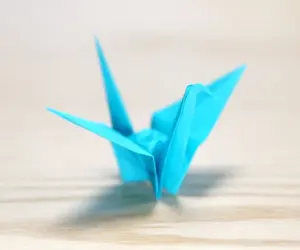
Paper cranes, especially the Japanese orizuru, symbolize peace, longevity, healing, hope, good fortune, and remembrance. Their meaning depends on context: a single crane may express affection or a wish, while 1,000 folded cranes, called a senbazuru, often represent sustained prayer, communal effort, or a public commitment to peace. What Do Paper Cranes Symbolize? The strongest meaning of a paper crane is a hopeful wish given visible form. In Japanese culture, the crane, or tsuru, traditionally represents long life and good fortune; in modern global culture, the folded crane also carries associations with Hiroshima, nuclear disarmament, innocent victims of war, and…
A mountain fold in origami is a crease that makes the paper rise toward the viewer like a ridge or mountain peak. The fold usually sends the folded portion away from the viewer, creating an inverted V when viewed from the front; its opposite is the valley fold, which sinks toward the viewer. Key Facts at a Glance A mountain fold creates a raised ridge on the side facing the folder. Origami diagrams commonly show it with a dashed or dash-dot line and an open arrow pointing away. The same physical crease can look like a mountain from one side…
Origami artists fold, crease, compress, stretch, shape, and sometimes dampen paper to transform a flat sheet into a three-dimensional form. Traditional origami relies primarily on folding without cutting or gluing, while advanced artists use crease patterns, wet-folding, tessellations, or interlocking modules to control structure, texture, and curvature. Key Facts at a Glance What Do Origami Artists Actually Do to Paper? Origami artists manipulate paper through controlled folding, unfolding, flattening, collapsing, pleating, twisting, and sculptural shaping. The artist does not merely bend a sheet once; the artist builds a planned network of creases that changes where the sheet can move and…
The best origami paper for beginners is standard 15 x 15 cm kami at roughly 50-60 GSM. Kami is inexpensive, easy to align, thin enough for multi-layer folds, and usually colored on one side with a white reverse that clarifies diagram instructions. Choose Tant, kraft, or foil only when a specific model or finish justifies their trade-offs. Key Facts at a Glance What Is the Best Origami Paper for Beginners? Standard kami is the strongest all-purpose choice because it minimizes the three problems that stop new folders: inaccurate alignment, excessive layer thickness, and poor crease visibility. A typical 15 cm…
Action origami is paper folding designed to produce a deliberate movement, sound, or shape change when someone taps, pulls, pushes, presses, blows into, or releases the model. Unlike display-focused origami, action origami combines crease geometry with paper elasticity to create interactive mechanisms such as jumping frogs, flapping birds, poppers, balloons, and transforming stars. Key Facts at a Glance What Does Action Origami Mean? Action origami means origami with an intentional kinetic function. The finished fold must perform a repeatable action, such as jumping, flapping, snapping, opening, closing, expanding, collapsing, gliding, or changing configuration after a defined input. The term covers…
Modular origami is the practice of folding multiple separate sheets into repeated paper units and assembling those units into a larger three-dimensional form. The modules usually interlock through tabs, pockets, or folded edges without glue, tape, or scissors, producing models such as polyhedra, wreaths, stars, floral spheres, and large sculptures. Key Facts at a Glance What Is Modular Origami? Modular origami is a branch of origami in which separate folded components, called modules or units, combine to form a single model. A designer may fold every unit from the same diagram, use several unit colors, or combine different modules according…
The difference between origami and kirigami is that origami traditionally transforms paper through folding alone, while kirigami combines folding with deliberate cutting. Origami preserves the sheet as one connected piece, whereas kirigami removes paper to create openings, silhouettes, pop-up mechanisms, radial patterns, or flexible structures. Key Facts at a Glance What Do Origami and Kirigami Mean? Origami means “folding paper,” from the Japanese words oru, meaning “to fold,” and kami, meaning “paper.” Traditional origami creates a model from a sheet through folds, without cutting or adhesive. A paper crane, frog, boat, or complex animal model fits this definition when the…