
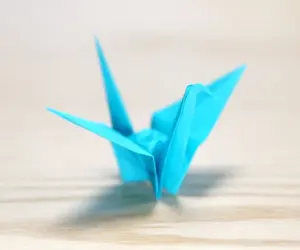

Origami paper keeps tearing when the fold places more tension on its fibers than the sheet can withstand. The usual causes are excessive crease pressure, folding across the grain, weak or brittle paper, moisture-related fiber swelling, and too many layers crowded into one fold. The correct fix depends on where and when the tear begins. Key Facts at a Glance Why Does My Origami Paper Keep Tearing? Origami paper usually tears because mechanical stress is concentrated at a crease, corner, or compressed multi-layer area. The outside radius of a sharp fold is pulled into tension, while the inside radius is…
Author: Orig Ami
Origami folds usually fail to stay in place because the crease has not overcome the paper’s elastic recovery, the layers are too thick, or the paper is unsuitable for the model. Accurate alignment, firm progressive pressure, reverse-creasing, and a better paper choice usually solve spring-back without glue. Key Facts at a Glance Why Do Origami Folds Spring Open? Origami folds spring open because paper stores elastic energy when its fibers and coatings bend, then releases part of that energy after the folder removes pressure. A crease becomes more stable when the fold produces permanent deformation in the sheet, but excessive…
An origami crane becomes lopsided when small alignment errors accumulate through the preliminary base, Bird Base, petal fold, or neck and tail folds. The most common source is an off-center crease or uneven layer collapse, not the final wing pull. Finding the first asymmetric fold usually fixes the whole model faster than reshaping the finished crane. Key Facts at a Glance A 0.5 mm center-point error can become visibly larger after several mirrored folds. The petal fold is the most common stage where a hidden asymmetry becomes obvious. A finished crane can usually be adjusted, but a sharply twisted body…
An origami balloon usually will not inflate because the blow hole is sealed, the internal flaps are tucked incorrectly, or stiff paper is resisting the creases. The water bomb must have an open air channel and flexible hinges before you blow; correcting those two conditions fixes most failed models without refolding the entire sheet. Key Facts at a Glance Why Won’t My Origami Balloon Inflate? The fastest diagnosis is to inspect the bottom aperture, the four side pockets, and the central creases in that order. If the opening is present but the model remains flat, the side layers are probably…
An origami rose keeps falling apart when its paper cannot hold creases, its locking folds are inaccurate, or the model is twisted from the wrong orientation. The most common failure occurs when weak grid creases prevent the central spiral and tucked flaps from generating enough friction to hold the petals together. Key Facts at a Glance Why Does My Origami Rose Keep Falling Apart? The immediate cause is usually a failed structural lock, not the curled petals. Origami roses hold together through compressed layers, tucked flaps, pockets, and a twisted center, so one inaccurate crease can prevent several parts from…
An origami flapping bird usually fails because its internal hinge is misaligned, its tail lock is folded incorrectly, its paper is too stiff, or the paper joint has torn. The quickest diagnosis is to pull the tail gently while holding the breast: a rigid bird has a jammed mechanism, while a soft bird that bends without lifting its wings has a weakened or misplaced crease. Key Facts at a Glance Why Won’t My Origami Flapping Bird Flap? The most likely cause is a mechanical fault at the wing hinge, tail anchor, or internal body pocket. Origami flapping birds depend on…
Your paper crane’s neck keeps unfolding because the inside reverse-fold hinge has not developed enough crease memory, the paper is springing back, or several misaligned layers are wedging the pivot open. Paper thickness, fold accuracy, pressure, humidity, and the final head fold determine whether the neck stays upright. Key Facts at a Glance What Physically Makes a Crane Neck Unfold? An origami crane neck unfolds when the restoring force in the paper exceeds the resistance created by the reverse-fold crease and compressed layers. The outside of a fold stretches while the inside compresses, so cellulose fibers and coatings retain some…
Your origami box is usually not square because the paper, center point, or repeated folds are not symmetrical. A 1 mm paper-size error can become visible in a small Masu box, while an off-center blintz fold or uneven wall crease can make the base rectangular, the corners twisted, or the walls lean. Key Facts at a Glance Why Is My Origami Box Not Square? An origami box is not square when an early geometric reference is inaccurate, when the paper itself is rectangular, or when thick layers prevent the final folds from sitting in their intended positions. The most common…
Modular origami pieces usually fall apart because flaps do not enter pockets deeply enough, folds are inaccurate, paper is too slick or flexible, or the growing structure is misaligned. Unlike single-sheet origami, a modular origami model depends on friction, compression, precise geometry, and balanced tension between separately folded units. Key Facts at a Glance Why Do Modular Origami Pieces Separate? Modular origami pieces separate when the joint produces less holding force than the model’s weight, handling force, or internal distortion. The holding force comes from friction, folded-paper spring tension, compression between neighboring units, and geometric interlocking. If any one of…
Origami lucky stars usually stay flat because the paper strip is too short, too wide, too stiff, or wrapped under excessive tension, or because the five edges are pinched in the wrong place. The most reliable fix is a balanced pentagon, loose but orderly wrapping, a fully tucked end, and five precise inward pushes at the edge midpoints. Key Facts at a Glance Why Won’t My Origami Lucky Stars Puff Up? Origami lucky stars fail to puff when their pentagonal structure cannot deform evenly. A tight wrap locks the layers, a short strip leaves too little layered wall, and an…