
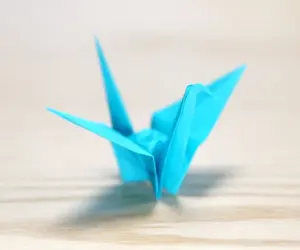

The math behind origami is the geometry of transforming a flat sheet into a three-dimensional shape while preserving distances within each uncreased face. Fold geometry combines Euclidean construction, spherical geometry, graph theory, kinematics, topology, and differential geometry to explain crease patterns, flat-foldability, rigid motion, and structural behavior. Key Facts at a Glance What Is the Math Behind Origami? The math behind origami begins with an ideal sheet represented as a two-dimensional region, usually a polygon, whose crease lines divide it into rigid faces. Each face moves through three-dimensional space by rotation about shared crease axes, while the distances between points…
Author: Orig Ami
Origami is used in science and engineering to transform flat materials into compact, deployable, movable, or load-bearing three-dimensional structures. Researchers apply crease geometry, rigid-panel kinematics, compliant hinges, and self-assembly at scales ranging from DNA molecules to spacecraft, enabling functions that conventional solid parts often achieve with greater mass, volume, or assembly complexity. Key Facts at a Glance What Does Engineering Origami Mean? Engineering origami is the design of three-dimensional structures through programmed folding, creasing, buckling, or self-assembly. The engineered object may begin as paper, polymer film, composite laminate, metal foil, biological material, or a molecular strand, but its useful behavior…
The benefits of origami for your brain come mainly from combining visual-spatial reasoning, sequential planning, fine-motor control, tactile feedback, and sustained attention in one activity. Origami may support spatial skills, hand-eye coordination, working memory, and short-term stress relief, but claims that it physically reshapes the brain or reliably creates new synapses remain unproven for ordinary recreational folding. Key facts at a glance Origami converts a two-dimensional sheet into a three-dimensional form through ordered physical actions. Folding requires visual interpretation, bilateral hand coordination, precision, error detection, and tactile feedback. Classroom research most consistently supports possible gains in spatial visualization and geometric…
Origami as therapy and mindfulness is a structured paper-folding practice that uses touch, visual attention, breathing, and sequential movement to support present-moment awareness. It may reduce momentary stress and improve engagement, but origami is not a proven replacement for psychotherapy, psychiatric treatment, or medical rehabilitation. Key Facts at a Glance What Is Origami as Therapy and Mindfulness? Origami as therapy and mindfulness is the intentional use of paper folding to practice attention, sensory awareness, emotional tolerance, and controlled movement. The person notices paper texture, crease placement, breathing, and frustration while folding, instead of judging the finished object as a success…
Kids can start exploring origami at about age 2 with crumpling, flattening, and assisted half-folds, while independent simple origami usually becomes realistic around ages 4-5. Children ages 6-8 can follow short diagrammed models, and many children age 9 and older can attempt complex or modular designs with practice. Key Facts at a Glance What Is Origami? Origami is the art of transforming paper through folding, traditionally using one sheet without cutting, glue, or tape. The English word comes from the Japanese terms oru, meaning “to fold,” and kami, meaning “paper.” Traditional origami can produce animals, containers, toys, flowers, geometric forms,…
Arthritis-friendly origami for seniors adapts paper size, folding pressure, workspace setup, tools, and project complexity for painful or stiff hands. The safest approach uses a stable surface, large forgiving paper, palm or forearm pressure instead of fingertip pinching, short sessions, and immediate rest when pain increases. Key Facts at a Glance Use 20 x 20 cm to 30 x 30 cm paper when 15 x 15 cm sheets force painful pinching. Choose flexible paper around 70-100 gsm before trying stiff cardstock. A 15-20 minute session is a practical starting point for fatigued hands. A silicone craft mat, wide-handled creaser, and…
The central origami rule is that pure origami uses folding alone, without cutting, tearing, gluing, or adding material. A model may begin with one uncut square, although modular origami uses several separate uncut sheets, and historical or contemporary designers may follow looser definitions. The rule preserves the paper while changing its geometry. Key facts at a glance Pure origami normally transforms paper through folding only, with no cuts, glue, staples, or added pieces. The one-sheet convention is common in modern origami, but it is not a universal rule for every historical or modular model. Origami folding preserves the sheet’s surface…
Origami is hard for beginners because a flat sheet must be converted into a precise three-dimensional structure while the folder interprets unfamiliar diagrams, controls small alignment errors, and manages increasingly thick paper layers. Improvement comes from learning fold vocabulary, using forgiving paper, practicing one technique at a time, and checking alignment before errors compound. Key Facts at a Glance Why Is Origami Hard for Beginners? Origami is difficult for beginners because several unfamiliar demands occur at the same time: spatial reasoning, fine motor control, diagram interpretation, sequencing, and geometric accuracy. A beginner may understand each individual instruction yet still lose…
Learning origami takes about 1-2 weeks for basic models, 1-3 months for intermediate designs, and 6-24 months for advanced folding when practiced for roughly 20-30 minutes a day. Origami progress depends more on practice quality, crease accuracy, paper choice, and model difficulty than on calendar time alone. Key Facts at a Glance How Long Does It Take to Learn Origami? Basic origami generally takes 5-15 hours of deliberate practice, while advanced origami takes 100-500 or more hours. A person folding for 30 minutes daily may reach basic competence in 1-2 weeks, intermediate competence in 1-3 months, and advanced competence in…
PVA glue is a chemical category, while Elmer’s is a brand that sells several PVA-based and modified adhesive formulas. For origami, thin professional or bookbinding PVA usually gives cleaner, stronger seams, while Elmer’s School Glue offers easier washing and lower risk for children. Elmer’s Glue-All sits between those choices. PVA Glue vs Elmer’s: The Short Answer PVA glue and Elmer’s are not equivalent categories. Polyvinyl acetate, or PVA, is the primary polymer used in many white glues; Elmer’s is a manufacturer whose products may contain PVA alongside water, stabilizers, preservatives, plasticizers, and other formulation components. For folded paper, the best…