
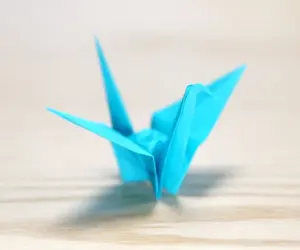

To clean dust off origami models, use a dry manual bulb blower first, then an ultra-soft brush only on stable surfaces that still need attention. Support the model at its base, keep air oblique to the folds, avoid moisture and breath, and work in short sessions. The model’s paper strength and fold complexity determine the safest method. Key Facts / At a Glance A manual bulb blower is the lowest-contact first choice for most origami models. Keep an air nozzle about 15-30 centimeters from thin paper and use short bursts. Never use water, damp wipes, window cleaner, or saliva-moistened tools…
Author: Orig Ami
To mail or ship origami without crushing it, wrap the model loosely in acid-free tissue or glassine, secure it to a rigid base without pressing its folds, place that base inside a roomy inner container, and suspend the container inside a stronger outer box. The package must prevent movement while keeping every paper point free from compression. Key Facts at a Glance How to Mail or Ship Origami Without Crushing It Origami shipping protects a folded paper sculpture by controlling movement, surface pressure, impact, and moisture in that order. A loose tissue wrap alone protects the paper surface but cannot…
To frame origami art, mount the model to an archival backing inside a shadow box or another deep frame, then keep the glass at least 3-5 mm away from the highest fold. The safest method uses reversible thread, paper hinges, or small neutral adhesive points, with UV-filtering glazing and a rigid, acid-free support. Key Facts at a Glance Origami should never touch the glazing because pressure can permanently flatten or crease folded paper. Measure the model’s maximum depth, then add at least 5 mm of clearance before selecting a frame. A 20-30 mm deep shadow box suits many single models,…
To waterproof origami, first choose a water-resistant substrate or seal a completely dry folded model with several thin coats of acrylic, outdoor medium, wax, or epoxy. For most decorative models, a clear acrylic spray offers the best balance of detail, weight, and cost. No paper coating makes a delicate model permanently indestructible, so match the treatment to its expected moisture and handling. Key Facts at a Glance What Does Waterproofing Origami Actually Mean? Waterproofing origami means reducing water entry into the paper and protecting the folded structure from fiber swelling, staining, and loss of stiffness. For ordinary craft projects, the…
To repair a torn origami model, align the paper fibers, apply a microscopic amount of archival adhesive, press the tear flat, and reinforce the inside when the joint carries stress. The best method depends on paper thickness, tear shape, crease direction, surface finish, and whether the model has historical or monetary value. Key Facts at a Glance A clean tear in medium-weight paper usually needs less than 0.1 mL of acid-free PVA glue. Thin Japanese tissue and methyl cellulose create a lighter, less visible interior reinforcement than ordinary tape. A repaired model usually needs 20-30 minutes before gentle handling and…
Origami is the art of creating forms by folding paper, while kirigami combines folding with deliberate cutting. Traditional origami generally excludes cuts and glue, whereas kirigami uses cuts to create negative space, silhouettes, hinges, pop-ups, and architectural structures. The right choice depends on whether you want fold-only sculpture or cut-assisted paper engineering. Key Facts at a Glance Origami vs Kirigami: What Is the Difference? The defining difference between origami and kirigami is whether the paper is cut. Origami forms a model through folds alone, while kirigami changes the sheet’s outline or internal structure through cuts before, during, or after folding.…
An origami tessellation is a geometric paper-folding design that repeats a motif across one sheet, usually without cutting or gluing. Instead of forming an animal or object, the folder builds a continuous field of pleats, twists, and polygonal cells that can remain flat, become corrugated, or open into translucent windows. Key Facts at a Glance What Is Origami Tessellation? Origami tessellation is the practice of folding a repeating, connected pattern into a single sheet of paper. The visible units may resemble triangles, squares, hexagons, stars, flowers, scales, or woven fabric, but the design remains a continuous folded surface rather than…
3D (Golden Venture) origami, also called Golden Venture Folding or Chinese modular origami, builds sculptures from hundreds or thousands of folded triangular paper units. Each unit has two pointed legs and two pockets, allowing neighboring units to interlock through friction and compression without glue in the standard construction method. Key Facts at a Glance What Is 3D (Golden Venture) Origami? 3D (Golden Venture) origami is a three-dimensional modular construction method in which identical folded paper triangles combine into vessels, animals, flowers, characters, geometric forms, and decorative figures. The technique differs from conventional origami because the finished sculpture depends on many…
Senbazuru, the Japanese tradition of folding and connecting 1,000 origami cranes, represents sustained hope, longevity, healing, good fortune, and peace. Its modern global meaning was shaped strongly by Sadako Sasaki and Hiroshima, while the older symbolism comes from the Japanese crane’s association with long life and auspiciousness. Key Facts at a Glance What Is the Legend of 1000 Paper Cranes? The legend of 1000 paper cranes, known in Japan as senbazuru, says that folding 1,000 origami cranes can carry a heartfelt wish for healing, long life, peace, or good fortune. The crane’s traditional association with longevity supplies the symbolism, while…
The most famous origami artists include Akira Yoshizawa, Robert J. Lang, Satoshi Kamiya, Tomoko Fuse, Eric Joisel, Sipho Mabona, Hoang Tien Quyet, and the Demaines. Together, these artists represent modern notation, wet-folding, super-complex design, modular construction, mathematical origami, monumental installation, and sculptural paper art. Key Facts at a Glance Who Is the Most Influential Origami Artist? Akira Yoshizawa is the most influential modern origami artist because he changed origami’s design language, teaching methods, and public reputation. His expressive animal models, wet-folding technique, and collaboration on the Yoshizawa-Randlett diagramming system gave folders a shared way to design and communicate models across…