
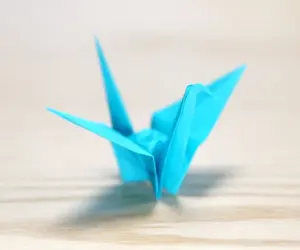

Yes, you can iron origami paper to flatten wrinkles, curls, and mild handling damage, but use low, dry heat through a clean barrier and test a spare corner first. Ironing will not restore paper fibers that have been sharply broken, and heat can cause ink transfer, scorching, adhesive failure, coating damage, or permanent warping. Key facts at a glance A dry iron on its lowest setting is safer than active steam for most origami paper. Place parchment paper or a clean, thin cotton cloth between the iron and the sheet. Start around 150-180°F (65-82°C) when the iron provides a reliable…
Author: Orig Ami
A valley fold bends paper toward the folder so the crease forms the bottom of a V, while a mountain fold bends paper away so the crease forms a raised ridge. Valley fold vs mountain fold explained simply: the two folds describe opposite directions from the visible side, although the same crease becomes the opposite fold when the paper is turned over. Key Facts at a Glance What Is a Valley Fold? A valley fold brings one part of the sheet toward the other so the crease sits at the lowest point of the bend on the visible side. If…
An inside reverse fold is an origami technique that turns a paper point or flap inward between existing layers, changing an outside point into an internal structure. To perform one, pre-crease the direction, open the surrounding layers, push the point inward, invert the side creases, and flatten the model while preserving alignment. Key Facts at a Glance What Is an Inside Reverse Fold? An inside reverse fold is a directional change in which an external paper flap is tucked into the model’s interior. The point does not vanish through a hole; instead, surrounding layers open temporarily so the flap can…
An outside reverse fold changes an origami flap’s direction by wrapping the paper layers around the model’s exterior. To make one, pre-crease the target angle in both directions, open the flap, invert the closed edge through the crease, then collapse and align the new outside layers. The movement usually takes under one minute for a beginner. Key Facts at a Glance What Is an Outside Reverse Fold? An outside reverse fold is an origami technique that reverses a flap around the model’s exterior rather than hiding the flap entirely inside the structure. The existing flap bends around its closed edge,…
The Origami Preliminary Base, also called the Square Base, is a four-flap folded configuration made from one square sheet. Two diagonal creases and two perpendicular creases let the sheet collapse into a smaller square, making the base a common starting point for the Bird Base, Frog Base, cranes, flowers, animals, and modular forms. Key Facts at a Glance What Is the Origami Preliminary Base? The Origami Preliminary Base is a symmetrical folded square that concentrates the four corners of a flat sheet into one closed point while leaving four layered flaps available for later folds. “Square Base” describes the visible…
The origami waterbomb base, also called the balloon base, is a four-flapped triangular foundation made from a square sheet through two diagonal and two perpendicular crease lines. Its opposing mountain and valley creases allow the paper to collapse flat, creating a reusable structure for the waterbomb, traditional frog, insects, flowers, and geometric models. Key Facts at a Glance What Is the Origami Waterbomb Base? The origami waterbomb base is a foundational fold in which a square becomes a compact triangular arrangement of layered flaps. Traditional origami diagrams often call it the balloon base because opening the finished model produces a…
An origami frog base is a folded foundation made from a square sheet that concentrates paper into four long flaps and four shorter corner structures. It develops from the preliminary square base through four squash folds and four petal folds, giving folders enough separated paper areas to design frogs, lilies, irises, insects, and other multi-limbed models. Key Facts The frog base begins with one square sheet and a preliminary square base. Four squash folds open the square base into four kite-shaped surfaces. Four petal folds create the characteristic long, narrow flaps. The base is commonly associated with frog and lily…
The origami fish base is a traditional folded-paper foundation that creates four functional points, usually two longer points and two shorter points arranged around a central body. Folders use the fish base for fish, whales, seals, birds, and other designs requiring a strong head-to-tail axis rather than four equal limbs. What Is the Origami Fish Base? The origami fish base is a preform made from one square sheet, not a completed fish. Its flattened silhouette usually resembles a narrow diamond or fish skeleton, with two long outer flaps and two shorter inner flaps that can become fins, jaws, tails, or…
The origami blintz base is a preliminary fold made by bringing all four corners of a square sheet to its exact center, producing a smaller square with four folded corner flaps. The result concentrates layers around the center and creates flap structures that designers can open, reverse, squash-fold, or graft into boxes, flowers, figures, and modular models. Key Facts at a Glance A standard blintz base folds all four corners of a square to one center point. The finished footprint has half the original side length and one-quarter of the original area. The base does not require diagonal precreases, although…
In origami diagrams, a dashed line usually marks a valley fold, while a dash-dot line commonly marks a mountain fold. A dotted line is less universal: it may show a hidden edge, an underlying crease, or a crease to make and unfold. The diagram’s legend, arrows, and changing paper layers determine the correct action. Key Facts at a Glance What Do Dashed vs Dotted Lines Mean in Origami Diagrams? The short answer is that dashed and dotted lines usually carry different jobs. In the widely used Yoshizawa-Randlett diagramming tradition, a regular dashed line represents a valley fold, a dash-dot line…